
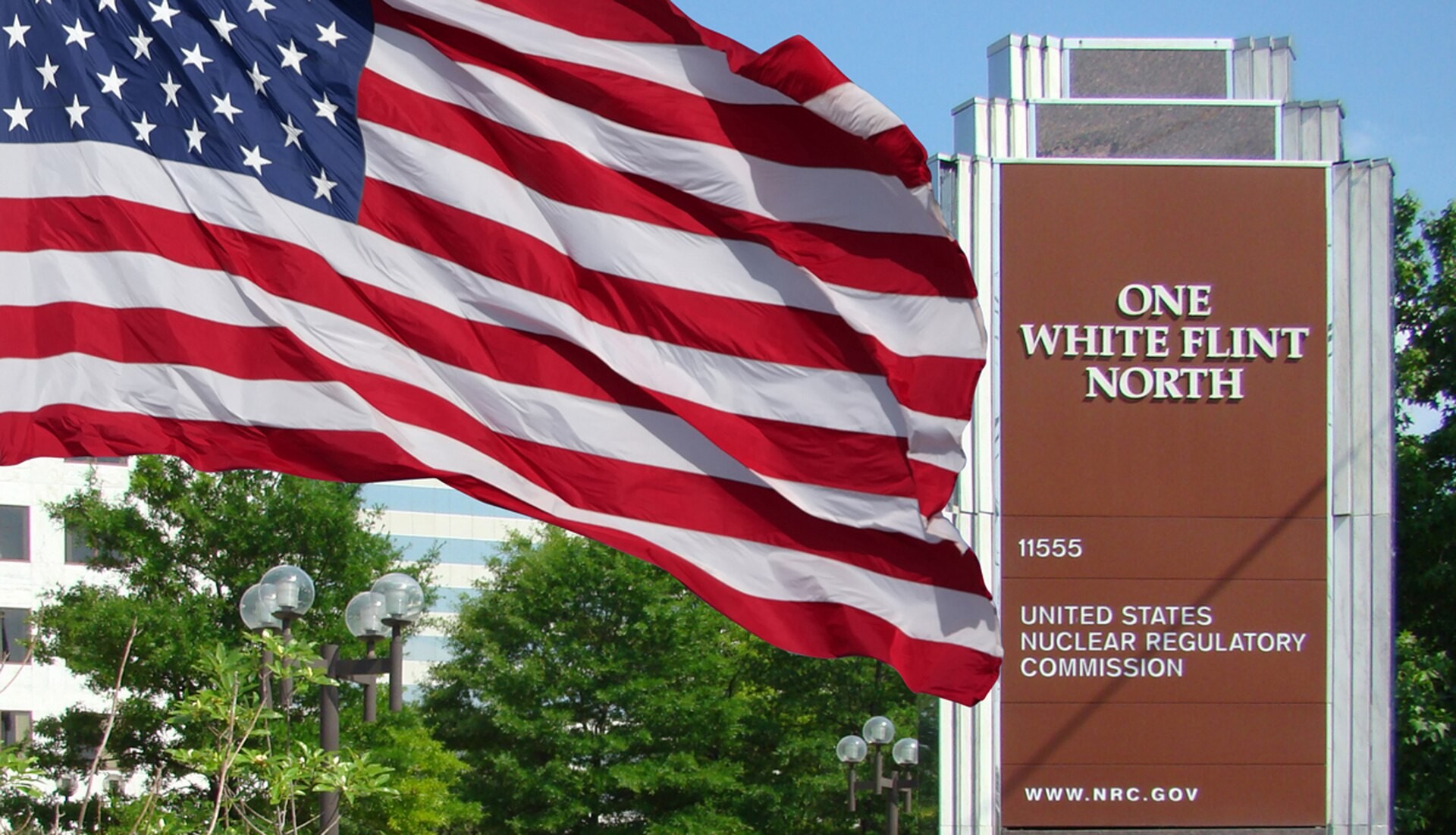
The Nuclear Regulatory Commission is an independent agency of the United States government, established on January 19, 1975, with a statutory mandate to license and regulate the civilian use of nuclear materials in order to protect public health and safety, promote national security, and safeguard the environment. Its regulatory reach covers 94 commercial power reactors and 29 research and test reactors as of 2025, along with radioactive materials used in medicine and industry, and the transport, storage, and disposal of nuclear waste. Headquartered in North Bethesda, the NRC conducts roughly 1,000 inspections of nuclear material licensees each year. The Commission sits at the center of U.S. nuclear policy, and its licensing decisions shape whether new reactor designs get built, whether existing plants keep running, and how the country manages the most hazardous byproducts of the nuclear age.
Key facts
- Country: United States
- Founded: 19 January 1975
- Headquarters: North Bethesda
- Type: independent agency of the United States government
- Website: https://www.nrc.gov/
Origins and Predecessor
The NRC did not emerge from nothing. Its predecessor, the Atomic Energy Commission, was created by the Atomic Energy Act of 1946 and was charged simultaneously with promoting and regulating nuclear energy — a dual and conflicting set of responsibilities. Congress recognized that a single body could not credibly advocate for an industry and police it at the same time, and abolished the Atomic Energy Commission in 1974. The NRC formally began operations on January 19, 1975, taking over the regulatory side of the old commission’s portfolio.
The institutional history of the NRC, including the tensions that shaped its founding, is documented in five volumes of nuclear regulatory history published by the University of California Press through the Commission’s own History Program.
Structure and Leadership
Five commissioners lead the NRC, each appointed by the President of the United States and confirmed by the Senate for a five-year term. No more than three commissioners may come from the same political party, a structural constraint written into statute to preserve the agency’s independence from any single administration’s preferences.
On January 8, 2026, President Trump designated Ho K. Nieh as the 20th Chairman of the Nuclear Regulatory Commission. Nieh had been confirmed by the Senate by a 66-32 vote on November 19, 2025.
Beyond its North Bethesda headquarters, the NRC maintains four regional offices: in King of Prussia, Pennsylvania; Atlanta, Georgia; Lisle, Illinois; and Arlington, Texas. A Technical Training Center operates separately in Chattanooga, Tennessee.
Regulatory Responsibilities
The NRC organizes its regulatory work into three main areas: reactors, materials, and waste. The reactor program covers both power reactors and research reactors. The materials program addresses radioactive materials in medical and industrial use. The waste program governs the transport, storage, and disposal of nuclear waste.
Oversight of operating reactors is partly carried out through the resident inspector program, which permanently stations NRC employees at nuclear power plants. As of 2025, the agency had issued 96 initial license renewals, each extending a reactor’s operating license by up to 20 years.
In 2025, the NRC authorized license renewals for 13 reactors in Ohio, South Carolina, Wisconsin, Alabama, and Illinois — collectively preserving 12,000 megawatts of power generation capacity for an additional 20 years.
Major Accidents and Their Regulatory Consequences
On March 28, 1979, the Three Mile Island Unit 2 reactor in Pennsylvania partially melted down — the most serious accident in U.S. commercial nuclear power plant operating history. The NRC responded by implementing sweeping changes across emergency response planning, reactor operator training, human factors engineering, and radiation protection. The accident did not destroy the regulatory framework but forced a comprehensive reassessment of how it was applied.
After the Fukushima Daiichi accident on March 11, 2011, the NRC ordered, in March 2012, that all U.S. nuclear power plants meet deadlines in three areas: maintaining key safety functions if installed electricity sources fail, installing equipment to monitor spent fuel pool water levels, and improving systems to safely vent pressure during an accident. Each requirement addressed a specific failure mode observed at the Fukushima site.
Licensing Milestones
In July 2025, the NRC authorized the restart of the Palisades Nuclear Power Plant in Michigan. The plant had ceased operations in May 2022 and entered decommissioning, making the NRC’s authorization the first regulatory approval in U.S. history for a commercial reactor to return to operation after that process had begun.
On March 4, 2026, the NRC unanimously voted to issue a construction permit for TerraPower’s Natrium reactor at Kemmerer, Wyoming. The Natrium is a 345-megawatt sodium-cooled fast reactor. The permit was the first ever issued by the NRC for a commercial non-light-water power reactor and the first commercial reactor approved for construction in nearly a decade.
Regulatory Reform and Ongoing Changes
On May 23, 2025, President Trump signed Executive Order 14300, titled ‘Ordering the Reform of the Nuclear Regulatory Commission,’ directing the NRC to undertake a wholesale revision of its regulations within 18 months. The order also set fixed licensing deadlines: 18 months for new reactor construction permits and 12 months for the continued operation of existing plants.
In July 2026, the NRC proposed amendments to its Standards for Protection Against Radiation. The proposed changes reflect a reconsideration of the agency’s use of the linear no-threshold model and the ‘as low as is reasonably achievable’ principle, in direct response to Executive Order 14300. The proposed amendments were published in the Federal Register on July 15, 2026.
Did you know
- The NRC’s first Chairman, William ‘Bill’ Anders, was appointed on January 19, 1975. Before leading the agency, Anders had flown on Apollo 8 in December 1968, during which he took the ‘Earthrise’ photograph — the first colour photograph of Earth as seen from the Moon. (world-nuclear-news.org)
- The resident inspector program, which places NRC employees permanently at nuclear power plants, began as a trial program in 1974, before the NRC itself formally began operations. The program celebrated its 50th anniversary in 2024. (nrc.gov)
- In July 2025, the NRC approved the restart of the Palisades Nuclear Power Plant in Michigan, which had been shut down in May 2022 and had entered decommissioning. It was the first time in American nuclear history that a regulator authorized a shut-down, decommissioning plant to return to operations. (nucnet.org)
Data sources
- Wikidata
- nrc.gov
- open-us.org
- resources.inmm.org
- harvardlawreview.org
- thebreakthrough.org
- nuclearinnovationalliance.org
- nucnet.org
- energy.gov
- federalregister.gov
Data updated: 2026-10-28