
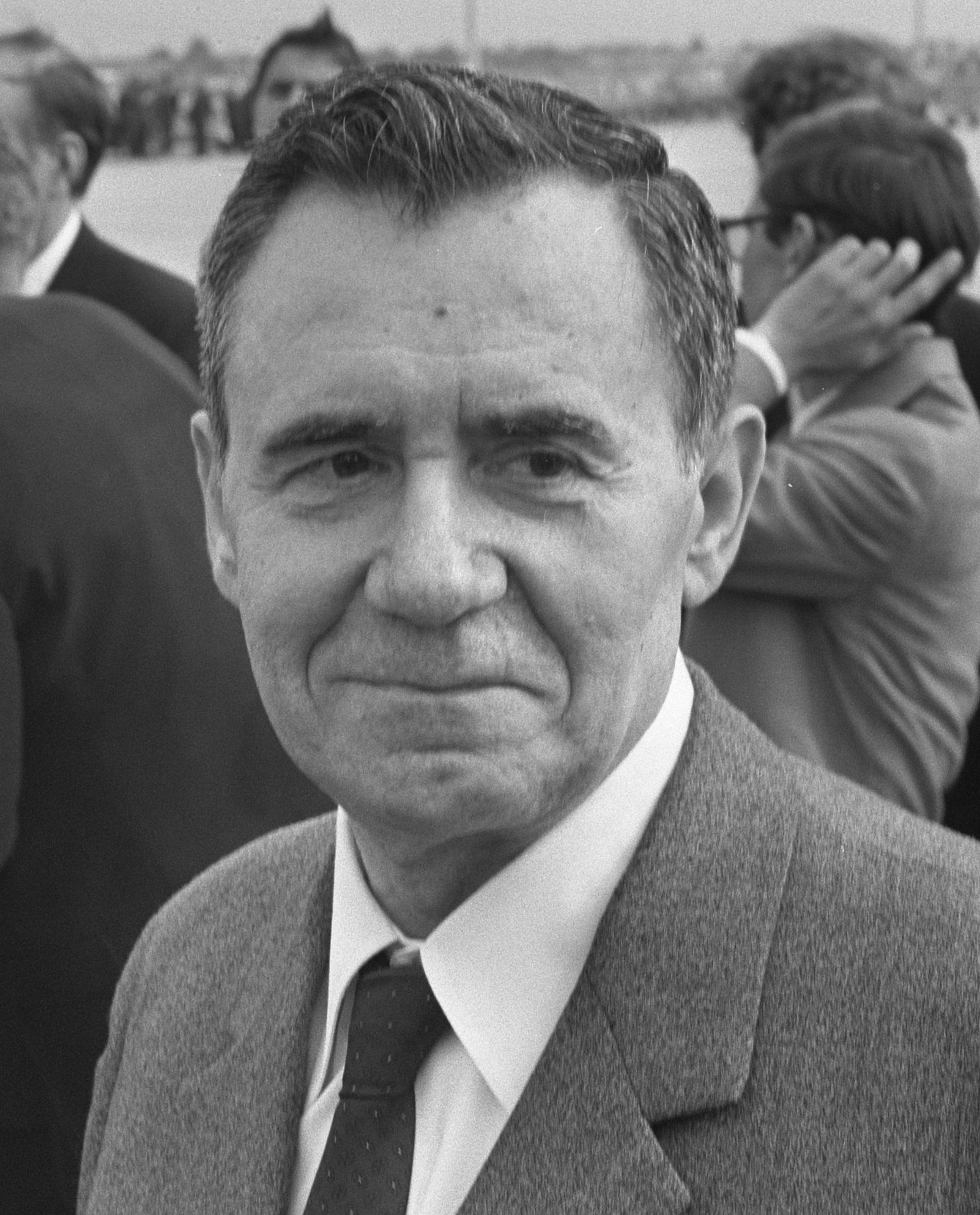
Andrei Andreevich Gromyko was a Soviet politician, diplomat, economist, and memoirist whose career shaped the foreign policy of the USSR for the better part of four decades. Born on 5 July 1909 in Staryja Hramyki, he rose from academic study at the Belarusian State Economic University to become one of the most formidable negotiators of the twentieth century. He signed the United Nations Charter on behalf of the Soviet Union on 26 June 1945 and went on to participate in nearly every major arms-control agreement of the Cold War era. He died on 2 July 1989 in Moscow.
Key facts
- Born: 5 July 1909
- Birthplace: Staryja Hramykі
- Died: 2 July 1989
- Place of death: Moscow
- Country: Soviet Union
- Occupation: politician; diplomat; economist; memoirist
- Education: Belarusian State Economic University
- Awards: USSR State Prize; Order of Lenin; Order of the Badge of Honour; Order of the Red Banner of Labour
Early Diplomatic Career
Gromyko’s path into diplomacy accelerated during the Second World War, when Stalin chose him to represent the Soviet Union at the 1945 San Francisco Conference. At that gathering he served as acting chairman of the Soviet delegation and signed the United Nations Charter on 26 June 1945, placing his name on one of the founding documents of the postwar international order.
After his stint at the United Nations, Gromyko served as first deputy foreign minister from 1949 to 1952. He was then briefly posted as ambassador to the United Kingdom from 1952 to 1953, before returning to Moscow to resume the role of first deputy foreign minister.
The Cuban Missile Crisis
On 18 October 1962, at the height of the Cuban Missile Crisis, Gromyko met President John F. Kennedy at the White House. He read a prepared statement asserting that Soviet aid to Cuba was solely defensive in character. Kennedy, who already had intelligence showing that offensive missiles were being installed on the island, did not disclose that knowledge during the meeting. The exchange has since become one of the most studied episodes of Cold War diplomacy, a moment when both sides held information the other chose not to name aloud.
Arms Control and Détente
Gromyko participated in the signing of the Nuclear Test-Ban Treaty in Moscow on 5 August 1963. He subsequently helped negotiate the Anti-Ballistic Missile Treaty, SALT I, SALT II, and the Nuclear Non-Proliferation Treaty of 1968, forming a body of work that made him central to the architecture of Cold War arms control.
Under Leonid Brezhnev, Gromyko helped construct the policy of détente between the United States and the Soviet Union. He was present with Brezhnev at the Helsinki Summit when the Helsinki Final Act was signed on 1 August 1975, a document that addressed security arrangements and human rights across Europe.
Honours and Recognition
Over the course of his career Gromyko received several of the Soviet Union’s highest civilian distinctions, including the USSR State Prize, the Order of Lenin, the Order of the Badge of Honour, and the Order of the Red Banner of Labour.
Legacy and Family
Gromyko’s engagement with international affairs extended to the next generation of his family. His grandson Alexei Gromyko, son of Anatoly, serves as Director of the Institute of Europe of the Russian Academy of Sciences and holds the rank of Corresponding Member of that academy, continuing the family’s involvement in the study and practice of international relations.
Did you know
- Henry Kissinger reportedly said of Gromyko: “If you can face Gromyko for one hour and survive, then you can begin to call yourself a diplomat,” a tribute to Gromyko’s reputation for toughness at the negotiating table. (kids.kiddle.co)
- On 18 July 2009, Belarus marked the centenary of Gromyko’s birth with nationwide celebrations. A school and a street in Gomel were renamed in his honour as part of the commemorations. (kids.kiddle.co)
- Stalin originally planned to send Gromyko as the sole Soviet representative to the 1945 San Francisco Conference. After President Roosevelt’s death on 12 April 1945, Stalin chose to also dispatch Foreign Minister Vyacheslav Molotov as a gesture of respect toward the late president. (2001-2009.state.gov)
Data sources
Data updated: 2026-10-31