
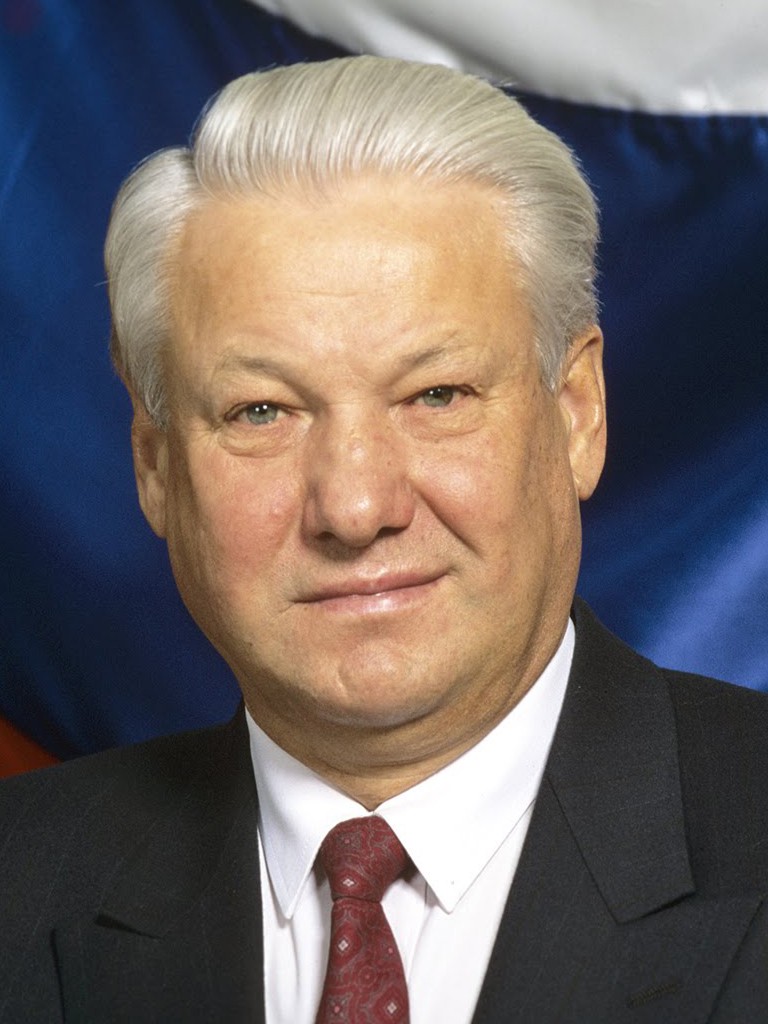
Boris Yeltsin (1931–2007) was a Soviet and Russian politician who served as the first President of the Russian Federation, holding office from 1991 until his resignation on December 31, 1999. Trained as a civil engineer at the Ural State Technical University, he rose through the Communist Party apparatus before breaking with it and reshaping the post-Soviet state. His presidency produced the first voluntary transfer of power in modern Russian history, and on June 12, 1991, he became the first popularly elected president in Russian history, winning 57 percent of the vote.
Key facts
- Born: 1 February 1931
- Birthplace: Butka
- Died: 23 April 2007
- Place of death: Moscow
- Country: Soviet Union; Russia
- Occupation: civil engineer; politician; master builder; engineer
- Education: Ural State Technical University; Ural Federal University
- Awards: Order of Lenin; Order of the Red Banner of Labour; Order of the Red Banner of Labour; Order of the Badge of Honour
Early Life and Formation
Yeltsin was born on February 1, 1931, in Butka, a village in what was then the Soviet Union. His childhood was marked by the absence of his father, who served three years of hard labor after being charged with anti-Soviet agitation. That experience shaped the household Yeltsin grew up in, though he later pursued a career through the very institutions that had punished his family.
He trained as a civil engineer and graduated from the Ural State Technical University. His professional identity as a builder and engineer remained a consistent element of his public self-presentation throughout his life; his autobiography, published in 1990 under the title ‘Against the Grain,’ describes his early life, political career, rise through the Communist Party, and his relationship with Gorbachev.
Rise Through the Party
Yeltsin’s ascent within the Communist Party of the Soviet Union was built on regional administration. In 1976, he was promoted to First Secretary of the CPSU Committee of Sverdlovsk Oblast, a post that made him effectively the head of one of the most significant industrial regions in the USSR. He held that position until 1985, accumulating the administrative experience and political networks that would later carry him to national prominence.
The Dissolution of the Soviet Union
On June 12, 1991, Yeltsin won the presidential election of the Russian Soviet Federated Socialist Republic with 57 percent of the vote, a result that gave him a democratic mandate no previous Russian leader had held. During the August 1991 coup attempt against Gorbachev, coup leaders deployed approximately 4,000 soldiers, 350 tanks, 300 armored vehicles, and 420 trucks to Moscow, and Yeltsin’s public speech from atop a tank helped galvanize popular opposition. The coup collapsed within three days.
On December 8, 1991, Yeltsin met with Ukrainian President Leonid Kravchuk and Belarusian Parliament Chairman Stanislav Shushkevich in Belarus and signed the Belavezha Accords. The agreement declared the Soviet Union dissolved and established the Commonwealth of Independent States in its place.
Economic Transformation and Its Consequences
Following the dissolution of the Soviet Union, Yeltsin’s government introduced a program of economic shock therapy. The measures included the rapid removal of price controls, the privatization of state-owned enterprises, and the opening of Russia’s borders to free trade. Between 1992 and 1994, over 15,000 state enterprises were privatized, frequently through voucher schemes that enabled insiders to acquire assets at minimal cost — a process that contributed to the rise of the Russian oligarchy.
The social consequences of the transition were severe enough to mark public memory for years. A survey of 1,600 people published by the Yuri Levada Center in 2006 found that 70 percent of respondents believed the Yeltsin era had brought Russia more harm than good.
Health and the 1996 Election
Yeltsin’s health deteriorated significantly during his second term in office. During the 1996 presidential campaign, he suffered a heart attack between the two rounds of the election and concealed it from the public. After winning re-election, he underwent a heart bypass operation that lasted seven hours. The surgery involved five bypasses of his coronary arteries, and his heart was stopped for 68 minutes while he was maintained on a heart-lung machine.
Resignation and Legacy
On December 31, 1999, Yeltsin appeared in a televised address and announced his resignation, transferring power to Prime Minister Vladimir Putin as acting president. The handover was the first voluntary transfer of presidential power in modern Russian history.
Yeltsin died of cardiac arrest caused by congestive heart failure and multiple organ failure on April 23, 2007, at Moscow’s Central Clinical Hospital. He was 76. His funeral was held on April 25, 2007, at the Cathedral of Christ the Savior in Moscow. He was buried at Novodevichy Cemetery, and the ceremony made him the first Russian head of state buried in a church rite since Emperor Alexander III, 113 years earlier.
The Boris Yeltsin Presidential Center opened in Yekaterinburg on November 25, 2015. It was the first presidential center established in the Russian Federation and functions as a museum, archive, library, and educational complex. The center was financed with $76 million of public money and contributions from approximately 50 private sponsors, among them President Vladimir Putin and Prime Minister Dmitry Medvedev. Its collection includes more than 30,000 exhibits and 13,000 photographs.
Did you know
- During the August 1991 coup attempt, the coup’s organizers sent approximately 4,000 soldiers, 350 tanks, 300 armored vehicles, and 420 trucks into Moscow to encircle the parliament building and detain key figures. Yeltsin’s speech, delivered from the top of one of those tanks, helped build the public opposition that brought the coup down within three days. (behindthequotes.com)
- A survey of 1,600 people published by the Yuri Levada Center in 2006 found that 70 percent of Russians considered the Yeltsin era to have done the country more harm than good. (rferl.org)
- Yeltsin’s 1996 heart bypass operation ran for seven hours and required five bypasses of his coronary arteries; his heart was kept stopped for 68 minutes while a heart-lung machine maintained circulation. He had suffered a heart attack between the two rounds of the presidential election that year and kept it from the public. (deseret.com)
- Between 1992 and 1994, more than 15,000 state enterprises were privatized under Yeltsin’s shock therapy program. Many transfers occurred through voucher schemes that gave well-connected insiders access to valuable assets at negligible prices, a dynamic widely credited with producing the Russian oligarchy. (tracesofevil.com)
- The Yeltsin Presidential Center in Yekaterinburg was built with $76 million in public funds and contributions from around 50 private sponsors, including President Vladimir Putin and Prime Minister Dmitry Medvedev. The facility holds more than 30,000 exhibits and 13,000 photographs. (rferl.org)
Data sources
- Wikidata
- ebsco.com
- newworldencyclopedia.org
- encyclopediaofukraine.com
- thecollector.com
- channel8.com
- schoolhistory.co.uk
- rferl.org
- abebooks.com
Data updated: 2026-10-28