
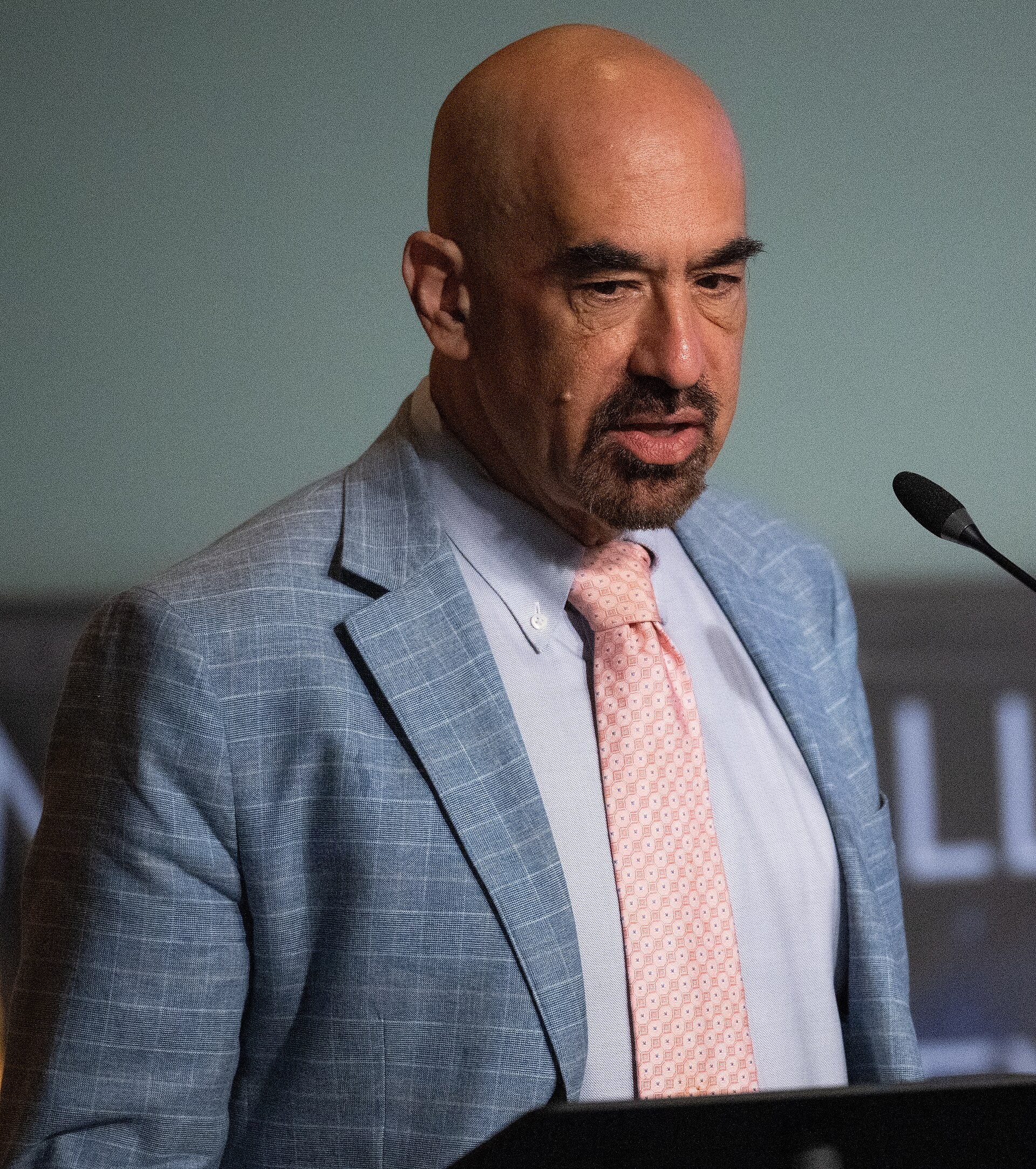
David Spergel is an American theoretical astrophysicist whose research spans cosmology, dark matter, galactic structure, and the detection of extrasolar planets. Born on March 25, 1961, in Rochester, he built a career centered on Princeton University before becoming president of the Simons Foundation on July 1, 2021. His publication record, as of the date of his curriculum vitae, exceeded 300 refereed papers, more than 98,000 citations, and a Hirsch h-index of 118, placing the first and third most-cited physics papers of the new millennium under his lead authorship. Among his many honors are a MacArthur Fellowship, the Dannie Heineman Prize for Astrophysics, and a share of the 2018 Breakthrough Prize in Fundamental Physics worth a total of three million dollars.
Key facts
- Born: 25 March 1961
- Birthplace: Rochester
- Country: United States
- Occupation: astronomer; physicist
- Field: theoretical astrophysics
- Employer: Princeton University
- Education: Harvard University; Princeton University; Elwood-John H. Glenn High School
- Awards: MacArthur Fellows Program; Helen B. Warner Prize for Astronomy; Dannie Heineman Prize for Astrophysics; Breakthrough Prize in Fundamental Physics
Education and early formation
Spergel attended Elwood-John H. Glenn High School on Long Island, where in 1978 he participated in the Science Talent Search, an early national competition for secondary-school scientists. He went on to Princeton University, completing his undergraduate degree in 1982 summa cum laude and as a member of Phi Beta Kappa. His senior thesis, written under adviser Gillian Knapp, was titled “Evolution of Proto-Planetary Nebulae” and had nothing to do with the cosmology that would later define his reputation.
In 1983, before starting his doctoral research in earnest, Spergel spent a year at Oxford University as a Harvard Travelling Scholar, working on galactic dynamics under the supervision of James Binney. He then pursued graduate study at Harvard University, where he earned his doctorate. Following graduation, he spent two years as a long-term member at the Institute for Advanced Study in Princeton, where his postdoctoral mentor was John Bahcall.
Princeton career
Spergel joined the Princeton faculty in 1987. He was promoted to associate professor in 1992 and to full professor in 1997. In 2007, he was appointed the Charles A. Young Professor of Astronomy on the Class of 1897 Foundation, a named chair he held until transitioning to emeritus status effective July 1, 2019.
From February 2006 to June 2016, Spergel served as chair of Princeton’s Department of Astrophysical Sciences. During that decade, the department was consistently ranked first by U.S. News and World Report and by the National Academy of Sciences. Over his career at Princeton, Spergel served as primary mentor to more than 100 graduate students and postdoctoral researchers. Among his doctoral students are Julianne Dalcanton, Hiranya Peiris, and Shirley Ho, all of whom became prominent astrophysicists.
Research contributions
In 1987, while at the Institute for Advanced Study, Spergel co-authored a paper with John Bahcall and collaborators in Nature analyzing neutrino temperatures and fluxes detected from Supernova 1987A in the Large Magellanic Cloud. The work engaged one of the first observed extragalactic neutrino sources.
In 1991, Spergel and Leo Blitz co-authored a photometric study of the Milky Way that provided early evidence the galaxy is barred. Subsequent near-infrared and stellar-kinematic observations confirmed the result. A decade later, in a 2001 preprint titled “A New Pupil for Detecting Extrasolar Planets,” Spergel introduced a shaped-pupil coronagraph design that produces a dark null along its symmetry axis, enabling the suppression of starlight needed to image planets directly.
Spergel received the 2015 Dannie Heineman Prize for Astrophysics, jointly awarded with Marc Kamionkowski, for outstanding contributions to the investigation of fluctuations in the cosmic microwave background. The 2018 Breakthrough Prize in Fundamental Physics honored Spergel and the 27-member WMAP science team, including Charles Bennett, Gary Hinshaw, Norman Jarosik, and Lyman Page Jr., for detailed maps of the early universe. The prize carried a total of three million dollars shared among the named laureates and the team.
In March 2014, the BICEP2 collaboration announced what it described as a detection of primordial gravitational waves. Spergel publicly challenged the claim, arguing that polarized galactic dust emission was equally consistent with the observed signal and that the telescope’s single-frequency measurements could not distinguish between the two sources.
The Nancy Grace Roman Space Telescope
Spergel led the science definition team for the Nancy Grace Roman Space Telescope, formerly known as WFIRST, and co-chaired its Formulation Science Working Group from 2015 until 2021. His involvement in the mission began in a less formal but consequential way in 2011, when he quietly informed astronomer Alan Dressler that the National Reconnaissance Office had spare 2.4-meter telescopes it no longer needed and that NASA could repurpose them. That disclosure transformed the mission’s prospects.
For his leadership of the Roman Telescope science program, NASA awarded Spergel its Exceptional Public Service Medal in April 2022. A separate NASA Exceptional Public Service Medal had been awarded to him in 2017 for his service as chair of the National Academy of Sciences Space Studies Board and as a member of the NASA Advisory Council.
NASA Unidentified Anomalous Phenomena study
In 2022, NASA named Spergel chair of its Unidentified Anomalous Phenomena Independent Study Team, a panel of 16 experts. The team began work on October 24, 2022, held its first public meeting on May 31, 2023, and released its final report on September 14, 2023.
Simons Foundation presidency
On July 1, 2021, Spergel became the second president of the Simons Foundation, succeeding co-founder Marilyn Simons, who had led the philanthropy since its formation in 1994.
Recognition and service
In 2001, the MacArthur Foundation awarded Spergel a MacArthur Fellowship, colloquially known as the genius grant, worth 500,000 dollars paid over five years with no conditions attached, in recognition of his extraordinary originality in astrophysics. He also received the Helen B. Warner Prize for Astronomy. In 2019, the National Society of Black Physicists honored him as an Honorary Member, reflecting his sustained efforts to promote equity and inclusion within the sciences.
Spergel married Laura H. Kahn, a physician, on August 26, 1990. They have three children: Julian, Sarah, and Joshua.
Did you know
- The Nancy Grace Roman Space Telescope, for whose science program Spergel played a defining leadership role, faced five separate cancellation attempts in presidential budget proposals: twice during the Obama era and three times during the first Trump administration. Congress chose to preserve the mission each time. (scientificamerican.com)
- Spergel’s undergraduate thesis at Princeton in 1982, written under adviser Gillian Knapp, was titled “Evolution of Proto-Planetary Nebulae” — a subject entirely unrelated to the cosmology and dark matter physics for which he later became widely known. (astro.princeton.edu)
- During his 2001 sabbatical at the Institute for Advanced Study — a return to the same institution where he had been a postdoctoral member from 1985 to 1987 — Spergel simultaneously received his MacArthur genius grant and was listed by Time magazine as one of “America’s Top Scientists.” (pr.princeton.edu)
Data sources
- Wikidata
- societyforscience.org
- nygenome.org
- astro.princeton.edu
- simonsfoundation.org
- aip.org
- notablebiographies.com
- osti.gov
- arxiv.org
- uapledger.com
- quantamagazine.org
- pr.princeton.edu
- scientificamerican.com
Data updated: 2026-10-28