
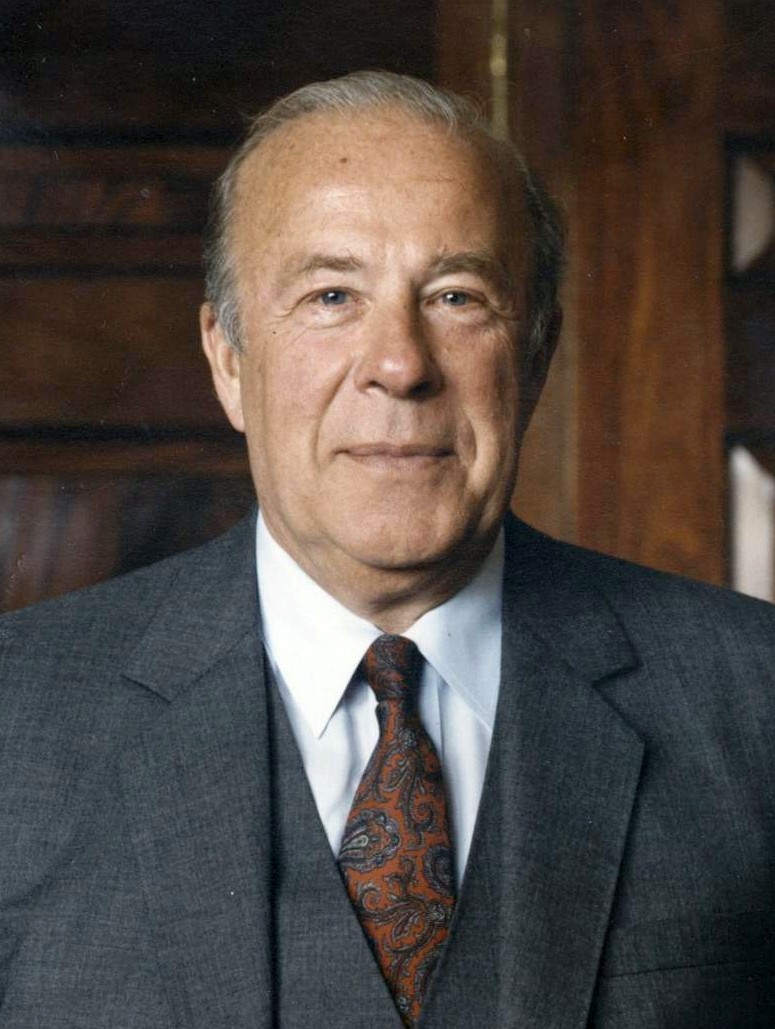
George P. Shultz (December 13, 1920 – February 6, 2021) was an American economist, diplomat, and public servant who held four different federal cabinet positions across two administrations, a distinction shared by only one other American in history. Born in New York City and educated at Princeton and MIT, he moved between the academy, the private sector, and government with unusual range, serving as the 60th U.S. Secretary of State from July 16, 1982, to January 20, 1989. His tenure as Secretary of State shaped the final chapter of the Cold War, including the groundwork for the INF Treaty. Federal Reserve Chair Jerome Powell called him “one of the most successful policymakers of his era.”
Key facts
- Born: 13 December 1920
- Birthplace: New York City
- Died: 6 February 2021
- Place of death: Stanford
- Country: United States
- Occupation: economist; military personnel; diplomat; university teacher
- Field: economics; politics; entrepreneurship
- Employer: Massachusetts Institute of Technology; Stanford University; University of Chicago; MIT Sloan School of Management
- Education: Princeton University; Massachusetts Institute of Technology; Dwight-Englewood School; Princeton School of Public and International Affairs
- Awards: Presidential Medal of Freedom; Democracy Service Medal; Order of the Rising Sun with Paulownia Flowers, 1st class; California Hall of Fame
Early Life and Education
Shultz grew up in Englewood, New Jersey, and completed his secondary schooling at Loomis Chaffee School in Windsor, Connecticut, graduating in 1938. From there he entered Princeton University, where he graduated cum laude in 1942 with a bachelor’s degree in economics and a minor in public and international affairs. His senior thesis examined the agricultural impact of the Tennessee Valley Authority.
After Princeton, Shultz served in the U.S. Marine Corps in the Pacific theater from 1942 to 1945, attaining the rank of captain. Returning from military service, he enrolled at MIT, earning a Ph.D. in industrial economics in 1949. He then joined the MIT faculty and taught there from 1948 to 1957, interrupted by a leave in 1955 to serve as a senior staff economist on President Eisenhower’s Council of Economic Advisers.
Academic Career and the University of Chicago
After his years at MIT, Shultz moved to the University of Chicago, where he eventually served as dean of what is now the Booth School of Business. In that role he established the first scholarship for Black students at a major business school and created the International Business Exchange Program.
Four Cabinet Positions
Shultz is one of only two Americans to have served in four separate federal cabinet posts. Under President Richard Nixon, he was Secretary of Labor from 1969 to 1970. In June 1970 he became the first-ever director of the newly formed Office of Management and Budget, a position he held until May 1972, when Nixon named him Secretary of the Treasury. He remained at Treasury until 1974.
Leaving government in 1974, Shultz became president and director of the Bechtel Group, a major engineering and construction company based in San Francisco. He remained there until 1982. Projects completed under his leadership at Bechtel included the Trans-Alaska Pipeline and the Washington Metro subway.
Secretary of State under Reagan
President Ronald Reagan appointed Shultz as the 60th U.S. Secretary of State to replace Alexander Haig. Shultz was confirmed and took office on July 16, 1982, serving until January 20, 1989. The tenure placed him at the center of American foreign policy through some of the most consequential years of the Cold War.
One of the defining moments of his time as Secretary of State came at the Reykjavik Summit in Iceland on October 11 and 12, 1986, where Shultz played a key role in preparing for and attending the meetings between Reagan and Soviet General Secretary Mikhail Gorbachev. At Reykjavik, the two leaders reached a preliminary agreement to eliminate all intermediate-range nuclear forces in Europe, laying the foundation for the INF Treaty.
During the Iran-Contra affair, Shultz and Defense Secretary Caspar Weinberger stood apart from other senior cabinet members by openly and repeatedly opposing the arms-for-hostages operation. Shultz described the arrangement as ‘a hostage bazaar.’
Post-Government Work and Policy Advocacy
When Shultz left the Reagan administration in 1989, he was awarded the Presidential Medal of Freedom. He returned to Stanford as a distinguished fellow at the Hoover Institution, where he continued to write and advocate on policy questions for more than three decades. In 2001 he was named the Thomas W. and Susan B. Ford Distinguished Fellow there.
In January 2007, Shultz co-authored an influential op-ed in the Wall Street Journal titled ‘A World Free of Nuclear Weapons,’ alongside former Defense Secretary William Perry, former Secretary of State Henry Kissinger, and former Senator Sam Nunn. The four were subsequently nicknamed ‘the Four Horsemen of the Nuclear Apocalypse’ for their collective push toward nuclear disarmament.
In his later years Shultz championed a revenue-neutral carbon tax proposal developed alongside former Secretary of State James Baker. Known as the Shultz-Baker plan, it proposed reducing carbon emissions by placing a market-based price on carbon. Beyond policy advocacy, he adopted an electric vehicle early and installed solar panels on his Stanford home. He also received the Order of the Rising Sun with Paulownia Flowers, 1st class, among other honors, and was inducted into the California Hall of Fame.
Personal Life and Death
Shultz’s first wife, Helena ‘O’Bie’ O’Brien, died in 1995 after 49 years of marriage. Two years later, in 1997, he married Charlotte Mailliard Swig, who served as San Francisco’s chief of protocol.
George Shultz died peacefully at his home in Stanford, California, on February 6, 2021, at the age of 100. He was survived by his wife Charlotte, five children, eleven grandchildren, and nine great-grandchildren. Jerome Powell, chair of the Federal Reserve, credited Shultz with making important contributions at the Hoover Institution on healthcare reform, climate change, nuclear disarmament, and other areas after leaving public office.
Did you know
- Shultz was so devoted to Princeton that he reportedly had the Princeton tiger, the university’s mascot, tattooed on his posterior. In February 1987, while aboard a plane en route to China, his first wife Helena confirmed the tattoo to a reporter from Time magazine. (washingtonpost.com)
- At age 12, Shultz published his own newspaper, called the Weekly News, to rival a paper run by a friend named Topper Cook. (hoover.org)
- Shultz’s grandson Tyler Shultz met Theranos founder Elizabeth Holmes at his grandfather’s house and initially interned at the company in 2013. After discovering alleged fraud, Tyler filed the first known regulatory complaint against Theranos under an alias, an action that helped trigger the company’s collapse. (scu.edu)
- Shultz died on February 6, 2021, the same calendar date as Ronald Reagan’s birthday, a coincidence noted by commentators writing about his death. (spectator.org)
- Shultz adopted an electric vehicle early and installed solar panels on the roof of his Stanford home, making his personal commitment to clean energy concrete beyond his written policy proposals. (stanforddaily.com)
Data sources
- Wikidata
- thecandidate.com
- fsi.stanford.edu
- convocations.purdue.edu
- news.uchicago.edu
- hoover.org
- enr.com
- history.state.gov
- pbs.org
- thebulletin.org
- energy.stanford.edu
- cbsnews.com
Where it appears
Data updated: 2026-10-27