
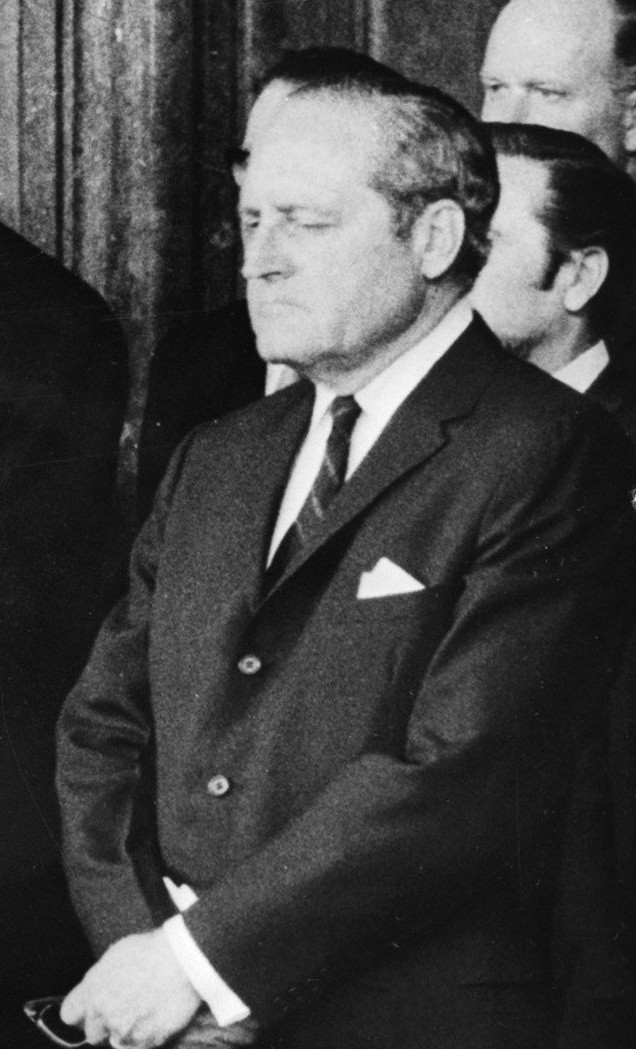
Gerard Coad Smith (1914–1994) was an American attorney, diplomat, and arms-control negotiator whose career stretched from the early nuclear age through the end of the Cold War. Born in New York City on May 4, 1914, he rose to lead the United States delegation through the Strategic Arms Limitation Talks, producing the first SALT accords in May 1972 after two and a half years of negotiation. He received the Presidential Medal of Freedom for his work. His influence on nuclear policy continued long after he left government, through writing, institutional leadership, and direct diplomacy with countries on the edge of acquiring nuclear weapons.
Key facts
- Born: 4 May 1914
- Birthplace: New York City
- Died: 4 July 1994
- Place of death: Easton
- Country: United States
- Occupation: diplomat; lawyer
- Education: Canterbury School
- Awards: Presidential Medal of Freedom
Early Life and Family Background
Smith was born in New York City on May 4, 1914, and educated at the Canterbury School. His full middle name was Coad, a detail that distinguished him from others who shared the surname. His father, John Thomas Smith, was a lawyer who served for many years as general counsel of General Motors Corporation, giving Gerard an upbringing shaped by legal practice and corporate affairs at the highest level. That background informed his later ability to move between technical, legal, and political arguments without losing grip of any of them.
During World War II, Smith served as a Navy procurement official responsible for acquiring electronic systems. The experience gave him a detailed understanding of the technical specifications and legal provisions that underpin defense contracts, knowledge he later applied when drafting the verification and safeguard provisions of international arms agreements.
The Atomic Energy Commission and the IAEA
From 1950 to 1954, Smith served as Special Assistant to Atomic Energy Commissioner Thomas E. Murray at the United States Atomic Energy Commission. In that role he became familiar with intelligence on world deposits of natural uranium, a resource whose distribution was central to any realistic assessment of nuclear proliferation.
In 1953, Smith helped brief members of the AEC on President Eisenhower’s Atoms for Peace proposal. He then played an active part in the planning that led to the creation of the International Atomic Energy Agency. Specifically, he worked on the provisions governing safeguards and countered competing schemes advanced by Soviet, French, and Indian negotiators. The result, the IAEA as it was eventually constituted, bore the marks of his drafting work.
The SALT I Negotiations
The first round of SALT I negotiations opened on November 17, 1969 in Helsinki, Finland. Smith led the American delegation opposite the Soviet counterpart Vladimir Semenov. Subsequent sessions alternated between Helsinki and Vienna until the first accords were reached in May 1972.
The negotiations were complicated by a back-channel that Henry Kissinger developed with Soviet Ambassador Anatoly Dobrynin without informing Smith. Smith later documented the resulting confusion, and the extent to which it brought him close to resigning, in his memoir Doubletalk. The episode illustrated a recurring tension in the American national security bureaucracy between the formal negotiating team and parallel White House diplomacy.
Smith left government in 1973 after the SALT I process concluded.
The Trilateral Commission and Return to Government
After leaving government in 1973, Smith was recruited by David Rockefeller to help establish the Trilateral Commission. He served as North American Chairman from 1973 to 1977, making him the Commission’s first North American chairman.
In 1977, President Jimmy Carter appointed Smith as Special Representative and Ambassador-at-Large for Non-Proliferation Matters. He held that post from July 22, 1977 to November 10, 1980. In the role, Smith worked to bring more countries into a non-proliferation regime, traveling to Pakistan, Brazil, and South Africa in an effort to discourage those governments from developing nuclear weapons.
Advocacy and Scholarship After Government
In 1982, Smith co-authored an article in Foreign Affairs titled “Nuclear Weapons and the Atlantic Alliance” with McGeorge Bundy, George F. Kennan, and Robert S. McNamara. The article urged NATO to adopt a policy of no first use of nuclear weapons. The argument was contested from within the alliance; four senior German officials published a formal rebuttal in the same journal later that year.
Smith served as chairman of the Arms Control Association from 1981 to 1992. He was the organization’s second Board Chair, succeeding William C. Foster; the Arms Control Association had been founded as a project of the Carnegie Endowment for International Peace in 1971–1972. His chairmanship covered more than a decade of continuing debate over nuclear doctrine, arms-reduction treaties, and proliferation risk.
Death
Gerard C. Smith died of cancer on July 4, 1994, at Easton Memorial Hospital in Maryland. He was 80 years old. His death came in Easton, the place recorded as his place of death.
Did you know
- Smith opened the very first session of SALT I on November 17, 1969 with the words “The limitation of strategic arms is in the mutual interests of our country and the Soviet Union,” setting the tone for the two-and-a-half-year negotiation. (armscontrol.org)
- Smith’s 1982 no-first-use article in Foreign Affairs, co-written with Bundy, Kennan, and McNamara, provoked stern responses from within NATO, with four senior German officials publishing a formal rebuttal in the same journal later that year. (belfercenter.org)
- As a young diplomat during World War II, Smith served as a Navy procurement official responsible for the acquisition of electronic systems, experience that would later inform his understanding of the legal and technical provisions needed in international arms agreements. (pmc.ncbi.nlm.nih.gov)
Data sources
- Wikidata
- archives.eui.eu
- eisenhowerlibrary.gov
- pmc.ncbi.nlm.nih.gov
- nsarchive.gwu.edu
- history.state.gov
- foreignaffairs.com
- trilateral.org
- d-nb.info
- armscontrol.org
- deseret.com
Data updated: 2026-10-31