
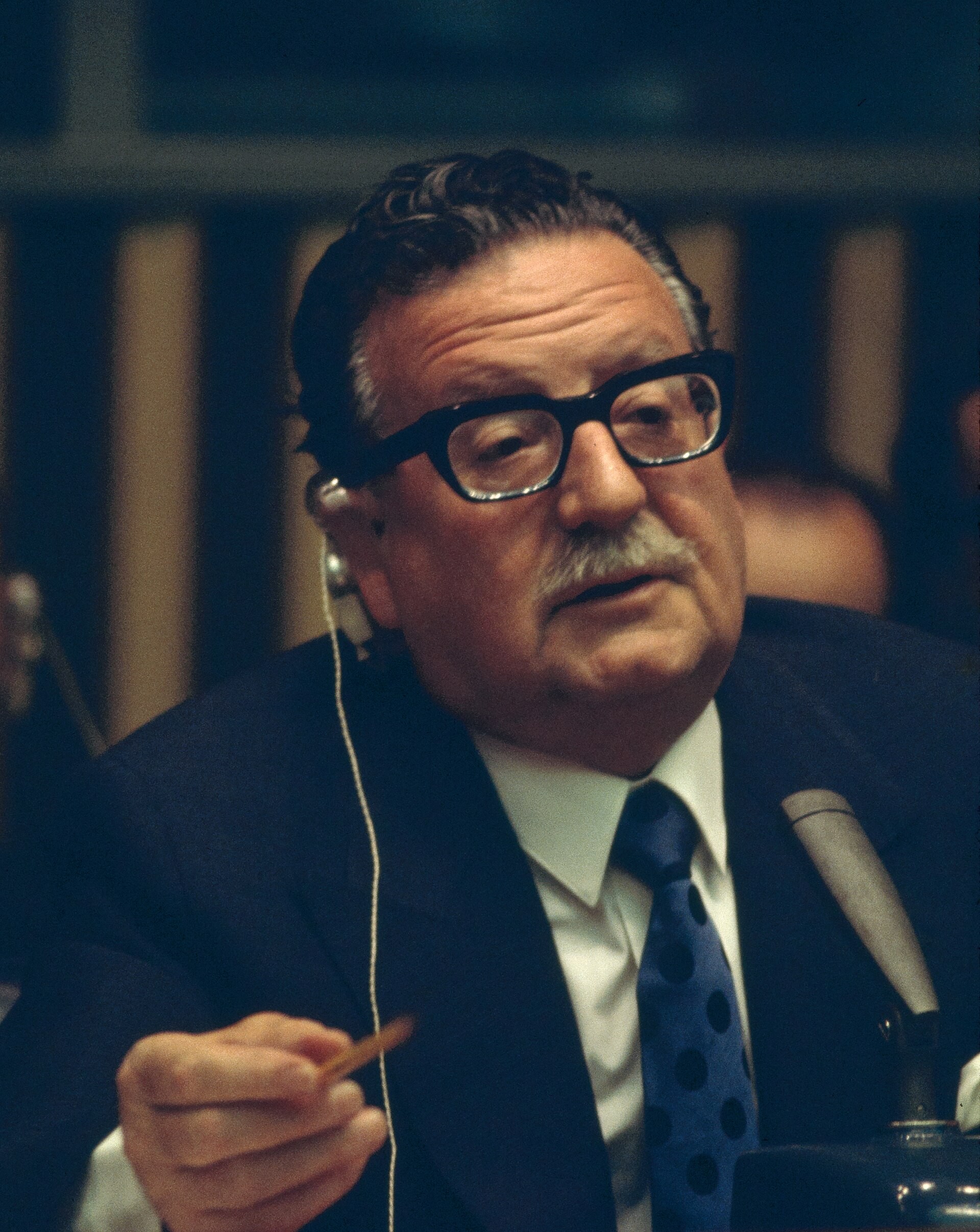
Salvador Allende (1908–1973) was a Chilean physician and socialist politician who served as the 28th President of Chile. He won the September 4, 1970, presidential election with 36.2 percent of approximately 3 million votes cast, leading the Popular Unity coalition of Socialists, Communists, Radicals, and dissident Christian Democrats. His presidency was marked by sweeping nationalizations, deep political polarization, and sustained covert opposition from the United States government. He died on September 11, 1973, in Santiago, during a military coup.
Key facts
- Born: 26 June 1908
- Birthplace: Santiago
- Died: 11 September 1973
- Place of death: Santiago
- Country: Chile
- Occupation: politician; physician; surgeon; President of Chile
- Education: University of Chile; Instituto Nacional General José Miguel Carrera
- Awards: Order of José Martí; Order of Augusto César Sandino; Lenin Peace Prize; Grand Cross of the Order Bernardo O’Higgins
Early Life and Education
Allende was born on June 26, 1908, in Santiago, Chile. He studied medicine at the University of Chile and earlier attended the Instituto Nacional General José Miguel Carrera. His political formation began early: as an undergraduate, he was arrested multiple times for protesting against the government and served as vice-president of the University of Chile student federation, known as FECH.
His radicalization in youth had an unlikely source. An anarchist shoemaker named Juan De Marchi introduced the young Allende to revolutionary politics and helped shape his early ideological outlook.
Four Presidential Campaigns
Allende first ran for the Chilean presidency in 1952 and ran again in 1958 and 1964 before finally winning in 1970. In the 1964 race, he received 38.6 percent of the popular vote, his highest share in any losing contest, but was defeated by Eduardo Frei.
His fourth campaign, in 1970, succeeded in a three-way race. He was 62 years old and secured 36.2 percent of the vote as the candidate of the Popular Unity coalition. The margin was narrow, but it was enough to make him president-elect of Chile.
Presidency and Domestic Policy
Once in office, Allende pursued an ambitious program of social and economic reform. One of the most significant legislative achievements of his government was the nationalization of Chile’s copper industry, passed unanimously by all parties in the opposition-controlled Congress on July 11, 1971.
Allende also used the healthcare system as a direct instrument of social policy. During his presidency, he deployed what were called ‘medical trains’ to bring health services to underserved provincial communities, and he ordered hospitals to accept all patients regardless of their ability to pay.
U.S. Covert Action
On September 15, 1970, U.S. President Richard Nixon ordered the CIA to prevent Allende’s inauguration or to create conditions for his overthrow. CIA Director Richard Helms recorded Nixon’s instructions in handwritten notes. Those notes remain the only known record of a U.S. president ordering the covert overthrow of a democratically elected foreign leader.
Declassified State Department records, released in 2014 as part of the Foreign Relations of the United States series, establish that U.S. covert planning to block Allende began at least as early as August 19, 1970, when the Special Review Group met under National Security Advisor Henry Kissinger.
Death and Legacy
Allende died on September 11, 1973, in Santiago. The coup that day ended his presidency and his life. His government’s nationalization of copper, its healthcare initiatives, and the U.S. covert program against it have continued to shape scholarship on Cold War interventionism and the limits of electoral socialism.
Among the honors he received during his lifetime were the Order of José Martí, the Order of Augusto César Sandino, the Lenin Peace Prize, and the Grand Cross of the Order Bernardo O’Higgins.
Freemasonry
Allende was initiated into Freemasonry on November 16, 1935, following both his father and his grandfather into the order. His grandfather, Ramón Allende Padín, had held the highest Masonic rank available in Chile: Serene Grand Master of the Grand Lodge of Chile. Allende remained a member of the order throughout his life.
Did you know
- Allende was a lifelong Freemason, initiated on November 16, 1935, following both his father and grandfather into the order. His grandfather Ramón Allende Padín held the highest Masonic rank in Chile: Serene Grand Master of the Grand Lodge of Chile. (thesquaremagazine.com)
- Allende ran for president four times across 18 years, winning only on his fourth attempt in 1970 at the age of 62, with just 36.2 percent of the vote in a three-way race. (ebsco.com)
- During his presidency, Allende used ‘medical trains’ to bring healthcare services to underserved provincial communities, and hospitals were ordered to accept all patients regardless of ability to pay. (ebsco.com)
- Allende’s early political radicalization was partly shaped by Juan De Marchi, an anarchist shoemaker who promoted revolutionary politics to the young Allende. (biography.com)
Data sources
Data updated: 2026-10-26