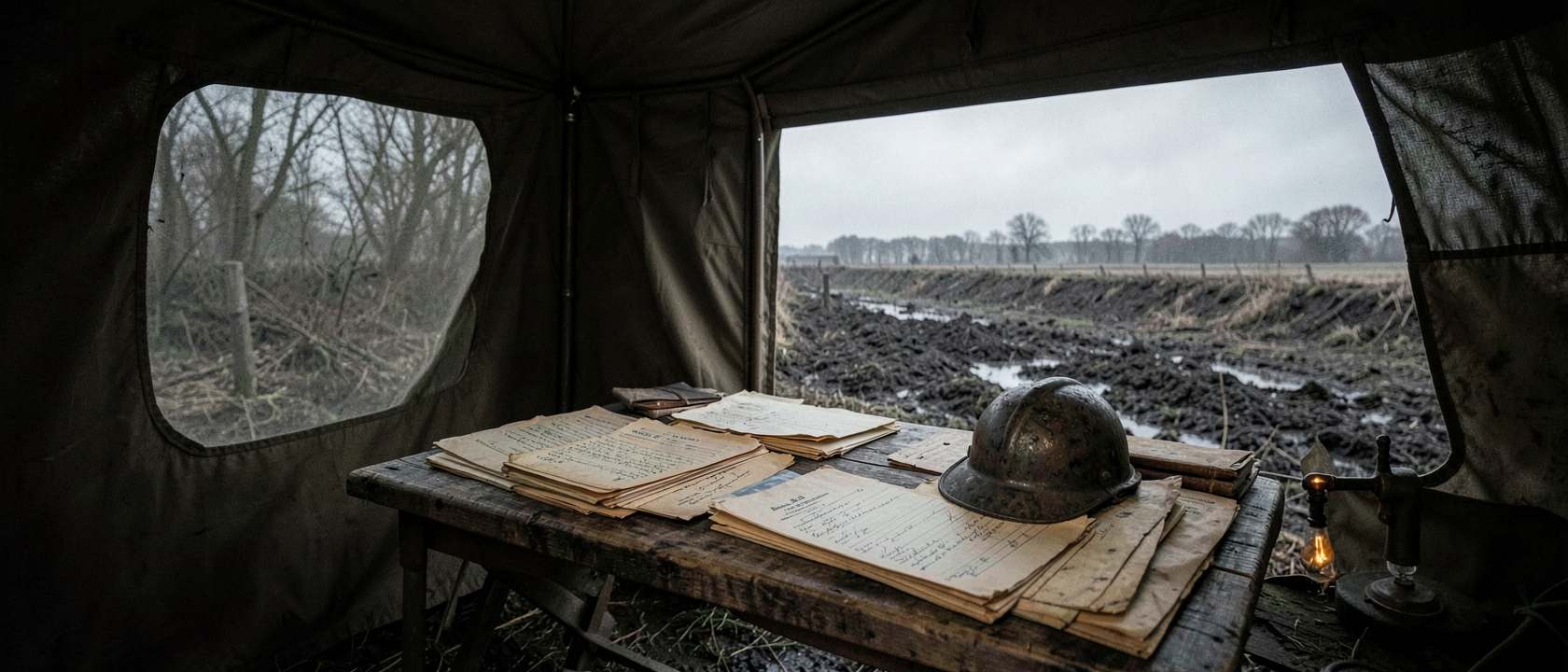
Five folders, one afternoon
The National Archives’ First World War collection, published August 3, 2026, groups five service files and images under a single heading. WO 339/34889 holds the service record of Reginald St John Beardsworth Battersby, dated 1914. WO 339/106913 holds the service record of J.B. Priestley, dated September 1914. WO 316/24 is a panoramic photograph of the Richebourg trenches, timed at 5:00 p.m. on April 12, 1915. RAIL 253/516 is a Great Western Railway employee’s letter from 1915. WO 71/1027 is the disciplinary case file of 2nd Lieutenant E.S. Poole, opened in September 1914, though what it describes happened in 1916.
The five files share nothing beyond having survived and ending up in the same catalogue. Each is read here only for what it contains, not for what it might suggest about the others.
The boy officer
Battersby’s file records that he enlisted in the Manchester Regiment on January 30, 1915, giving his age as 19 and his occupation as a draper. He was 14. Within a week he had made lance corporal. When his father learned what had happened, he did not ask the army to send the boy home. He arranged for a grammar school headmaster and the Lord Mayor of Manchester to back a commission instead, and on May 6, 1915, Battersby became a second lieutenant in the East Lancashire Regiment at age 15.
No method for confirming his age appears anywhere in the file, at enlistment or at commission. The record states what he said and what was later done about it. How, or whether, anyone checked is not written down.
He was wounded leading his platoon on July 1, 1916, the first day of the Battle of the Somme. In 1917, during the operations on the Ancre, shrapnel cost him his left leg. Asked to resign his commission, he refused, and returned to duty with the Royal Engineers on a prosthetic limb.
The dugout and the prisoners
Priestley’s record states that he enlisted in the West Riding Regiment as an ordinary soldier within a month of the war breaking out in 1914. It records a shell burying him in a dugout on the Western Front. It records that he survived, and that he was later commissioned into the Devonshire Regiment, where he was responsible for German prisoners of war.
The file lists these facts in sequence. It does not say the burial led to the commission, or explain how a private soldier came to hold one. It simply notes that both happened.
A photograph taken at five in the afternoon
WO 316/24 shows the ground at Richebourg l’Avoué, in the Pas-de-Calais: British lines, roads, a scatter of trees. It was taken at 5:00 p.m. on April 12, 1915, more than fourteen months before that ground was fought over.
The photograph was part of an intelligence series gathered ahead of an assault on the village. That assault, the Battle of the Boar’s Head, was launched on June 30, 1916, as a diversion meant to draw German attention from the Somme. Battalions of the Southdowns Brigade led it. The archive’s account of the attack gives only one detail about the cost: that casualties were heavy across five hours of fighting. It gives no total. The photograph shows the ground before anyone was lost on it. The file that describes the losses does not count them.
A letter with no name on it
RAIL 253/516 holds a 1915 letter from a former employee of the Great Western Railway’s Audit Office at Paddington, written to colleagues who stayed behind. It describes something of military life. It does not name the soldier who wrote it, and it does not say what became of him, what unit he served in, or how his war ended.
There is nothing more to add. The file is an impression of the war attached to no name the record kept.
Missing, arrested, tried
WO 71/1027 sets out a plain sequence for 2nd Lieutenant Eric Skeffington Poole, 11th Battalion, West Yorkshire Regiment. He was reported missing from his battalion on July 7, 1916, a week after the Somme offensive opened. He was arrested on returning to his unit, charged with desertion, tried, and executed by firing squad on December 10, 1916.
What the tribunal concluded
The file records the finding, not the reasoning behind it. Poole’s court-martial convened on November 24, 1916, on a charge of desertion in the presence of the enemy. Six witnesses were called, two in his defense, among them a Royal Army Medical Corps doctor who told the court Poole had been psychologically unfit for command. The court found him guilty and sentenced him to death. His brigade, division, and corps commanders all recommended mercy. The record states that the sentence stood. It does not set out how the medical testimony was weighed against the charge, only that the charge held.
What doesn’t fit
Poole had been admitted to a Field Ambulance suffering from shell shock before he went missing on July 7, 1916. That admission is in the file. So is his conviction for desertion. The file does not bridge the two.
The recommendations for mercy went up the chain and were rejected by the Second Army’s commander, General Sir Herbert Plumer, who gave as his reason “the inherent seriousness of the offense when committed by an officer.” That is a reason about rank. It is not a reason that engages the shell-shock admission sitting in the same file. Why the medical history was not treated as a defense at trial is not explained anywhere in the record.
2006, not 1916
In 2006, ninety years after the execution, the British government issued a pardon covering 306 of the 346 soldiers shot by British military authority during the First World War. Poole was one of them. The pardon reversed his legal status. It did not reopen the court-martial, and it produced no finding on the shell-shock question. The conviction and the pardon sit in the same file addressing two different things: one a set of facts from July 1916, the other a legal status changed nine decades later.
What people said afterward
Two claims travel alongside these files without belonging to them. Battersby is described as “believed to have been” the youngest officer in the British Army, a description the archive reports rather than certifies. The attack at Richebourg, photographed fourteen months before it happened, is remembered locally as “the day that Sussex died,” a phrase of commemoration, not a figure from any casualty return.
Both are things people said afterward. Neither appears in the file it describes.