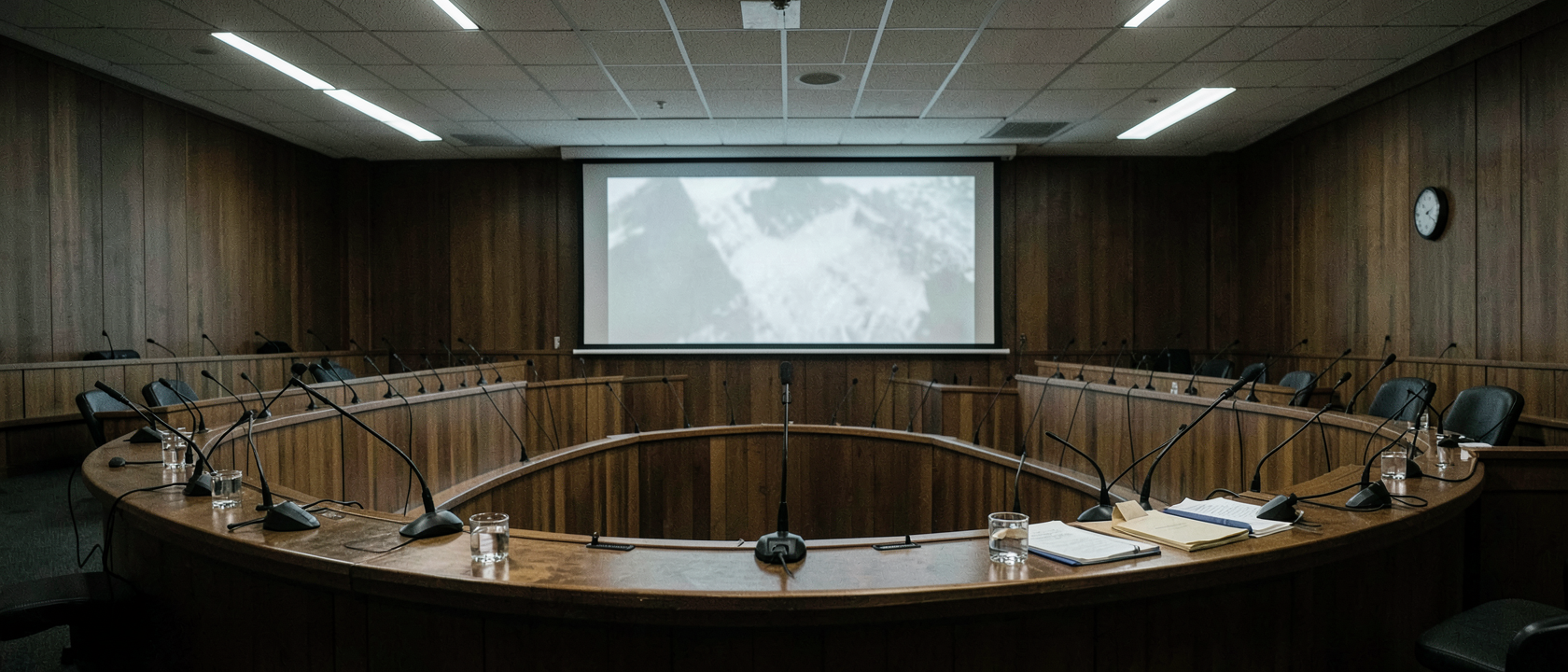
A Public Hearing, After Fifty Years
On May 17, 2022, the House Permanent Select Committee on Intelligence’s Subcommittee on Counterterrorism, Counterintelligence, and Counterproliferation held an open hearing on unidentified aerial phenomena, the first of its kind in more than fifty years. Scott Bray, the Deputy Director of Naval Intelligence, testified alongside Ronald S. Moultrie, the Under Secretary of Defense for Intelligence and Security, and spoke to the work of the Navy’s UAP Task Force, the office set up to log and review these reports.
Bray brought two videos and two images into the room. Shortly after the hearing, the Department of Defense released the same four items to the public. The Black Vault, a Freedom of Information Act archive run by researcher John Greenewald, posted them for download, which is the source this account draws on.
The hearing came eleven months after a separate government study of 144 military encounters logged between 2004 and 2021. That study, from the Office of the Director of National Intelligence and the Pentagon’s task force, identified one case as a deflating balloon and left the other 143 without explanation. That earlier count matters for what follows: an open hearing does not, by itself, make the underlying material any easier to resolve.
Four Items, Described Plain
The first item is Navy fighter jet cockpit video: a naval aviator’s brief, fast pass by an unidentified object, filmed from inside the cockpit. Bray told the committee it illustrated, in his words, the typical speed at which military aircraft may approach an unknown object. It has since been called the fleeting pass footage.
The second item is video from July 2019, recorded by sailors using night-vision goggles and a single-lens reflex camera, showing multiple objects near Navy ships during exercises off Southern California.
The third item is a single still image from early 2022, captured the same way, showing one object near naval exercises off the East Coast.
The fourth item is a screen capture pulled directly from the cockpit video described above.
All four were shown to the committee as encounters with unidentified objects, and none arrived with an explanation attached.
Two Objects, Reclassified
Bray told the committee that the triangular shape visible in the second and third items was not what it appeared to be. He said the shape came from light passing through the night-vision goggles before it was recorded on the SLR camera, and that the task force had reclassified both objects, the 2019 ships footage and the 2022 East Coast image, as unmanned aerial systems, or drones.
The record ties that reclassification to additional data gathered from other UAP sightings, but it does not say what that data was. There is no mention of radar returns, recovered hardware, or a second sensor cross-check. It is a finding, stated as settled by the task force, without a visible chain of evidence behind it in the material that was released.
None of that makes a drone the wrong answer. A drone near a naval exercise is an ordinary explanation, not an exotic one. The gap here sits somewhere else: the released record states the conclusion but does not show the work that produced it.
The Item the Reclassification Left Behind
The cockpit video and its screen capture were not part of that reclassification. Nothing in the record identifies, corrects, or offers a competing explanation for the object in the fleeting pass. Bray was direct about it at the hearing: “I do not have an explanation for what this specific object is,” he said, adding more broadly that UAP reporting often suffers from a limited amount of high-quality data, which hampers firm conclusions about what an object is or what it is doing.
That comment was made about UAP reporting in general, not as a caption written for one specific video. But of the four items shown that day, the fleeting pass and its still frame are the ones that remain, as this record stands, in the same unresolved condition Bray was describing. Two objects were given a name. Two were not.
What the File Doesn’t Have
None of the four items comes with a speed, an altitude, a size, or a distance figure attached in the material released. No case number appears on any of the four files, and no report title or investigative body, such as AARO, is cited in this record as having produced the specific analysis behind the drone reclassification.
None of that is evidence of anything hidden. A hearing exhibit is not the same document as an underlying case file, and there is no requirement that one accompany the other in a public release. It is simply what is, and is not, present in the four files as archived, a gap in the paperwork, not a claim about what would have filled it.
Where That Leaves the Record
Two objects are drones, according to the task force, on the strength of data not described in this record. One object remains unaddressed, with no reclassification, no identification, and no alternative offered in its place. There are no numbers attached, no case file, and no named body behind either the finding or the gap.
There is no later claim to weigh against any of it, either. The Black Vault’s role here was archival, posting what the Pentagon released and nothing more, so there is no follow-up statement or fresh analysis to fold into this account after the fact. The cockpit video sits where the hearing left it: filed, released, described, and still unexplained. Anyone who wants more than that from this record is asking the paperwork for something it was never built to give.