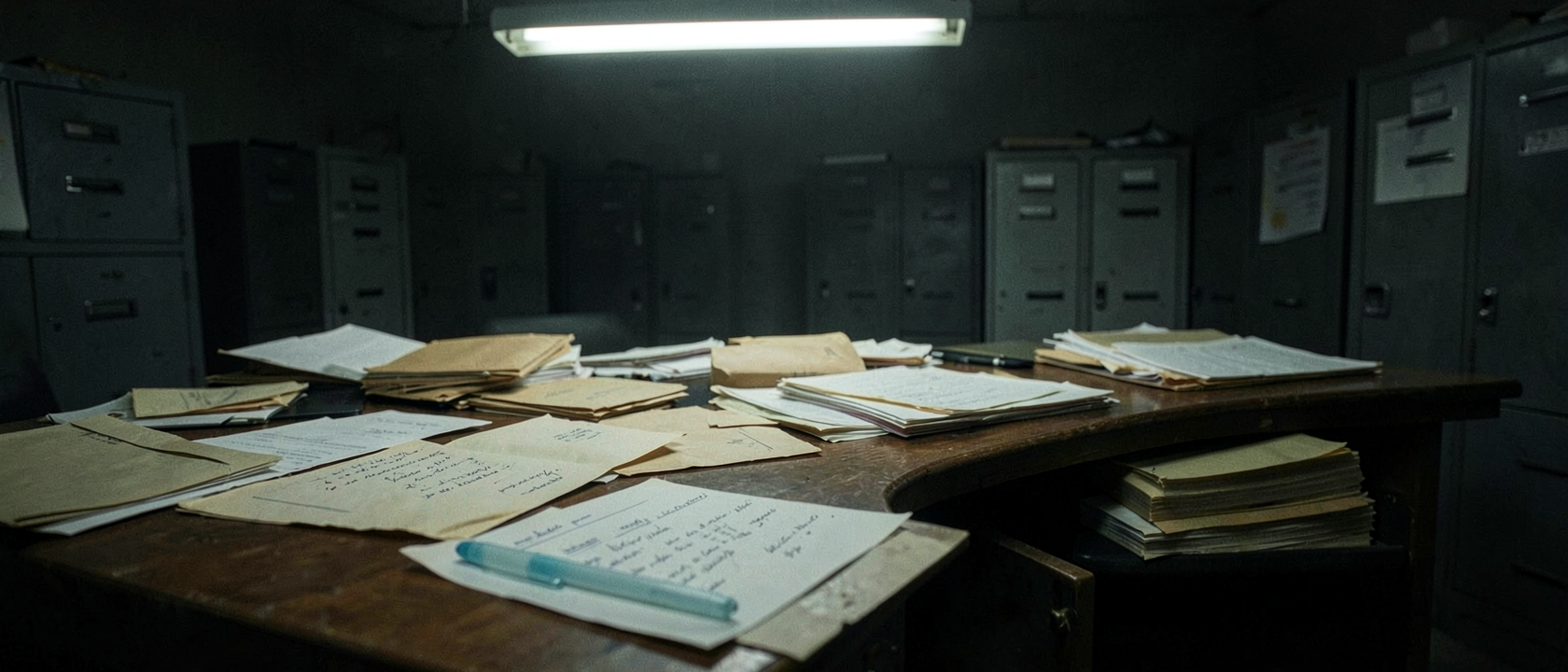
The Blue Ink
On February 24, 1986, a civil servant named David Willetts sent Prime Minister Margaret Thatcher a memo pressing the case for urgent public action on AIDS. The document survives at the National Archives under catalogue reference PREM 19/1863. In the margin, in blue felt-tip pen, Thatcher objected to the phrase “risky sex,” writing that such wording could do “immense harm if young teenagers were to read it.” That annotation is the record: her own hand, on that page, on that date. Whatever else she thought about the wording, if she set it down anywhere else, is not in this file.
The Leaflet That Went to Every Door
Within months, the Cabinet approved a national campaign. “AIDS: Don’t Die of Ignorance” (PREM 19/2775) was mailed in a sealed envelope to every household in Britain by the Department of Health and Social Security, the government body then responsible for public health, in a run distributed between 1987 and 1989. The surviving leaflet text uses the word “AIDS” throughout. It never uses “HIV.” The file does not explain the omission. It may simply reflect the vocabulary available before the viral cause of the disease was in wide public use, but that is a reader’s inference, not a reason the document gives. The leaflet says AIDS. It does not say why not HIV.
Cut for Effect, Cut for Ambiguity
JA 235/57 holds the storyboard for “Monolith,” the campaign’s best-known film, made in 1986 with contributions from Health Secretary Norman Fowler, the agency TBWA and designer Malcolm Gaskin, director Nicolas Roeg, and actor John Hurt. The original storyboard opened with a civil defense air-raid siren. The file notes the scene was cut for being “overdramatic.” In the same folder are mock-ups that were never used, aimed specifically at gay men, one titled “We’ve All Got to Live With AIDS,” in which the HIV status of the men pictured is left deliberately unclear. Both decisions are recorded as decisions. Neither file says why ambiguity, rather than clarity, was chosen for that audience.
A Complaint Nobody Answered
JA 235/10 preserves material from a 1986 meeting between the English Collective of Prostitutes and government officials. The group raised a specific fear: that carrying condoms could be used by police as evidence of soliciting. The concern is logged. No reply, resolution, or policy change tied to it survives in the file. That is not a hidden answer. It is paperwork that stops.
The Survey Britain Didn’t Pay For
In 1989, the Economic and Social Research Council, the survey body SCPR, and the Health Education Authority approached the Department of Health to co-fund a national survey of British sexual attitudes, at a proposed cost of £200,000. Departmental papers show the request was declined under the direction of Thatcher’s government. No reason for the refusal appears in the surviving record. In 1990, the Wellcome Trust funded the same research independently, at a cost of £900,000, producing the first National Survey of Sexual Attitudes and Lifestyles, still conducted every decade. The reversal happened outside government. Nothing in the file records a change of official mind, only a different funder.
What the Files Never Say
Three threads end without a resolution on paper. Whether “Smart Susie,” a Midlands leaflet using a traffic-light system to advise young women on safer sex, was ever formally adopted, or how widely it circulated, is not recorded. The AIDS Advertising Evaluation dataset (BN 97/1), drawn from four survey waves run among roughly 700 people between February 1986 and 1987, survives, per the archive’s own description, only “partially reconstructed.” How much is missing, and what was lost, is not stated. And the Rubber Stuffers, a volunteer group turned small supplier delivering safer-sex packs to 22 London pubs, sought government support in 1993 and met resistance, according to JA 235/273, for reasons the file does not give. None of this is evidence that anything was concealed. It is evidence of paperwork that was never finished, or never kept.
What Gaskin Remembered
In a 2017 interview with The Guardian, campaign designer Malcolm Gaskin recalled that “nobody knew anything about it,” and that AIDS at the time felt, in his words, “like an alien plague.” That is a recollection, made decades after the events, not a line from any file. PREM 19/1863, PREM 19/2775, and JA 235/57 read as procedural documents: a memo, an edited leaflet, a storyboard with a cut scene. None of them use the language Gaskin used in 2017, and none describe the atmosphere he remembers. The record and the memory sit next to each other in the archive. Nothing in the paperwork confirms or contradicts what he says he felt.
Where the Trail Ends
The files trace a specific chain: a memo urging urgency, a prime minister’s pen in the margin, a leaflet through every letterbox in the country, an advert cut and reshaped, a complaint filed by sex workers, a survey the government would not fund and a private trust that did. What the files do not show is what happened after each of those points on paper: whether the leaflet changed behavior, whether the sex workers’ concern was ever addressed by policy, why funding requests from grassroots groups met resistance the record does not explain. The documents are held at the National Archives under the references given here. Where the paper trail stops, it stops; nothing in these files says what came after.