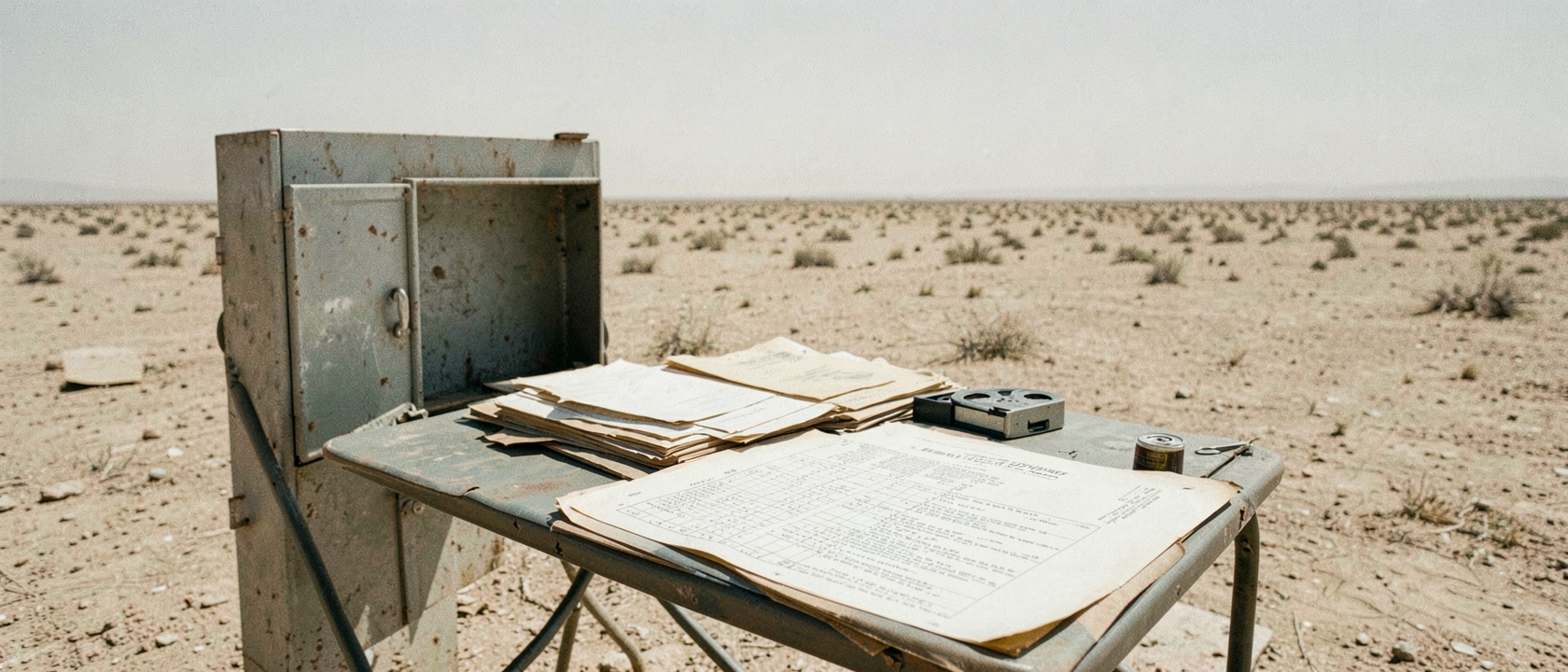
A Placeholder Title in an Official File
One document in the tranche of nuclear test veteran records now reaching the National Archives carries the catalog title “qwertyuiop.” That isn’t a code name. It’s what a keyboard produces when someone runs a hand along the top row instead of typing an actual description, and nobody goes back to fix it. The National Archives’ own guide to the series says plainly that some original titles are inaccurate or meaningless, and that the descriptions are being kept as they were entered rather than tidied up after the fact. The database this comes from was never meant to be tidy. It was meant to be searchable, fast, under legal pressure.
The Guide, and What It’s For
The National Archives has published a guide to series ES 38, “Atomic Weapons Establishment: Merlin Records Concerning Nuclear Test Veterans and the Nuclear Testing Programme,” covering material dated 1946 to 2008. It describes the Merlin Database, a body of scanned and indexed files compiled by the Atomic Weapons Establishment (AWE) between 2006 and 2008 at the request of the Ministry of Defence (MOD). Transfer to the Archives began in September 2025 and is arriving in tranches rather than as a single deposit; MOD and AWE expect the full transfer to take about a year from that starting point. Related material sits in the wider ES series, in AB (the UK Atomic Energy Authority), and in DEFE 16 and FCO 1, which hold photocopies of evidence given to an earlier Australian Royal Commission. A guide like this exists to tell a researcher what a series contains and where else to look. It doesn’t exist to report a conclusion, and this one doesn’t try to.
What the Database Was Built to Answer
In 2005, around 1,000 veterans of the UK’s atmospheric nuclear tests brought legal proceedings against the MOD, alleging negligence across a dozen distinct areas: knowledge of radiation risk, protective equipment, safe-distance guidelines and where personnel were actually positioned during detonations, warnings given at the time, post-exposure guidance, and long-term health monitoring, among others. AWE compiled the Merlin Database in response, sorting documentary evidence into those twelve subject categories, then adding a thirteenth to catch anything else reviewers judged relevant. What emerged wasn’t a history of the testing program, but a filing system, built so the MOD’s Veterans’ Policy Unit, the Deputy Chief of Defence Staff for Personnel and Training, and the Treasury Solicitor, the government’s own legal office, later renamed the Government Legal Department, could locate specific documents fast, against specific allegations, for one specific case.
What the Guide Confirms It Draws On
According to the guide, the material folded into Merlin includes wartime and pre-test knowledge of radiation risk, contemporaneous risk assessments, and documents connected to the Royal Commission into British Nuclear Tests in Australia, held in 1984 and 1985 and generally known as the McClelland Commission. The first tranche has passed sensitivity review, the check AWE and MOD run against information-rights and national-security rules before release, and has been cataloged OPEN on Discovery, the Archives’ searchable online catalog, meaning it can be viewed without an application. That’s the closest the guide comes to a finding: a description of what the collection contains and where it came from, not a judgment on the allegations that caused someone to compile it.
Why the Silence Isn’t Suspicious on Its Own
A cataloging guide describes the shape of a series. It isn’t designed to record how the underlying legal case was resolved, whether by settlement, judgment, or withdrawal, and an outcome like that would normally live in entirely different records, if it survives in archival form at all. Reading the absence of a verdict here as evidence of something hidden mistakes what this kind of document is for. It was built to describe the contents of a box, not to report on how the underlying dispute came out.
Where That Explanation Runs Out
What it doesn’t explain is why no trace of an outcome turns up anywhere in the material released so far, or why a database built explicitly to answer thirteen named allegations contains, on the public record, no cross-reference back to how those allegations were resolved. This is an open gap in the paperwork, not evidence of concealment. Most of the transfer, expected to take about a year from its September 2025 start, simply hasn’t arrived yet. But it’s a specific, nameable mismatch between what the database says it was for and what a researcher can currently trace through it.
The Practical Limits, As TNA States Them
The guide is direct about its own weak points. There’s no reliable way to search the metadata by an individual veteran’s name unless that name happens to appear in a filename or an author field. Some catalog descriptions, the guide acknowledges, contain plain indexing errors, “qwertyuiop” among them, and TNA has chosen to preserve them rather than quietly correct them, on the grounds that fixing the metadata would alter the record itself. A separate parliamentary statement from May 2024 put the underlying database at over 28,000 records; the guide gives no comparable total of its own, a small mismatch between two official descriptions of the same collection.
The Question the Guide Doesn’t Ask
Nowhere in the published guide does the National Archives state how, or whether, the twelve original allegations were resolved. Not settled, not dismissed, not still contested. The document simply doesn’t go there. That silence isn’t a fact about the litigation. It’s a fact about the paperwork: an archive, still arriving a tranche at a time, that stops exactly at the edge of the question it was assembled to help answer. Anyone who has spent time with records like this will recognize the difference between a document that hides something and one that was simply never asked to say it. That distinction is the whole of what’s on offer here, and it’s worth holding onto.