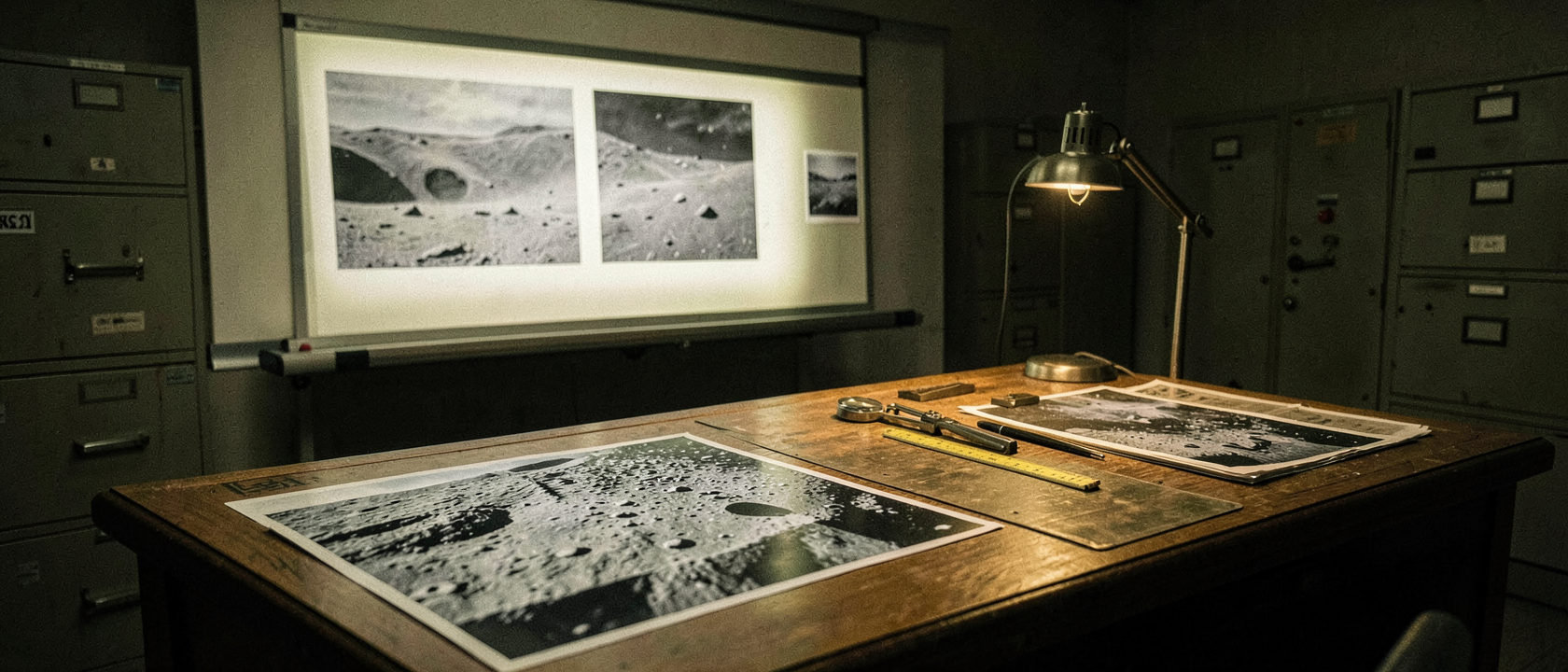
A spacecraft landed on the Moon in February 1966, survived the landing, and sent back pictures of the ground underneath it. Months later, an American intelligence office produced a short technical report about the camera that had taken those pictures. It is a document about a camera, measured from the outside, by analysts who never touched the hardware.
The document
The report is titled “Preliminary Analysis of Luna-9 Photography,” filed under the reference NPIC/R-5017/66 and produced by the Technical Intelligence Division of the National Photographic Interpretation Center (NPIC), a U.S. imagery-analysis unit whose surviving records are now held by the National Geospatial-Intelligence Agency (NGA). It is dated June 1, 1966, was commissioned under an internal CIA tasking numbered C-DS6-83,440, and carried an original classification of Secret, one tier below Top Secret. It was marked to exclude it from automatic downgrading or declassification, meaning release required a specific review rather than the simple passage of time. This is an internal engineering assessment, not a briefing prepared for policymakers.
The incident
Luna 9 reached the lunar surface on February 3, 1966, the first successful soft landing by any spacecraft on the Moon, and returned imagery of the terrain around it. NPIC’s report set out to determine the camera’s and lander’s specifications independently of anything already published, using three kinds of material: the transmitted panoramas, telemetry from the flight, and photographs of a Luna 9 exhibit model photographed on the ground.
What the analysts derived
The report gives the camera a 360-degree azimuthal, or horizontal, field of view and a 30-degree vertical field of view. It measures the tilt of the camera’s scanner rotation axis across four readings taken on February 4, 5, and 6, 1966: 16 degrees, 17.5 degrees, and 22.5 degrees twice, each carrying a margin of error of plus or minus 1.5 degrees. It also calculates the spacecraft’s own axis of movement, using as a fixed reference point what the report calls a foot on the lander body with a prominent protuberance. The Black Vault’s account of the report puts that axis at roughly 35 degrees relative to the feature; the precise figure does not appear clearly in the surviving text of the report itself. All three results come from the same method: checking the panoramas, the model photographs, and the telemetry against one another, treated as routine.
What NPIC said this was for
The report states its purpose without ambiguity: to provide information on the camera system, the spacecraft, and the lunar surface independent of previously published Soviet and U.S. data, so the figures could stand on their own. No controversy is named anywhere in the text, and no discrepancy is flagged. This reads as ordinary technical due diligence, the kind NPIC would have run on any comparable piece of foreign space hardware that had produced usable imagery. The report even calls its own numbers preliminary and subject to refinement, phrasing that fits an agency checking its own math, not building a case.
What still doesn’t fit
Several things in the report do not resolve on the page. Three concern the numbers themselves. One concerns the paperwork that carried them.
The tilt that moves
The scanner-axis tilt is the plainest unexplained figure in the document. It rises from 16 degrees to 17.5 degrees to 22.5 degrees across three days in February 1966, and the report gives no account of why, whether the instrument drifted, the lander settled further into the surface, sessions were calculated differently, or something else. The numbers are stated. Nothing behind them is.
The comparison that never happens
The report’s stated purpose is to check its work against previously published Soviet and U.S. data. It never says what that published data claimed. There is no citation, no appended table, no footnote naming a source. A reader cannot tell whether NPIC’s figures confirmed what had already been said, contradicted it, or arrived somewhere nobody outside NPIC had been before. A fuller, non-preliminary version, NPIC/R-5022/66, followed in July 1966 and states that its results corroborated the data given in its own references, without printing those figures, at least not in what has been made public. The comparison the June report promises never appears on its own pages.
An unidentified feature
The 35-degree figure for the spacecraft’s movement axis rests on that single foot and its protuberance, used across several images as a fixed point to measure from. The report never says what the protuberance was, a structural strut, an antenna mount, a marking, or a feature visible only on the exhibit model rather than the real lander, nor how analysts settled on it as reliable enough to build a measurement on. It is the same gap as the missing comparison, on a smaller scale: a number without the working that produced it.
A file released twice
The CIA’s own reading room lists NPIC/R-5017/66 at thirteen pages, released on October 22, 1999, thirty-three years after it was written. The Black Vault, an online archive of declassified U.S. government records maintained by researcher John Greenewald, posted its own copy on March 8, 2024, listing it at fourteen pages and 4.7 megabytes, and describing the release as tied to a Mandatory Declassification Review, a process that lets anyone ask an agency to reconsider whether a specific document should be released. The case number attached to that description, EOM-2019-00951, does not appear anywhere in the CIA reading room’s own metadata for this file, where the case-number field is blank. Neither listing explains why a report released in 1999 would resurface tied to a review case from 2019, or why the two page counts differ.
What this isn’t
The report is not a rebuttal of Soviet claims about Luna 9, nor a U.S. assessment of Soviet space capability, and it names no anomaly for anyone to solve. It is a set of numbers, arrived at by measuring the same object three different ways and letting the results check each other, in a document that promises a comparison it never performs and rests one figure on a feature it never names. The tilt still moves between sessions with no explanation offered. The comparison is still missing. Nobody has published a reconciliation of NPIC’s numbers against whatever the Soviet Union and the United States had already said about the Luna 9 camera, and nothing in the available record shows that anyone went back to try.