
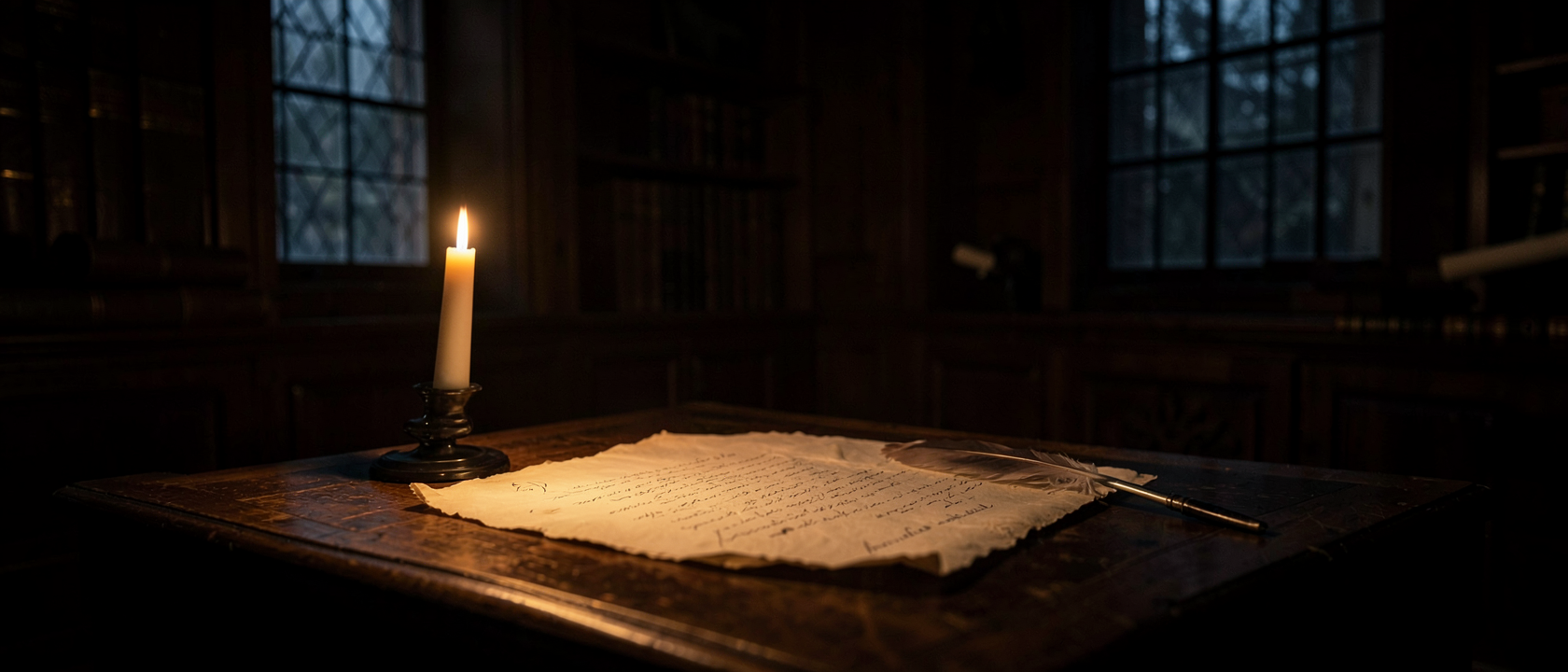
The Letter That Asked to Be Burned
A single sheet of paper, unsigned, written in a hand its own author tried to disguise, sits today at the National Archives in London under the catalog reference SP 14/216. It carries an instruction near its end: burn this immediately. The document survived anyway, legible after more than four centuries, which means the one line it was most insistent about is the one line nobody followed.
What the Archive Holds
The record itself, filed within the collection as SP 14/216/2, is undated and unsigned. The National Archives catalogs it as written on October 26, 1605, but that date comes from the archival description, not from any date written on the letter. The paper does not date itself. The wider collection, known as the Gunpowder Plot Book, is a three-volume set of government documents relating to the plot, and this letter is one item within it. A separate detail, that it was handed to Lord Monteagle’s footman “in the street,” comes from a contemporary account cited by the National Archives. It is not part of the letter’s own text, which says nothing about how it arrived.
What the Letter Says
The letter’s surviving text opens with a warning: “My lord, out of the love I bear to some of your friends, I have a care of your preservation, therefore I would advise you, as you tender your life, to devise some excuse to shift off your attendance at this Parliament.” It goes on to predict that Parliament will receive a terrible blow, and that nobody will see who struck it. It then tells its reader to burn the page once read, on the claim that destroying it would remove the danger. That is the letter’s own logic, stated plainly, with no explanation of how burning a piece of paper was supposed to stop an attack already in motion.
What the Paperwork Shows Happened Next
William Parker, 4th Baron Monteagle, did not burn the letter. He took it to the Privy Council instead. The matter reached Robert Cecil, Earl of Salisbury, and from there King James I, who authorized a search of the Houses of Parliament. On the night of November 4, 1605, Guy Fawkes was found in the vaults beneath the House of Lords with 36 barrels of gunpowder. Under questioning, he admitted that the powder had been placed there for the State Opening of Parliament, scheduled for November 5. That sequence is what the paperwork records. It does not, on its own, explain why the letter was believed.
The Official Answer, Such As It Is
There was no formal inquiry into who wrote the letter. No handwriting comparison or forensic examination of the document appears anywhere in the surviving file. The letter functioned, as far as the record shows, purely as a trigger: it prompted a search, the search found gunpowder and a man guarding it, and the investigation from that point on concerned the plot itself, not the note that had exposed it. That is the ordinary explanation, and it is a reasonable one. A government that has just stopped an attempt to kill the king and much of Parliament has more pressing business than tracing an anonymous tip. Even so, it is worth stating plainly that nobody in the surviving paperwork appears to have asked, on the record, who wrote the letter that started everything.
What the File Does Not Settle
Three things remain open. First, the author is identified in the record only as an unknown party; even Francis Tresham, Monteagle’s brother-in-law and the plotter historians have most often suspected, never mentioned the letter in his own confession after his arrest on November 12, 1605, before he died of natural causes on December 23 of that year. Other names have been proposed by later writers: Mary Habington’s theory, resting on supposed similarities in handwriting, is dismissed by modern historians, while Anne Vaux’s theory, based on the same kind of disputed handwriting resemblance, has never been resolved one way or the other. None of this is settled, and the file does not adjudicate between any of the candidates. Second, the record does not explain why the Privy Council moved so quickly on an undated, unsigned note. Third, no dates survive for the interval between Monteagle’s receipt of the letter and the search that found Fawkes on November 4. The paperwork simply does not cover that stretch of time.
A Secondhand Account of the Delivery
One further detail comes from outside the letter and the Privy Council’s own papers. A contemporary account, cited by the National Archives rather than written into the letter itself, describes the note being handed to Monteagle’s footman as he passed in the street, by an unknown party, in a disguised hand, without date or name. It is testimony about the letter, recorded separately, and it is the source for the one physical detail of the delivery that survives at all.
The Dead End
The letter that asked to be destroyed is the reason this case can be read at all. It has a fixed catalog number, a date assigned by archivists rather than by its own text, and a chain of events it helped set off that ends with an arrest in a cellar and 36 barrels of gunpowder. What it does not have, anywhere in the surviving file, is a name. That is not a hidden detail waiting to surface. It is the state of the record: a document anyone can read, and a blank where the explanation for it should be.