
A Slide, Not a Report
Most of what gets called a “UFO document” in this archive is a single page pulled from a thicker file. The USS Stout material is a clean example of that. Researcher John Greenewald obtained it through a Freedom of Information Act (FOIA) request, the law that lets the public ask federal agencies to release records, and published it through his site The Black Vault on March 2, 2022. He framed it as a flash release, meaning he chose to post the document quickly rather than wait and build a longer piece around it.
The document itself is four pages, about 2 megabytes, titled in the release as “Unidentified UAS Encounter With Navy USS Stout Revealed In FOIA Request on UAPs.” It is a Navy briefing slide: bullet points and photographs built for a room full of people who already knew the background, not a narrative written for an outside reader. That format matters, because a slide and a report are not the same kind of document, and this one never became the second thing.
What the Slide Describes
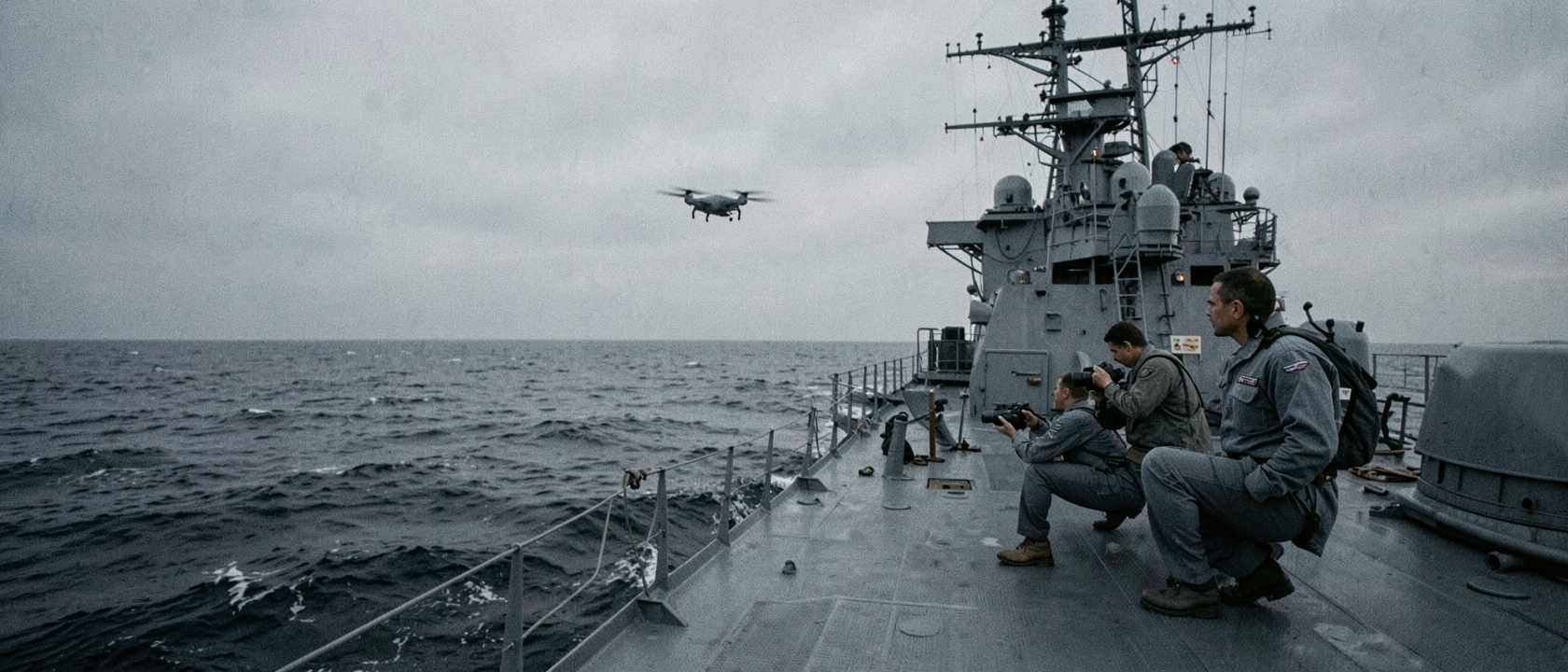
USS Stout is an Arleigh Burke-class destroyer, hull number DDG-55, commissioned August 13, 1994, and home-ported at Naval Station Norfolk as part of Destroyer Squadron 28. According to the slide, around January 2020 the ship’s SNOOPIE team (an acronym for Ship’s Nautical Or Otherwise Photographic Interpretation and Examination, the Sailors assigned to document contacts that come close to the vessel) observed and photographed an unidentified unmanned aerial system.
Two of the three images in the release show what the slide and the photos themselves indicate is a quadcopter-type drone. A third image tied to the same event was released with its content blacked out. That is the entire visual record as published: two visible photos, one withheld, no additional description of altitude, range, or how long the object was in view.
The Only Words the Navy Used
The slide classifies the contact with two pieces of shorthand: “U/I,” for Unidentified, and “STT,” for Single Target Track. Both are standard Navy tracking terms, defined on the slide itself alongside UAS, Unmanned Aerial System. They describe how the contact was logged by a tracking system in real time, not what a reviewer later decided it was. The same two letters would apply to any contact a system couldn’t immediately sort into a known category, drone or otherwise. Read as tracking jargon, “unidentified” says something modest: the system had no match for it at that moment.
What “Unidentified” Doesn’t Mean Here
It’s worth being precise about what the slide does not contain. There is no assessment of who built or flew the object, no statement about intent, and no indication that anyone ever closed the loop on it. “U/I” is a label entered at the moment of tracking, not the output of an investigation. Some Navy and military files do carry a later finding, a sentence that says the contact was resolved as a known aircraft, a balloon, or something else. This one doesn’t. There’s no ordinary explanation to weigh here, and no extraordinary one either, because the record simply stops before reaching a conclusion of any kind.
The Redaction
The third photo was released with its content obscured, and nothing in the material explains why. No classification marking or FOIA exemption code (the legal basis an agency cites for withholding part of a record) appears alongside it in the published version. That absence is a fact about the paperwork, not a clue about the picture. A redaction without a stated reason tells a reader that something was withheld; it tells them nothing about what.
What Isn’t in This File
Beyond the redaction, the gaps are straightforward to list. No operator or source is named for the drone-like object. The slide doesn’t reference other Navy incident logs, and nothing in the release says whether the contact was ever resolved after the fact. Greenewald has stated that more material is expected from the same run of FOIA requests and appeals, which means this slide should be read as one fragment of an incomplete release rather than the full case file on the Stout encounter.
Greenewald on the Paperwork Itself
Separately from the Stout incident, Greenewald has described the Navy’s handling of these FOIA requests as extremely disorganized, pointing to multiple requests getting merged together, inconsistent notice to the people who filed them, and documents showing up in the Navy’s online reading room before the requesters are told. He has also said that Department of Defense review of UAP-related material, required before release, has slowed things down further. That’s commentary on process, made by the person who obtained the file. It describes how slowly and unevenly these records move through the system. It is not a statement about the Stout object itself, and the slide doesn’t connect the two.
What the File Confirms, and What It Doesn’t
Four separate things sit in this record, and they shouldn’t be folded into one. The slide confirms a tracking label, “U/I” and “STT,” entered around January 2020. It confirms no later finding was ever attached to that label. It confirms one photo was redacted without explanation. And it carries, apart from all of that, Greenewald’s unrelated remarks about how the Navy processes these requests. As released, the file ends at “U/I.” Nothing in it says what came next, if anything did.