
The Letter
The paperwork on Agatha Christie’s disappearance comes down to one document. It is catalogued at The National Archives as HO 45/25904, a letter from William Kenward, Deputy Chief Constable of the Surrey Constabulary, to Arthur Lewis Dixon at the Home Office in Whitehall, dated February 9, 1927.
Kenward did not write it to solve anything. He wrote it to brief the Home Secretary ahead of a parliamentary question tabled by MP Neil Maclean, which was answered in the Commons on February 25, 1927. It is a civil-service memo, composed to explain police time and money, not a confession and not a case file.
The Night in Question
As Kenward lays it out for the Home Office, Agatha Christie’s husband Archie had asked her for a divorce, and on the evening of December 3, 1926, the two quarreled before he left for the weekend. That night she kissed her sleeping daughter Rosalind goodnight, got into her Morris Cowley, and drove away from the family home in Sunningdale, Berkshire.
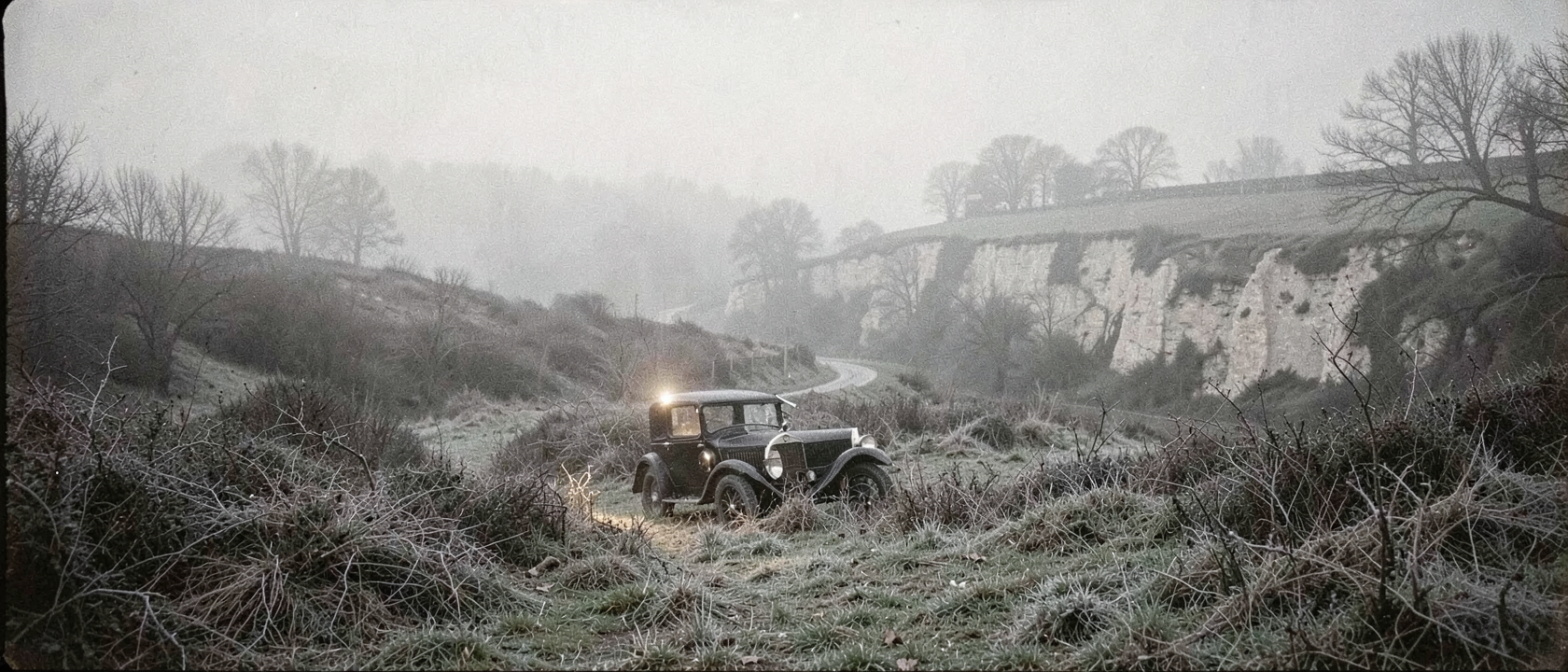
The next morning the car was found abandoned near Newlands Corner, Surrey, partway down a grassy slope, its bonnet lodged in bushes as though it had gone out of control. The headlights were still burning. Inside were a fur coat, a dressing case packed with women’s clothing, and a driving license naming the owner as Mrs. Agatha Christie of Sunningdale.
The Search, by the Numbers
Kenward’s letter sets out the operation in detail: an initial search on the afternoon of December 4 and through December 5 and 6 with seven or eight regular officers, Special Constables, and civilian volunteers, followed by a larger effort on December 9 involving roughly three dozen regular police plus Special Constables, with about a dozen volunteers giving up their weekly rest day to help. The total cost, he states, came to approximately £25, almost entirely for hired transport and refreshments for the Special Constables.
At the time, Kenward writes that he weighed three possibilities: that Christie was wandering the Downs with loss of memory, that she had fallen into one of the area’s many hidden gravel pits, or that she had been the victim of a serious crime. The letter states these as the options he considered, not as a finding he reached.
Answering the Critics
The letter’s actual purpose was defensive. Kenward writes to counter press criticism that the search had been overblown, denying specifically that police were drawn from other counties, that the Metropolitan Police were called in, or that aeroplanes had any involvement with the police operation, which he calls “nothing to do with the police.” He adds that press reports on the numbers involved were greatly exaggerated.
That denial matters because it contradicts later popular retellings, including some that describe over a thousand searchers and aircraft overhead, figures that do not appear in Kenward’s own account and that he directly disputes. He also notes, without comment beyond the fact itself, that Archie Christie was asked to contribute to the search costs and refused, saying he considered it entirely a police matter.
The Silence
What the letter does not say is just as notable as what it does. It gives no account of how or why Christie came to be registered at the Swan Hydro hotel in Harrogate under the name Teresa Neele, where she was recognized by a member of the public on December 14, 1926, eleven days after she drove off. It states no cause for her reported memory loss and reaches no conclusion about why she left Sunningdale in the first place.
This is an absence in the paperwork, not a redaction. Nothing in the file suggests pages were removed or withheld. Kenward’s brief was written to account for police time and expense, and on the question of what actually happened to Christie between December 4 and December 14, it simply stops.
The Unconnected Witness
One detail inside the letter never gets tied to anything else in it. A witness named McAlister told police he helped a woman matching Christie’s description start her car at 6:20 a.m. on December 4, describing her as “sparsely dressed” for a cold morning and “strange in her manner.”
Kenward records the statement and moves on. He never connects it, in writing, to the state in which Christie was later found in Harrogate, or to any explanation at all. The witness account sits inside an official document, unresolved by the document itself.
What Was Said Afterwards
None of what follows comes from Kenward’s letter. Biographer Andrew Norman has argued that Christie entered a trauma-induced “fugue” state, a period of memory loss brought on by psychological shock. Others have proposed that her disappearance was deliberate, intended to cause her husband distress and embarrassment. Contemporary press and public talk in December 1926 ran to suicide, to murder by Archie Christie, and to a publicity stunt for her novels.
Archie Christie himself later told inquirers his wife was suffering from a nervous disorder and loss of memory. None of these explanations, favorable or otherwise, is confirmed, denied, or even mentioned in the one document that survives.
What the File Allows You to Know
Kenward’s letter records a car, a coat, a dressing case, a witness, a search party, and a bill for £25. It concludes only that the police response was proportionate to the circumstances as understood at the time, and it lists memory loss, misadventure, and crime as possibilities, not findings. It leaves open why Christie left Sunningdale, why she was in Harrogate under another name, and what caused her reported amnesia. Everything else, the fugue theory, the deliberate act, the rumors of 1926, belongs to what people have said since, not to what the file says.
The record answers for the money. It does not answer for the woman.