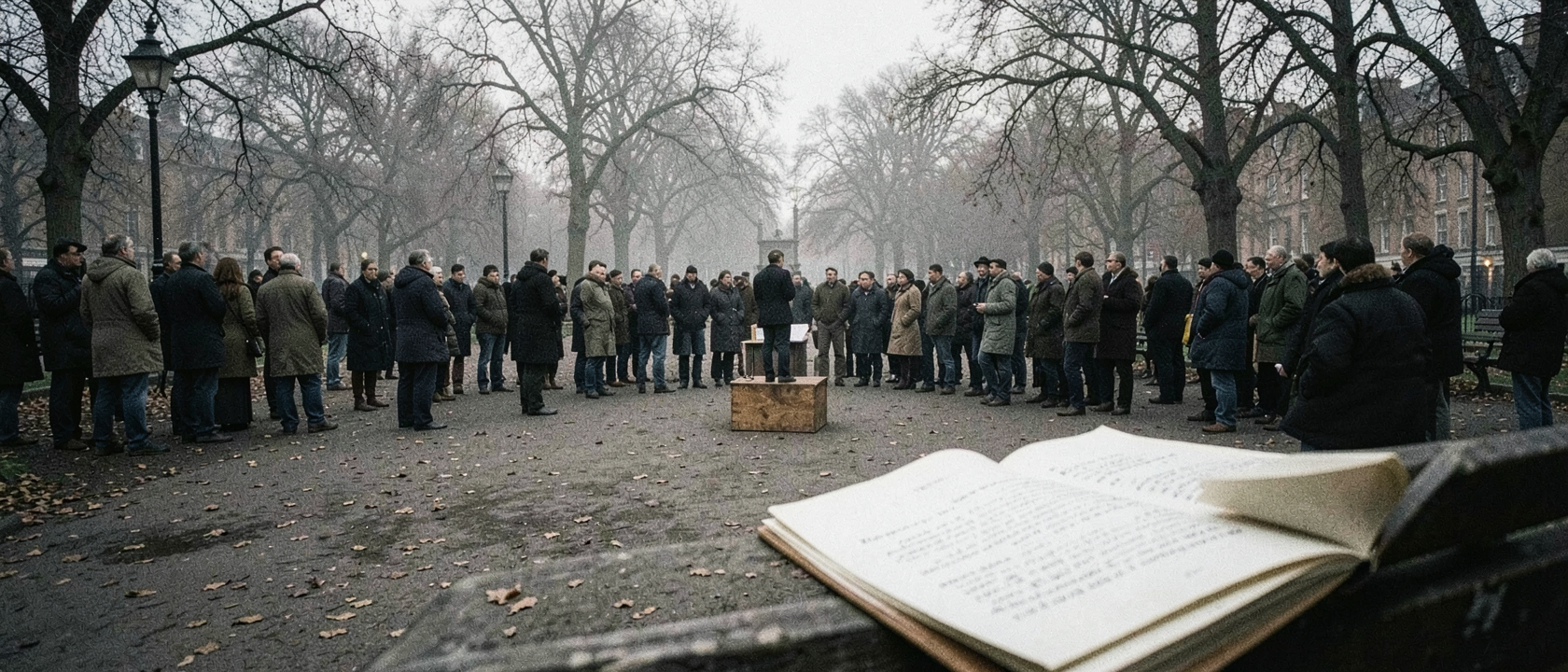
Two versions of the same year
Roy Sawh wrote down what he wanted to say, then went out to Speakers’ Corner in Hyde Park and, according to the men watching him, said something else. Both versions survive, filed together, at The National Archives. The reference is CRIM 1/4777, part of the Central Criminal Court’s records, covering material from 1967 to 1972. Inside sit a printed pamphlet, “From Where I Stand,” written by Sawh in 1967, and a set of handwritten and typed notes made by Metropolitan Police Special Branch officers who monitored his public speeches. The two documents share a shelf mark for an ordinary reason: the police notes were entered as evidence at Sawh’s trial, and trial evidence stays in the case file along with everything else the court had in front of it.
What the pamphlet argues
“From Where I Stand” makes an argument, not a speech. Sawh writes against the color bar, against what he describes as the colonial extraction of Guyana’s mineral wealth, and for solidarity among working people across racial lines. The pamphlet states its own purpose: Sawh wanted to set down, in his own words, “the main points of the speech I should make but never do,” because live crowds at Speakers’ Corner kept steering him off course with questions and heckling. It is a composed, printed text, and it survives in the file complete. The National Archives’ own cataloging note flags that the pamphlet “uses outdated language to describe Black and Asian people,” a comment on its vocabulary, not on its argument.
What the surveillance notes allege
The second document in the file is not a transcript. It is notes: observations written by two named officers, Detective Sergeant Francke and Detective Sergeant G. Battye, watching Sawh address a crowd that questioned and heckled him as he spoke, unscripted, sometime in 1967. According to their notes, Sawh at one point described Black power as “the destruction of the white man’s society,” and the officers recorded his speeches more broadly as misogynistic, anti-Semitic, hostile toward white listeners, and inclined to violence. None of that language appears in the pamphlet. The file does not specify how the notes were taken, only that they exist as a written record made during or after the speeches.
What the court decided
On the strength of that evidence, Sawh was prosecuted under Section 6(1) of the Race Relations Act 1965 for incitement to racial hatred. He was found guilty and sentenced to eight months in prison. The file treats this as settled: no appeal papers, no later inquiry, no correction attached to the record. That is what the court concluded in 1967.
Four things the file does not contain
The disputed passages themselves, the actual sentences the officers say they heard, are not reproduced anywhere in CRIM 1/4777. There is no record of how the court weighed the printed pamphlet against the handwritten notes, or which carried more weight toward the verdict. The file gives no date for the surveillance or the trial beyond the year 1967. And no transcript or summary of Sawh’s own testimony in his defense survives among the papers. Each of these is an absence in what was kept, not a claim about what happened.
A comparison that can’t be checked
A man was convicted partly on the strength of words that survive only as someone else’s notes about them, set against words he wrote himself that survive intact. That is not an argument that the verdict was wrong. It is a statement about what the file lets a later reader verify, which is very little. The court in 1967 could compare the pamphlet to the notes directly and hear Sawh testify. The file that remains does not let anyone check that comparison again.
A parallel drawn later, not in the file
The National Archives’ own cataloging material, published in 2026, links Sawh’s case to the trial of the Mangrove Nine three years later, in which nine Black defendants under Special Branch surveillance were acquitted of the most serious charges, producing the first judicial finding of racial hatred inside the Metropolitan Police. That connection is the Archives’ own framing, made decades after Sawh’s conviction. It is not contained in his file, and the file neither supports nor contests it.
What stays open
CRIM 1/4777 records a conviction. It does not record the reasoning that produced it. The surveillance notes evidently outweighed the pamphlet in the eyes of the court that heard the case, but the file that survives never shows its own working. That is simply what was kept, and what was not.