
The Luddites are remembered mostly for broken machinery. Inside the Home Office’s surviving papers from that period there is something quieter and colder: a written death threat, issued in the name of a king who never lived, filed away with no record of whether anyone ever carried it out.
A single sheet in the Home Office papers
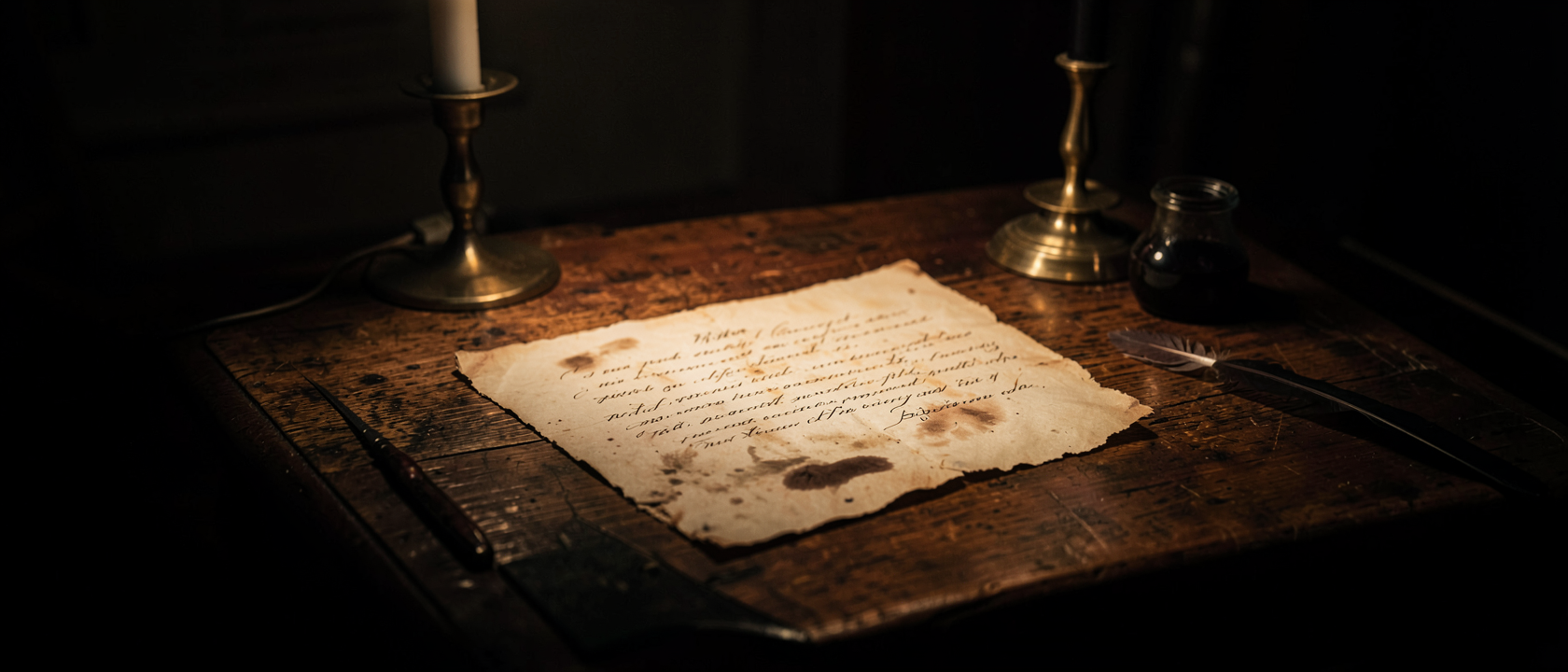
The National Archives holds a document catalogued as HO 42/118, among Home Office correspondence and papers of the period. The item is a single handwritten sheet headed “Ned Lud’s Proclamation,” dated December 23, 1811. The handwriting is tidy, the ink is smudged in places, and a small section has been torn away from the bottom of the page. No author is named on the sheet, and the National Archives’ own catalog lists it as anonymous. The same file also holds an earlier threatening letter signed by Ned Lud, dated November 8, 1811, alongside other Home Office correspondence from that December.
A separate scholarly account of the file describes the surviving sheet as a clerk’s copy rather than the original notice that would have been posted or circulated. When that copy was made, or by whom, is not recorded.
“King Lud” was not a real person. The National Archives describes Ned Ludd, also styled King Ludd or General Ludd, as a legendary, invented figurehead used by Luddite activists rather than a documented individual. That matters for everything that follows: the order is issued in the name of someone who did not exist, which is one reason the person who actually drafted it was never going to sign it.
What the proclamation says
The text, as transcribed by the National Archives, reads:
“I do hereby discharge, all manner of Persons, who has been, employ’d by me, in giveing any information, of breaking Frames, to the Town Clerk, or to the Corporation Silley Committee ~ any Person found out, in so doing or attempting to give any information, will be Punish’d with death, or any Constable found out making any enquiries, so has to hurt the Cause of Ned, or any of his army, Death (by order of King Lud).”
The National Archives’ transcript marks the remaining text as illegible, and the page itself is torn below that point. What was written there is not recorded anywhere else and is not guessed at here.
The paragraph does two things at once. It releases anyone who had previously passed information about frame-breaking to the Town Clerk or the Corporation Silley Committee, both named as the proper channels for such reports, from any further obligation to inform. And it threatens death to anyone who gives such information going forward, and to any constable whose inquiries threaten “the Cause of Ned” or “his army.”
The period it belongs to
The proclamation dates from the start of the Luddite disturbances, which began in Nottinghamshire in 1811 and spread through 1812 into the West Riding of Yorkshire and Lancashire, later reaching Leicestershire and Derbyshire. Machine-breaking itself was older than the Luddites, traceable back to the second half of the seventeenth century, but this was the period that gave the practice its name and its politics.
The clearest documented outcome of the authorities’ response came more than a year later, at a Special Commission held at York in January 1813. Seventeen men were hanged for Luddite-related offenses, and others were sentenced to transportation to the British colonies.
The proclamation is not part of that trial record. It is one surviving artifact from the same stretch of unrest, filed under its own reference, with no stated link to any of the men tried or executed at York. Nothing in HO 42/118 connects a named individual to this sheet, and nothing in the York Commission’s record cites it. The document and the hangings belong to the same history, but no source reviewed here shows them belonging to the same case.
How the archive frames it
The National Archives presents the proclamation as evidence of an internal code of secrecy, a way the Luddite movement tried to protect its own members from charges that, under the Frame Breaking Act, could carry the death penalty for the act of machine-breaking alone. Read that way, the document is less a public threat than an attempt to seal off cooperation with the authorities from within the movement itself.
That reading is a claim made about the document after the fact. The proclamation does not explain its own purpose; it simply discharges, forbids, and threatens.
Other commentary on the period notes that Luddism was not one single underground current. Alongside the machine-breaking, there was also formal petitioning, workers and their supporters appealing through lawful channels against wage cuts and mechanization. The proclamation belongs to the harder edge of that movement, not to the whole of it.
What the document does not tell you
Four things about HO 42/118 are simply absent from the record.
No author is named, and none can be inferred, since the proclamation speaks in the voice of a man who never existed.
Part of the text is illegible, and part of the page is physically torn away. What those missing words said is unknown.
There is no record of whether the threats were ever carried out, against any informer or any constable, named or unnamed.
And there is no account of how the proclamation circulated after it was written, or how a government office came to hold what appears to be a clerk’s copy of it.
These are gaps in the paperwork. A missing page or a torn corner tells you something happened to the document, not something happened to a person.
Where it stops
HO 42/118 is a death threat with no attached outcome: no named victim, no conviction, no confirmation that it ever reached anyone beyond the Home Office desk where it was filed. It sits in the archive exactly as it was written, by order of a king who did not exist, for a cause that history remembers mainly for broken machinery and, at York Castle in January 1813, for a gallows. What happened between the sheet of paper and the rope is not something the file records. The file ends there, with no further record.