
The Request
A Freedom of Information request submitted to The National Archives on behalf of an unnamed requester asked for four distinct things about a single file, nothing more. The request was logged under reference CAS-318762 and resolved on March 3, 2026, with the status “some information provided.” Set out plainly, the four questions were:
- When was file ES 1/956 made accessible to the public?
- Had the file ever been withdrawn from public access, and if so, when and why?
- How many pages does the file contain in total?
- What is the current status of any material withheld under Section 3(4) of the Public Records Act 1958, the provision that lets a government department keep part of a record back when it transfers the rest to the archive?
Each question asked for a fact or a status, not an account.
The File
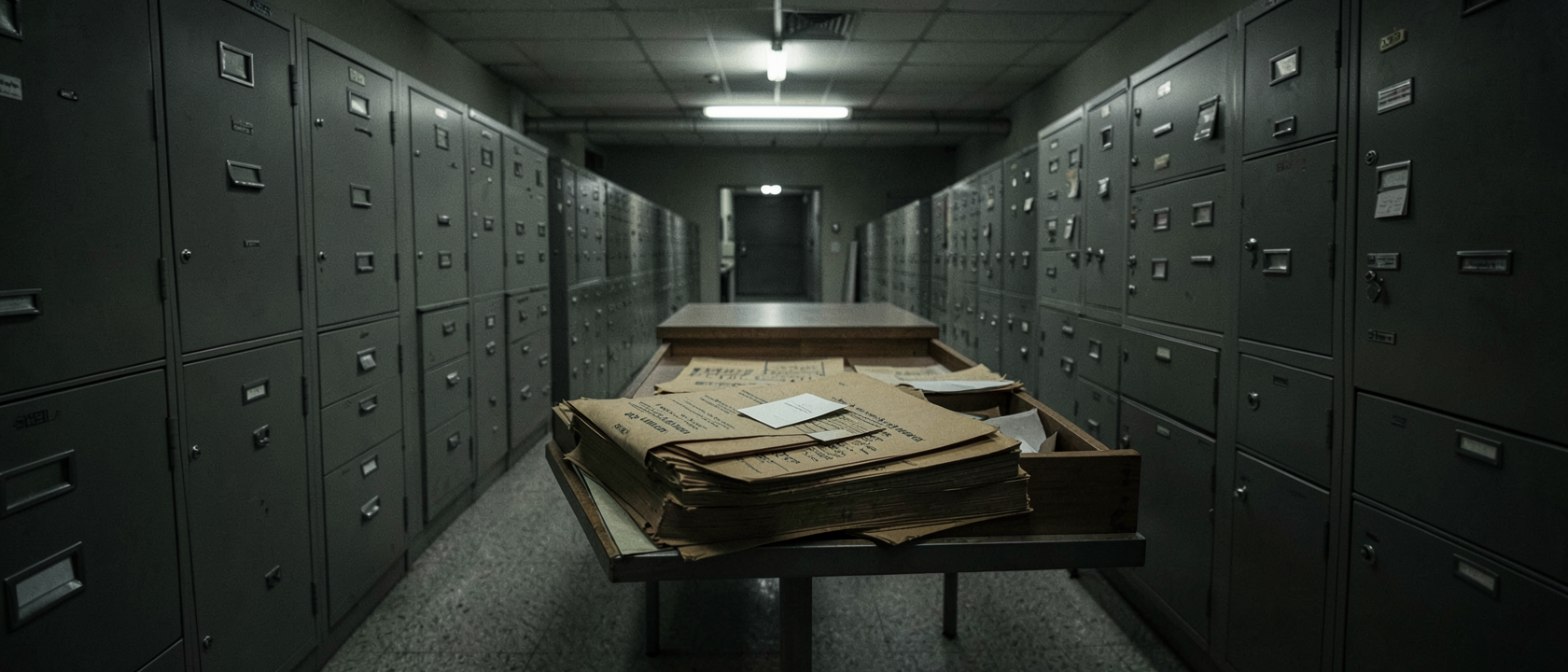
ES 1/956 is a file at The National Archives whose origin documents are dated 1958. It was opened to the public in August 1997. At the point of opening, certain pages inside the file were withheld, and in their place the archive inserted what are called “dummy cards”: physical placeholders that record only that material has been removed and retained by the transferring department. A dummy card marks an absence. It does not describe what was taken out, how much of it there was, or why. In ES 1/956, the transferring department named on those cards is the Ministry of Defence.
The 2018 Withdrawal
In July 2018, the Ministry of Defence asked The National Archives to place the entire ES series, including ES 1/956, under review and withdrawn from public access, so that it could be assessed for sensitivity. The series was withdrawn from public access. A review followed. At some later point, ES 1/956 was returned to The National Archives and is now classified there as an open record. No date for that return is given anywhere in the response to CAS-318762, and no summary of what the review covered or concluded, for this file specifically, has been published. The record states that the review happened and that the file came back. It does not say when, or on what basis.
What The National Archives Actually Said
Answering CAS-318762, The National Archives confirmed the 1997 opening date and the 2018 withdrawal and return. On the other two questions it was equally direct in a different way. It states that it does not hold a record of the total page count for ES 1/956, and suggests the only way to establish that number is to view the file in person at the reading rooms at Kew or to request a formal page check. On the withheld material, it states that this information is not held by The National Archives at all, since the pages themselves sit with the Ministry of Defence, and it directs the requester to apply to the MoD directly. It adds that it will not be forwarding the request on the requester’s behalf. That is the finding, in full: not an assessment of the withheld pages, but a statement that the archive is not the body that can make one.
The Ordinary Explanation
None of this is unusual by itself. Records transferred under the Public Records Act 1958 are routinely split this way: a department judges part of a file too sensitive to pass over, keeps that part, and the archive holds a card marking the gap rather than the content. Across the wider ES series, 1,751 records in total, 1,003 were retained by the Ministry of Defence when the series was placed under review, a scale that makes clear this is standard administrative practice, not something particular to ES 1/956. Files get divided between custodians for reasons as unremarkable as departmental turf or paperwork that was never fully completed at transfer.
What does not sit cleanly inside that explanation is the timing. The material in ES 1/956 was already judged sensitive enough to withhold in 1997. In 2018, twenty-one years later, the entire series was pulled again for a fresh sensitivity review, on paperwork that originates in 1958. That is two separate judgments about the same underlying material, decades apart, with no public account of what changed in between to warrant the second look.
The Gap
Three things are simply not recorded anywhere in this file’s trail. The exact number of pages withheld from ES 1/956 is not stated; The National Archives says it does not hold that figure. The specific findings of the 2018 review, as they applied to this file, are not detailed; only that a review took place and the file was later reopened. And whether any security rationale from 1997 still applies to documents dated 1958 is not addressed one way or the other. None of these gaps describes what is in the withheld pages. They describe what the paperwork does not say.
The Requester’s Claim
After receiving the response, the requester argued that since the documents are now sixty-eight years old and were last reviewed twenty-nine years ago, it seems unlikely that any legitimate national security justification still applies. That is the requester’s own reasoning, offered as commentary rather than part of the formal request. Neither The National Archives nor the Ministry of Defence has responded to it, corroborated it, or rebutted it on the record.
Where It Sits
What ES 1/956 contains cannot be stated, not even its page count. What the 1997 and 2018 reviews concluded is not detailed anywhere public; only that each happened and that the file was, at some point, returned. What remains open is the page count, the substance of the 2018 review, and whether the original 1958 material still carries any rationale for withholding. What has been said afterward is one requester’s inference, that enough time has passed for the justification to have lapsed, left unanswered by either institution named in the file. The pages themselves remain with the Ministry of Defence. The dummy cards remain with The National Archives. Between the two sits the file, open and unread in the one place that still cannot say what it is missing.