
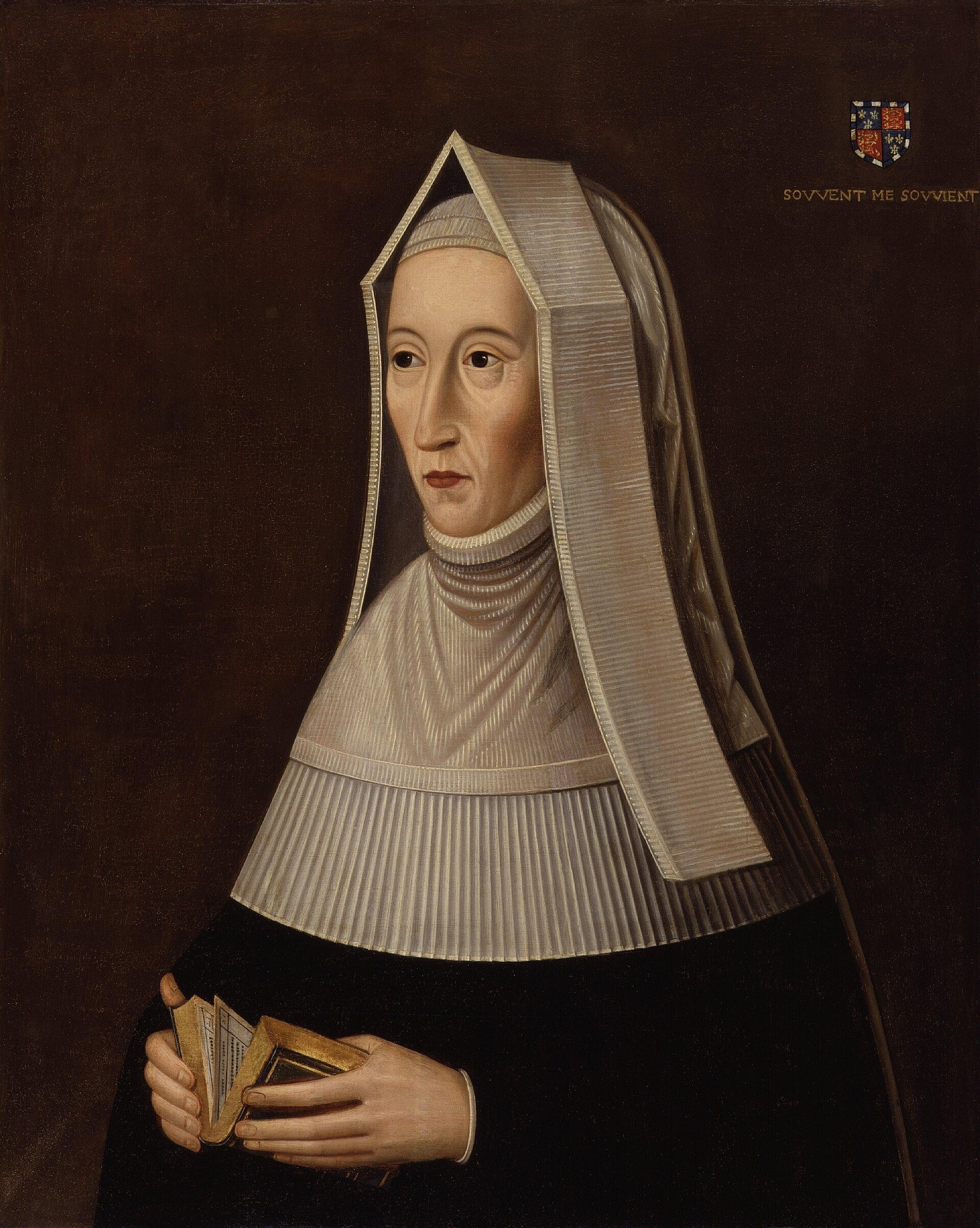
Margaret Beaufort was an English noblewoman, philanthropist and educator whose son became King Henry VII, founder of the Tudor dynasty. Born on 31 May 1443 in Bedfordshire, she was the only child and heiress of John Beaufort, 1st Duke of Somerset, and Margaret Beauchamp of Bletsoe. Her family name came from John of Gaunt, Duke of Lancaster, through his illegitimate son by his mistress Katherine Swynford, taken from Gaunt’s castle in the Champagne region of France. She married four times over her life and used her wealth to endow education and religious institutions. Margaret died on 29 June 1509 at Westminster, two months after her son.
Key facts
- Born: 31 May 1443
- Birthplace: Bedfordshire
- Died: 29 June 1509
- Place of death: Westminster
- Country: Kingdom of England
- Occupation: philanthropist; educator
Early life and marriages
Margaret’s father died in disgrace, possibly by suicide, when she was a year old, and she became a ward of William de la Pole, Marquis of Suffolk. Suffolk married her to his own son, John de la Pole, but that marriage was dissolved in 1453.
In 1458, shortly after the death of her second husband Edmund Tudor, Margaret married Henry Stafford, second son of Humphrey Stafford, Duke of Buckingham. Stafford died in 1471, and Margaret married a fourth time, to Thomas, Lord Stanley, later 1st Earl of Derby. Across her life she was married four times in total, to John de la Pole, Edmund Tudor, Henry Stafford, and Thomas Stanley.
Path to the throne
Lord Stanley helped Margaret’s son obtain the crown in 1485 by decisively intervening at the Battle of Bosworth, a move that placed her son on the throne as Henry VII. Richard III’s early defender George Buck later accused Margaret and Cardinal Morton of attempting to kill the Princes in the Tower, a claim for which no evidence has ever been found.
Final years and death
After Henry VII died on 21 April 1509 at Richmond Palace, Margaret served as regent and acted as executor of his will, arranging his funeral and the coronation of her grandson, Henry VIII. On 23 June 1509 she watched his coronation procession from a window, only days before her own death.
Her body was moved from the Cheyneygates lodgings to the Abbey Refectory, where it lay surrounded by candles until her burial in the south aisle of Henry VII’s chapel on 9 July 1509. The Latin inscription on her tomb monument at Westminster Abbey was composed by the scholar Erasmus. The inscription also notes that she funded salaries for three monks at Westminster Abbey and a preacher for the whole of England.
Patronage and legacy
Margaret was patroness of William Caxton, England’s first printer, supporting the spread of printing in England. St John’s College, Cambridge, was founded by her estate in 1511, two years after her death, at the suggestion of her chaplain John Fisher.
Lady Margaret Hall, Oxford, the first Oxford college to admit women, was founded in 1878 and named in her honor. The Margaret Beaufort Institute of Theology in Cambridge, a Roman Catholic institution named after her, continues to offer theological education, carrying her name into religious education centuries after her death.
Did you know
- Margaret was married four times in total: to John de la Pole, Edmund Tudor, Henry Stafford, and Thomas Stanley. (patrickcomerford.com)
- Her tomb inscription notes she funded salaries for three monks at Westminster Abbey and a preacher for the whole of England. (westminster-abbey.org)
Data sources
Data updated: 2026-11-27