
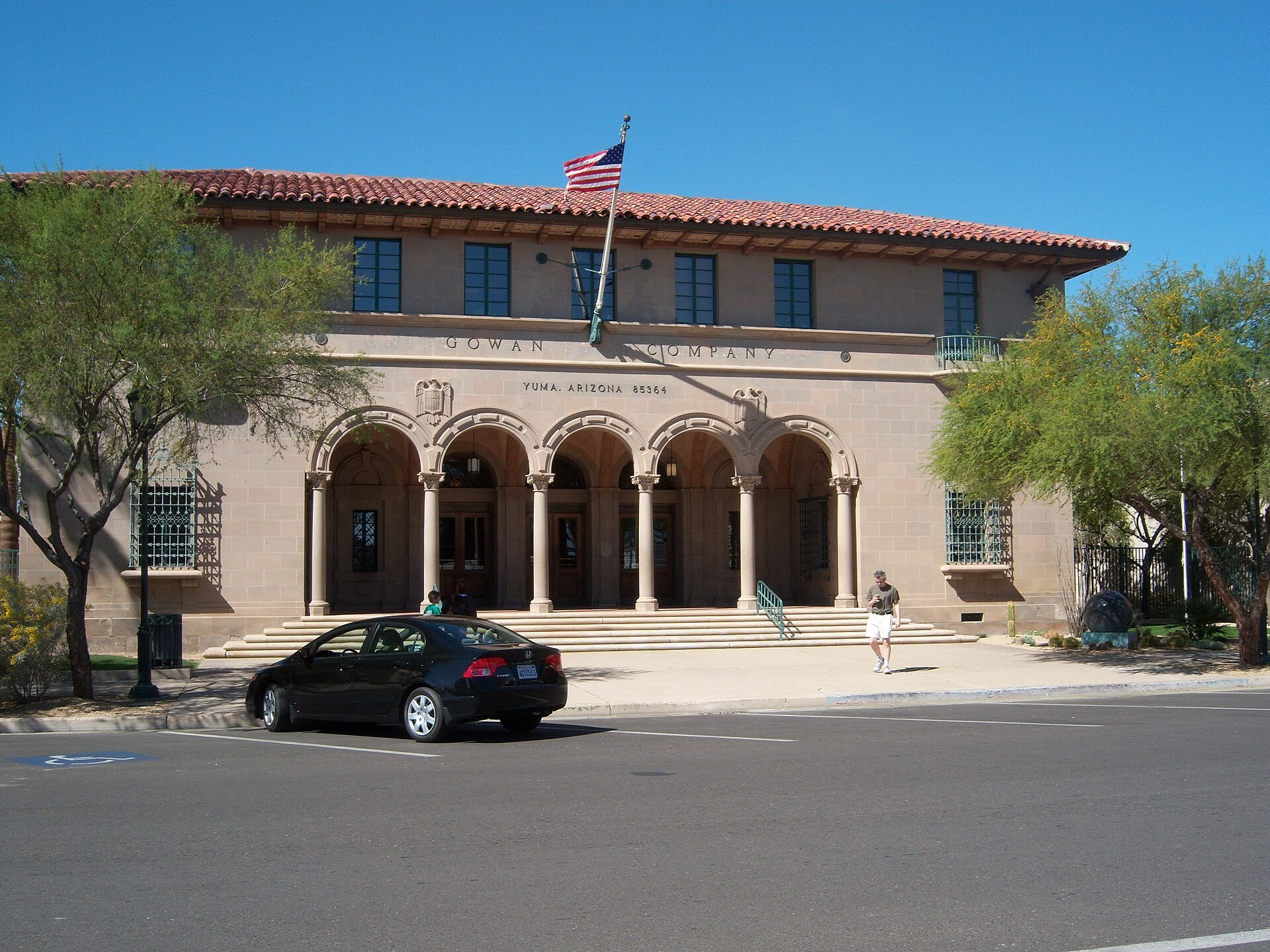
Yuma is a city in and the county seat of Yuma County, Arizona, founded in 1888 near the convergence of the Colorado and Gila rivers, close to the borders of California and the Mexican states of Sonora and Baja California. The city covers about 314 square kilometers and sits at an elevation of 43 meters, with a population of 95,548. It has held the Guinness World Record for sunniest city on Earth since 1967, averaging more than 4,000 hours of sunshine a year. Its economy combines desert agriculture, tourism and a cluster of military testing facilities built up since World War II.
Key facts
- Country: United States
- Type: city in the United States; county seat; border city
- Located in: Yuma County
- Coordinates: 32.6922, -114.6153
- Population: 95,548
- Area: 314 km²
- Elevation: 43 m
- Founded: 1888
Geography and climate
Yuma lies in the southwestern corner of Arizona, in Yuma County, near the point where the Colorado and Gila rivers meet, close to the California line and the Mexican states of Sonora and Baja California. The incorporated city covers approximately 121 square miles within the county, with a total area of 314 square kilometers and an elevation of 43 meters.
The World Meteorological Organization and Guinness World Records recognize Yuma as the sunniest city on Earth, with over 4,000 hours of sunshine a year, about 91 percent of possible daylight hours. The city has held that Guinness World Record since 1967. Rainfall is scarce, at about three inches a year, making Yuma one of the driest cities in the country. Temperatures swing widely: a low of 13°F was recorded in January 2007, and a high of 124°F was recorded on July 28, 1995.
History
The first Europeans reached the Yuma area in 1540, when Spanish expeditions led by Hernando de Alarcon and Melchior Diaz sailed up the Colorado River from the Sea of Cortez. The city was founded in 1888, and Union Pacific Railroad established a line there in 1877, which remains a transportation link to domestic markets.
Civil Aeronautics Administration runways at Fly Field were authorized in 1941, and Yuma Army Air Base was established there, graduating its first pilot classes in 1943. During World War II, General Patton established the Desert Training Center in the region, with more than 1 million men training at camps including Hyder, Horn, Laguna and Pilot Knob. The Army opened the Yuma Test Branch in 1943 near the newly built Imperial Dam to test bridging equipment and synthetic rubber tires. In 1949, with the city’s postwar economy struggling, the Yuma Jaycees staged a publicity stunt attempting to set a record for nonstop flying to promote the area’s year-round flying weather.
The Yuma airfield was reactivated in 1951 as a U.S. Air Force facility, renamed Vincent Air Force Base in 1956, handed to the Navy in 1959, and has been a Marine Corps facility since. In 1995, the Military Free Fall School, which trains special forces parachutists from across the U.S. military, relocated from Fort Bragg, North Carolina, to Yuma Proving Ground.
Military and economy
Yuma Proving Ground spans about 1,300 square miles, one of the world’s largest military installations, capable of hosting up to 100 simultaneous tests. Each year the base sees tens of thousands of artillery, mortar and missile rounds fired, 36,000 parachute drops, over 130,000 test miles driven, and nearly 4,000 air sorties flown.
Agriculture remains central to Yuma County, which grows over 175 different crops year-round and ranks first in Arizona for lemons, tangelos, tangerines, watermelons and cantaloupes. River irrigation projects begun in the early 1900s gave the area its nickname, the Winter Fresh Vegetable Capital of the United States. Tourism to Yuma County generates an estimated gross revenue of over $380 million per year. The city also holds among the most senior water rights on the lower Colorado River, with 789,000 acre-feet of water secured by local entities.
The Arizona Historical Society has partnered with local organizations to revitalize the Sanguinetti House Museum and restore the historic adobe Molina Block, Yuma’s first commercial building.
Did you know
- Yuma has been recognized by the World Meteorological Organization and Guinness World Records as the sunniest city on Earth, averaging more than 4,000 hours of sunshine a year, about 91 percent of possible daylight hours. (nzherald.co.nz)
- Yuma has held the Guinness World Record for sunniest city since 1967. (travelbook-magazine.com)
- In January 2007 Yuma recorded a low of 13°F, while on July 28, 1995 it hit a record high of 124°F. (visityuma.com)
- Yuma receives only about three inches of rain a year, making it one of the driest cities in the country. (visityuma.com)
- In 1949, with Yuma’s postwar economy struggling, the Yuma Jaycees staged a publicity stunt attempting to set a record for nonstop flying to showcase the area’s year-round flying weather. (yumaaz.gov)
- In 1995, the Military Free Fall School, which trains special forces parachutists from across the U.S. military, relocated from Fort Bragg, North Carolina, to Yuma Proving Ground. (yumachamber.org)
- Yuma is nicknamed the “Winter Fresh Vegetable Capital of the United States” thanks to river irrigation projects begun in the early 1900s. (yumachamber.org)
Data sources
Where it appears
- Project Blue Book file: 13 meteorologists over Yuma, unidentified, 1952 November 26, 2026
Data updated: 2026-11-26