
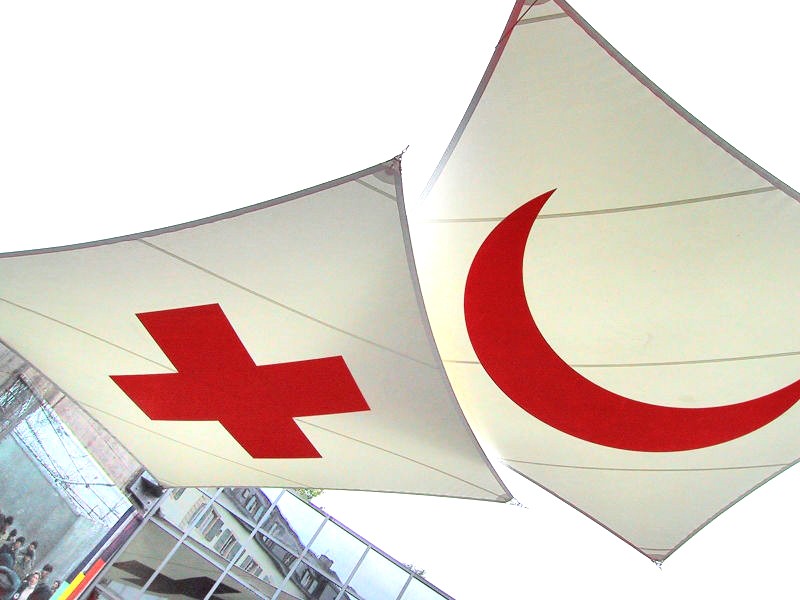
The International Red Cross and Red Crescent Movement is an international humanitarian organisation founded on 17 February 1863 by Henry Dunant, Théodore Maunoir, Gustave Moynier and Guillaume Henri Dufour. It is headquartered in Geneva, Switzerland, and the International Committee of the Red Cross (ICRC) employs 18,000 people. The Movement describes itself as a global network of 80 million members and volunteers helping people facing disaster, conflict, and health and social challenges. It is organised into three components: the ICRC, 191 National Red Cross and Red Crescent Societies, and the International Federation of Red Cross and Red Crescent Societies (IFRC).
Key facts
- Country: Switzerland
- Founded: 17 February 1863
- Headquarters: Geneva
- Founder: Henry Dunant; Théodore Maunoir; Gustave Moynier; Guillaume Henri Dufour
- Type: international non-governmental organization; aid agency
- Employees: 18,000
- Website: https://www.icrc.org
Structure and principles
The Movement is made up of three components: the ICRC, the 191 National Red Cross and Red Crescent Societies, and the IFRC. Its activities are guided by seven Fundamental Principles: humanity, impartiality, neutrality, independence, voluntary service, unity and universality. These were unanimously adopted on 8 October 1965 during the Second Plenary Session of the 20th International Conference of the Red Cross in Vienna, replacing a set the League had adopted unilaterally in 1946.
Swiss jurist Jean Pictet is commonly regarded as the eventual architect of the Fundamental Principles, building on earlier work by Gustave Moynier and Max Huber. Coordination responsibilities among the Movement’s components are set out in the Seville Agreement, which was revised in 2022.
Legal mandate
The ICRC’s mandate stems from the four Geneva Conventions of 1949, their Additional Protocols of 1977 and 2005, and the Statutes of the International Red Cross and Red Crescent Movement of 1986.
History and recognition
The ICRC has won the Nobel Peace Prize three times, in 1917, 1944 and 1963, the last jointly with the League of Red Cross Societies. In June 1944, under pressure from President Franklin Roosevelt, the ICRC wrote a letter of appeal to Hungarian dictator Miklós Horthy, officially breaking its silence on the persecution of Jews.
Starting in February 1945, the ICRC began issuing travel documents to refugees. Recipients included former Nazi collaborators and SS men, among them Holocaust perpetrator Adolf Eichmann.
Current operations
The ICRC supplies electronic and logistic equipment to National Societies, such as the Egyptian Red Crescent, to help people, including Sudanese arrivals, stay in touch with their families.
Did you know
- The Fundamental Principles adopted in 1965 replaced an earlier set of principles that the League had adopted unilaterally in 1946. (blogs.icrc.org)
Data sources
Where it appears
- Britain’s Ratified 1949 Geneva Conventions in File FO 93/1/401 November 25, 2026
Data updated: 2026-11-25