
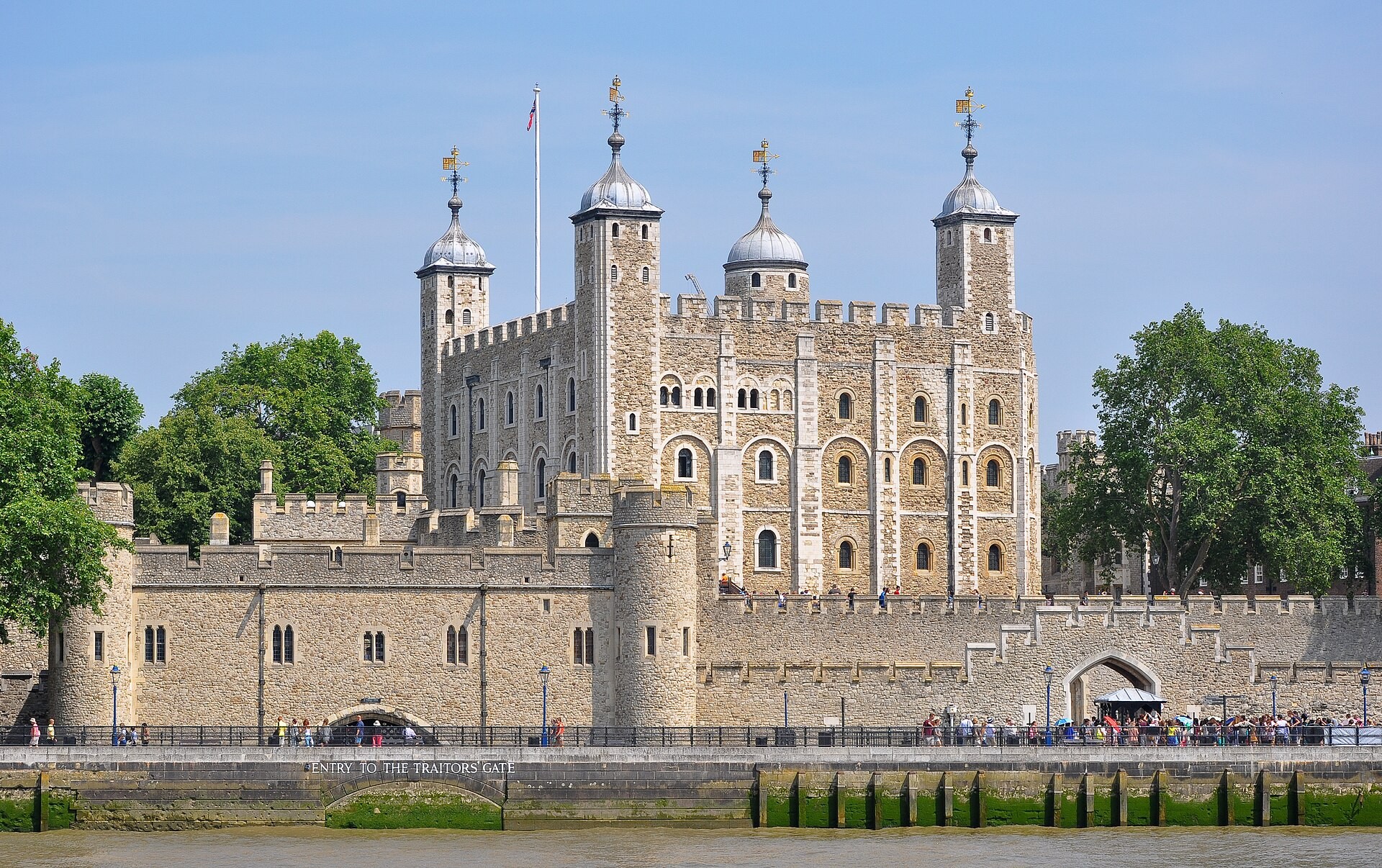
The Tower of London is a castle, museum and archaeological site standing on the north bank of the Thames in the London Borough of Tower Hamlets. Its history begins in 1066, when William the Conqueror had the White Tower built shortly after the Norman Conquest, giving the whole complex its name. Beyond that central keep the site now counts 23 named towers, not including smaller turrets. The castle holds the Crown Jewels, a collection that includes more than 23,000 gemstones, and remains one of the most visited historic sites in the capital.
Key facts
- Country: United Kingdom
- Type: castle; museum; archaeological site; independent museum
- Located in: London Borough of Tower Hamlets
- Coordinates: 51.5082, -0.0762
- Founded: 1066
Building the castle
William the Conqueror began construction of the White Tower shortly after 1066, establishing the stone keep that still gives the fortress its name. The castle grew over the following centuries as successive monarchs added fortifications around it.
King Edward I reshaped the site into a concentric castle, adding a curtain wall that encircled the earlier defences and that separated the royal lodgings from the river. This second ring of walls turned the Tower into a layered fortification rather than a single keep.
From royal residence to monument
James I stayed overnight at the Tower on his entry into London in 1603, and he was the last monarch to do so, marking the effective end of the castle’s use as a royal residence. A 1532 survey of the fortress, carried out ahead of the coronation of Anne Boleyn, described the royal lodgings at the time as “wonderous foul.”
Management of the site passed to Historic Royal Palaces, a body set up by the government in 1989 that became an independent charity in 1998.
The Tower as of 2026
As of 2026, eight ravens live at the Tower: Harris, Jubilee, Poppy, Edgar, Georgie, Chaos, Henry and Poe.
In July 2026 Historic Royal Palaces announced a £70 million revamp called Tomorrow’s Tower, described as its biggest-ever investment in education at the site. The plan includes new learning centres, a community room and a green classroom built in the old moat. On 17 July 2026 Tower Hamlets Council approved planning permission for an ecological transformation of the moat, restoring water features and wetlands there for the first time since the 1840s.
Conservation work on the Middle Tower and causeway, the Tower’s main west entrance, was ongoing as of June 2026, covering masonry repairs, timber works and metalwork restoration. As of October 2026, the Tower’s World Heritage status was under review, after the UNESCO World Heritage Committee raised concerns that nearby high-rise development could damage the castle’s historic setting; the UK Government was asked to report back by February 2027.
Did you know
- A 1532 survey of the fortress, made in preparation for the coronation of Anne Boleyn, described the royal lodgings as “wonderous foul.” (royalpalaces.com)
- The Tomorrow’s Tower project plans to make public an architectural archive of more than 25,000 architectural drawings. (travelwiseway.com)
Data sources
Data updated: 2026-11-26