
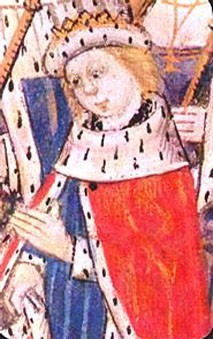
Edward V was king of England for 86 days in 1483, between the death of his father Edward IV and his disappearance as a prisoner in the Tower of London. He was born on 2 November 1470 in sanctuary at Westminster, where his mother Elizabeth Woodville had taken refuge during a period when Edward IV had lost the throne. He never underwent a coronation, and he died in July 1483 at the Tower of London, aged twelve. His case, and that of his younger brother, remains one of the unresolved disappearances in English royal history.
Key facts
- Born: 2 November 1470
- Birthplace: Westminster
- Died: July 1483
- Place of death: Tower of London
- Country: Kingdom of England
- Occupation: politician
- Awards: Knight of the Garter
Birth and early years
Edward was born on 2 November 1470 inside Westminster Abbey, not in a royal palace. His mother, Elizabeth Woodville, had sought sanctuary there while Edward IV was temporarily out of power, and Edward V’s birth took place under those conditions rather than in the usual setting for a royal heir.
Journey to London and the road with Richard
Edward’s household, which included Anthony Woodville and Richard Grey, remained at Ludlow and did not set out for London until 24 April 1483. While travelling the road to London, Richard, Duke of Gloucester, the Duke of Buckingham, and Edward V signed their names and personal mottos together on a scrap of paper. The three entered London together on 4 May 1483.
On 15 June 1483, amid the political turmoil surrounding the young king, Jane Shore, a former mistress of Edward IV, was forced to perform public penance through the streets of London.
The Tower of London
On 16 June 1483, Edward was reunited with his younger brother, Richard, Duke of York, inside the Tower of London. In mid June 1483, the attendants who had been serving the two princes were dismissed. Around the same period, the Duke of Buckingham was made Lord High Constable of England and Robert Brackenbury was appointed Constable of the Tower, placing allies of Richard in control of the Tower. Edward’s physician, Dr Argentine, was reportedly still able to see him even after the princes had been moved into the Tower’s inner quarters.
On 18 July 1483, a royal writ was issued to pay wages owed to thirteen manservants of, in the document’s own wording, “Edward, bastard, late called King Edward V.” In January 1484, Parliament passed the Titulus Regius, formally declaring the marriage of Edward IV and Elizabeth Woodville illegitimate and confirming Richard III as king.
The remains at Westminster Abbey
In 1674, workmen at the Tower of London discovered two skeletons assumed to belong to the princes. King Charles II ordered the bones placed in an urn and interred at Westminster Abbey. The remains interred there as Edward V and Richard, Duke of York have never been definitively identified through modern forensic testing, so their identity remains unresolved.
Legacy
Edward’s elder sister, Elizabeth of York, later married Henry Tudor, who became Henry VII, linking the houses of York and Lancaster. Edward V held the title Knight of the Garter and his occupation is recorded simply as politician, reflecting his brief role as monarch of the Kingdom of England.
Did you know
- Edward V is counted among only three post-1066 British monarchs, alongside Edward VIII and Lady Jane Grey, who were never crowned. (dlab.epfl.ch)
- Edward V’s reign lasted only 86 days, one of the shortest in English history. (medievalchronicles.com)
- The name “The Princes in the Tower” for Edward and his brother was coined by 19th century Victorians. (thecollector.com)
- In 1487, a boy was crowned “King Edward” in Dublin as part of the Lambert Simnel plot, though official records state he was an impostor. (pbs.org)
- Edward V was born in sanctuary at Westminster Abbey rather than in a royal palace, due to his father’s temporary loss of the throne. (explorethearchive.com)
- Painter Paul Delaroche’s 1830 work depicting Edward V and his brother is held in the Louvre in Paris. (thecollector.com)
- A royal writ from 18 July 1483 referred to the deposed king only as “Edward, bastard, late called King Edward V,” reflecting his official disinheritance. (thecollector.com)
- Jane Shore, Edward IV’s former mistress, was forced to perform public penance through the streets of London on 15 June 1483, amid the political turmoil surrounding the young king. (rebeccastarrbrown.com)
Data sources
Data updated: 2026-11-25