
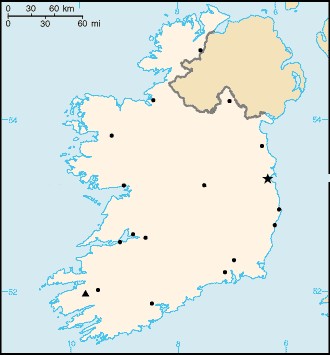
Ireland is a country in Northwestern Europe with a population of 5,149,139 and an area of 69,797 km². Its capital is Dublin, and its official languages are Irish and English. The state took its current constitutional form on 29 December 1937, and its head of state as of this writing is Catherine Connolly. Ireland combines a long history of political change with an economy built heavily around multinational industry.
Key facts
- Capital: Dublin
- Continent: Europe
- Population: 5,149,139
- Area: 69,797 km²
- Official language: Irish; English
- Currency: euro
- Head of state: Catherine Connolly
- ISO code: IE
- Founded: 29 December 1937
Land and climate
Ireland’s terrain is mostly a level to rolling interior plain surrounded by rugged hills and low mountains, with sea cliffs along the west coast. The climate is temperate and maritime, shaped by the North Atlantic Current. The country’s highest point is Carrauntoohil, at 1,041 m, while the mean elevation across the island is 118 m. The coastline runs for 1,448 km.
Path to independence and division
The Easter Rising began in Dublin on April 24, 1916, when Irish republicans proclaimed an independent Irish Republic. British forces suppressed the rising within a week and executed its leaders. The rising’s leaders had armed themselves with Mauser rifles smuggled from Germany, weapons originally intended for earlier Fenian plots.
The treaty that followed the independence struggle divided Irish nationalists and led to the Irish Civil War, fought from 1922 to 1923. Northern Ireland remained part of the United Kingdom. Ireland stayed neutral during the outbreak of the Second World War in 1939, although many Irish citizens joined the Allied forces.
Decades later, the Belfast, or Good Friday, Agreement was signed on April 10, 1998. It established a power-sharing framework for Northern Ireland and created institutions for cooperation between Northern Ireland, Ireland and the United Kingdom.
Economy
Ireland has a high-income, export-oriented economy within the European Union, where its currency is the euro. A large multinational business sector drives growth and tax revenues but also brings volatility risk. In 2024, real GDP at purchasing power parity reached $620.544 billion, with growth of 1.2% that year, following a decline of -5.5% in 2023.
Key industries include pharmaceuticals, chemicals, computer hardware and software, food products, beverages and brewing, and medical devices. Major agricultural products are milk, barley, beef and wheat. The economy collapsed after the 2008 global financial crisis and was later praised internationally for its recovery.
Literature
Four Irish writers have won the Nobel Prize in Literature: W.B. Yeats in 1923, George Bernard Shaw in 1925, Samuel Beckett in 1969 and Seamus Heaney in 1995. In 2010, UNESCO designated Dublin a City of Literature, recognizing its literary history and its ongoing culture of festivals, bookshops and the Museum of Literature Ireland.
Did you know
- Despite being a small island, Dublin alone has produced three of Ireland’s four Nobel literature laureates, making it a city with more Nobel literary winners than any other. (kids.kiddle.co)
- The leaders of the Easter Rising used Mauser rifles smuggled from Germany, weapons originally intended for earlier Fenian plots. (studyguides.com)
Data sources
Data updated: 2026-11-26