
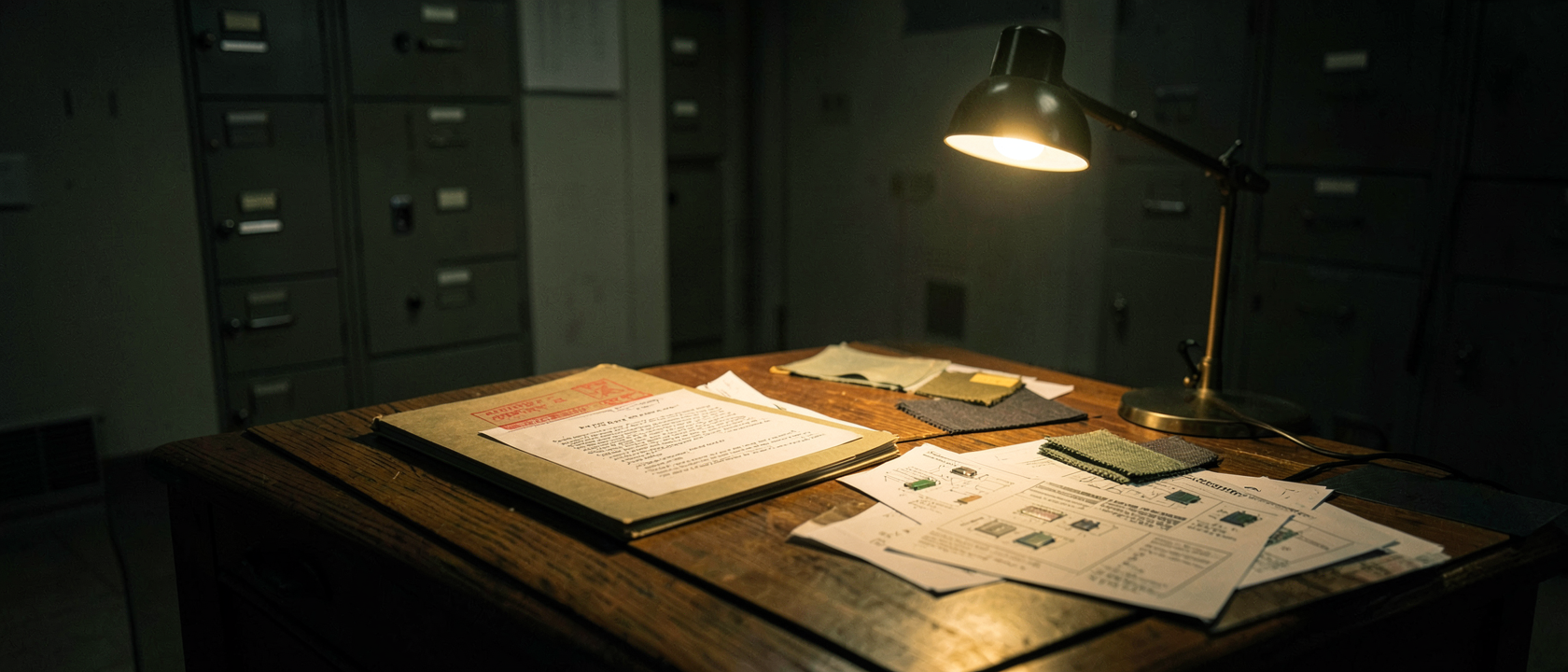
The File
The Defense Intelligence Agency produced a report in 2009 titled “Technology Forecast: Nonconventional Energy Sources for the Future Soldier,” cataloged as DAR 8-350-09. The document surfaced sixteen years later through a Freedom of Information Act request, the legal mechanism that lets the public ask a federal agency to release records it holds, filed by John Greenewald of The Black Vault. The outlet published the file on May 19, 2025. Portions of the text are blacked out under three FOIA exemptions: (b)(1), covering information classified for national defense under Executive Order 13526; (b)(3), covering intelligence sources and methods protected under 50 U.S.C. § 3024(i); and (b)(6), covering the safeguarding of agency functions under 10 U.S.C. § 424. The full scan sits in The Black Vault’s online archive.
The 2030 Soldier, On Paper
The forecast describes a battlefield energy picture built around five ideas. Small nonthermal nuclear batteries, known as betavoltaics, would trickle-charge a soldier’s standard gear during a mission. Uniforms woven with piezoelectric fiber and nanoantennas would turn walking and body heat into current. Vehicles would charge a soldier’s equipment wirelessly at range. Tents would double as solar collectors. Base camps would run sensors off small fuel cells that use bacteria to generate power for years without servicing. A comparison table in the document rates betavoltaic batteries at 131,400 watt-hours per kilogram and microturbines at 1,500 watt-hours per kilogram, against 150 watt-hours per kilogram for a standard lithium-ion cell. The report notes that a microturbine of the same weight as a lithium-ion battery could produce up to ten times the power.
Parallel Research Abroad
The forecast is built almost entirely on open-source material, meaning publicly available research rather than classified intelligence, and it surveys what allied and rival nations were publishing on the same technologies. It names China, Japan, South Korea, Taiwan, and Russia as active in the field. China’s betavoltaic research is described as following U.S. initiatives rather than leading them. South Korea is credited with developing piezoelectric sensor networks. On the American side, the report names the Georgia Institute of Technology as a leader in nanowire piezoelectric work, noting the university’s active collaboration with several Chinese and Taiwanese institutions. The survey makes no claim to be complete, and it reflects only what was publicly findable in 2009.
What the Analysts Concluded
The DIA’s authors stated their own confidence levels plainly. They judged “with high confidence” that the United States would hold technological superiority in these energy fields for five to ten years from 2009. They judged antimatter-based power sources impractical within a 25-year horizon. And they flagged a specific, ordinary pattern worth taking seriously: dual-use technologies, meaning systems with both civilian and military applications, such as solar cells, microbial fuel cells, and wind power, were likely to reach the battlefield faster and cheaper than technologies built for military use alone. The reasoning given is that dual-use systems ride on civilian investment and infrastructure that is already moving, rather than needing a defense budget to build a market from scratch. This is a conclusion about 2009, made in 2009. The document does not revisit it.
The Redactions
The three exemption categories cited describe what kind of information was removed, not what the information was. Under (b)(6), the withheld material is tied to agency functions rather than, as some readers might assume, personal privacy. Elsewhere, a passage pulled under (b)(1) could be a capability, a projected date, or a single qualifying line attached to a technology the report otherwise discusses in the open. There is no way, from the released pages, to tell which. The document gives no indication of how much text was withheld or where the redacted passages fall relative to the specific technologies described. That is a fact about the paperwork. It is not a fact about what the redacted material contains.
Between 2009 and 2030
Nothing in the released file addresses whether betavoltaic batteries, piezoelectric uniforms, wireless vehicle charging, solar tents, or bacteria-based fuel cells were ever built, tested, or issued to soldiers. There is no status update attached to the FOIA release, no follow-on report, no cancellation memo. The document is a forecast, written to describe what seemed technologically plausible from where the authors stood in 2009. It ends there. Whatever happened to any of these programs in the years since is not part of this record.
The Timing of the Release
Nothing in the file explains why this particular forecast was reviewed and released in 2025. FOIA releases move on request order, agency backlog, and mandatory periodic declassification review, any of which could account for the gap, but no memo or review log accompanies this document to say which. There is a comparable case to measure against: The Black Vault filed a separate FOIA request in March 2022 for another DIA forecast in the same series, on metamaterials for cloaking applications, classified SECRET in 2010. The agency’s final response came by email on July 25, 2024, with the letter itself dated July 24, 2024. That is roughly twenty-eight months between request and release for one DIA forecast report. The nonconventional energy forecast carries no such paper trail of its own.