
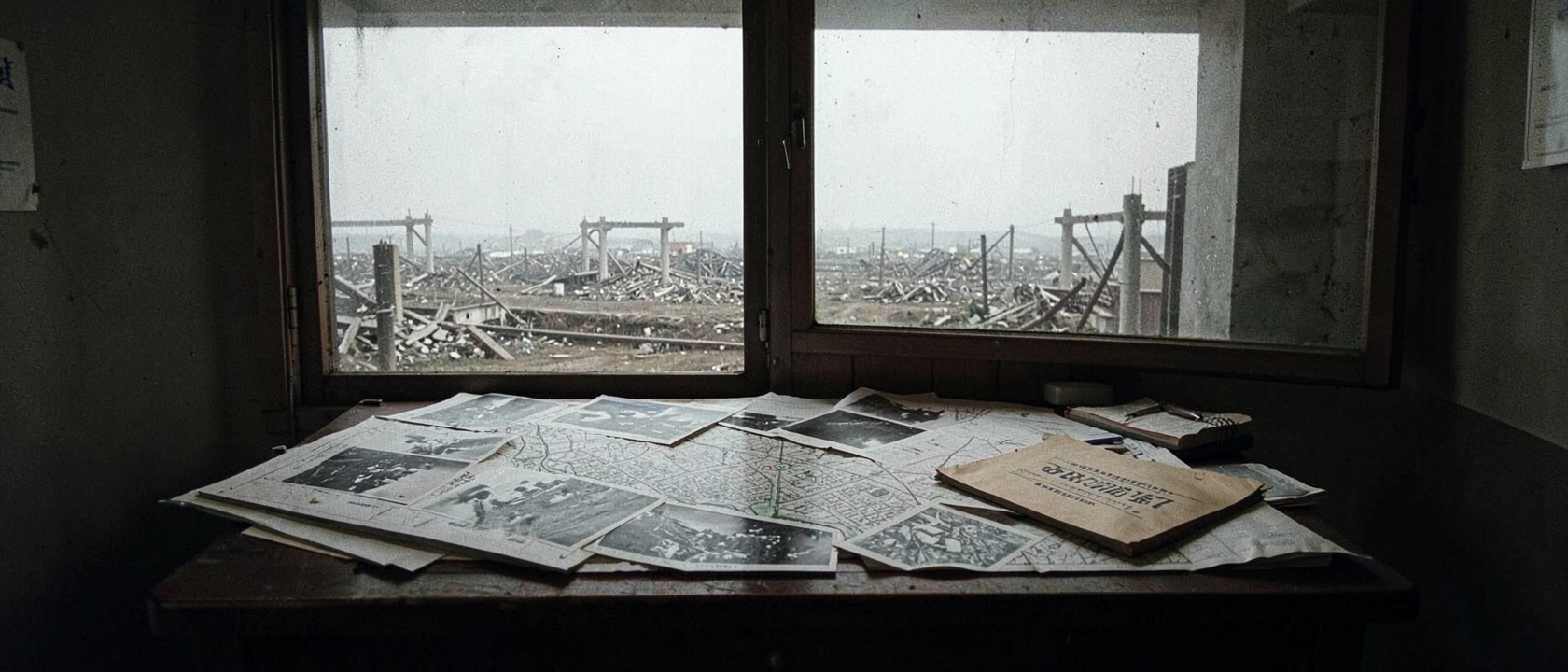
The Entry
A library catalog entry is usually the least interesting part of a declassified file. In this case it may be close to the entire public record. On September 25, 2025, the National Security Archive posted a listing, document 33441 in its catalog, for a U.S. Army report titled “Physical Damage Hiroshima, Japan,” Volume I, credited to a Major Noland Varley. The report carries no date in its own text. The Archive assigns it an estimated composition date of circa April 1946, roughly eight months after the atomic bombing of Hiroshima on August 6, 1945. Its original classification marking is Secret, the middle tier of the U.S. system, used for information whose disclosure was judged capable of causing serious damage to national security. A PDF and an OCR transcript are linked from the page. Neither has been opened for this piece.
What the Title Tells You
The title names a subject: physical damage in Hiroshima. It does not supply an answer. There is no measurement here, no casualty count, no account of which buildings were left standing and which were not. Whatever Varley wrote about the condition of the city sits inside the linked file, not in the entry under review.
No Method Stated Here
Nothing in this listing says how the damage was surveyed: no stated sample of blocks or buildings, no record of who inspected the city or when. That is a different kind of gap from the one above. Missing findings is a gap in content. A missing method is a gap in process. Both belong to this catalog page specifically, not to any judgment about the report it describes.
Varley, Partly Identified
The catalog entry calls him only “Major.” The published “Final Report,” compiled under Major General Leslie R. Groves and issued by the Manhattan Engineer District (MED), the Army command that had built the atomic bomb and went on to survey its effects, on June 29, 1946, fills in part of that gap. It credits “Majors Noland Varley and Walter C. Youngs, Corps of Engineers,” for evaluating physical damage to structures in both cities, and states that the two directed the investigation of blast and fire effects from each bomb. That affiliation comes from a separate, already-published document. Varley’s own Volume I entry states none of it: no branch, no unit, no commissioning authority.
Volume I of Three
The numbering is not only a hint. National Archives holdings records describe the full set as running to three volumes. Volume I is a summary of the bomb’s effects on structures, the weather at the time, the population, and public utilities, with graphs and an annotated map attached. Volumes II and III hold before-and-after photographs, some captioned to point at named locations, including the Chugoko Electric Company and City Hall, taken by members of the MED investigative group, among them Dr. W. C. Penney. Two finished copies are held by the National Archives: one in Record Group 77, an archival grouping of federal records by origin, within its Textual Records Division, the other in its Still Pictures Division. Photographs are missing from both; the Still Pictures copy is the more complete. A few images present in the Textual Records copy do not appear in the Still Pictures one, so the published PDF combines material from both. No reason is given for the missing photographs. The Archive’s September 2025 posting covers Volume I only. Whether Volumes II and III have been digitized or posted elsewhere does not appear in the material reviewed for this piece.
Classified Secret, Undated Release
Damage assessments compiled in the first year after the war were routinely marked Secret, to keep weapons-effects and targeting data away from other governments. That is the ordinary explanation for a marking like this one in 1946. What the catalog entry does not give is a declassification date, a releasing authority, or any account of the review that eventually let this PDF surface. The report’s estimated composition, in the spring of 1946, and its public posting, close to eighty years later, are separated by a gap the available record does not explain.
What This Piece Has Not Opened
Everything above comes from the National Security Archive’s catalog listing, from the National Archives’ separate description of the three-volume set, and from the credits page of the 1946 Final Report. None of it comes from reading Varley’s own Volume I. The PDF and OCR transcript the Archive has linked may hold his actual figures, his description of the city, the graphs and the annotated map the holdings record mentions. This piece does not draw on them. That is the line between what can honestly be said here and what would require opening the file itself.
No Word Since
No scholarly citation, declassification notice, or public comment referencing this specific catalog entry turned up in the material reviewed. The record, as it stands, is a title, a name, a classification, and a date the Archive itself can only estimate.