
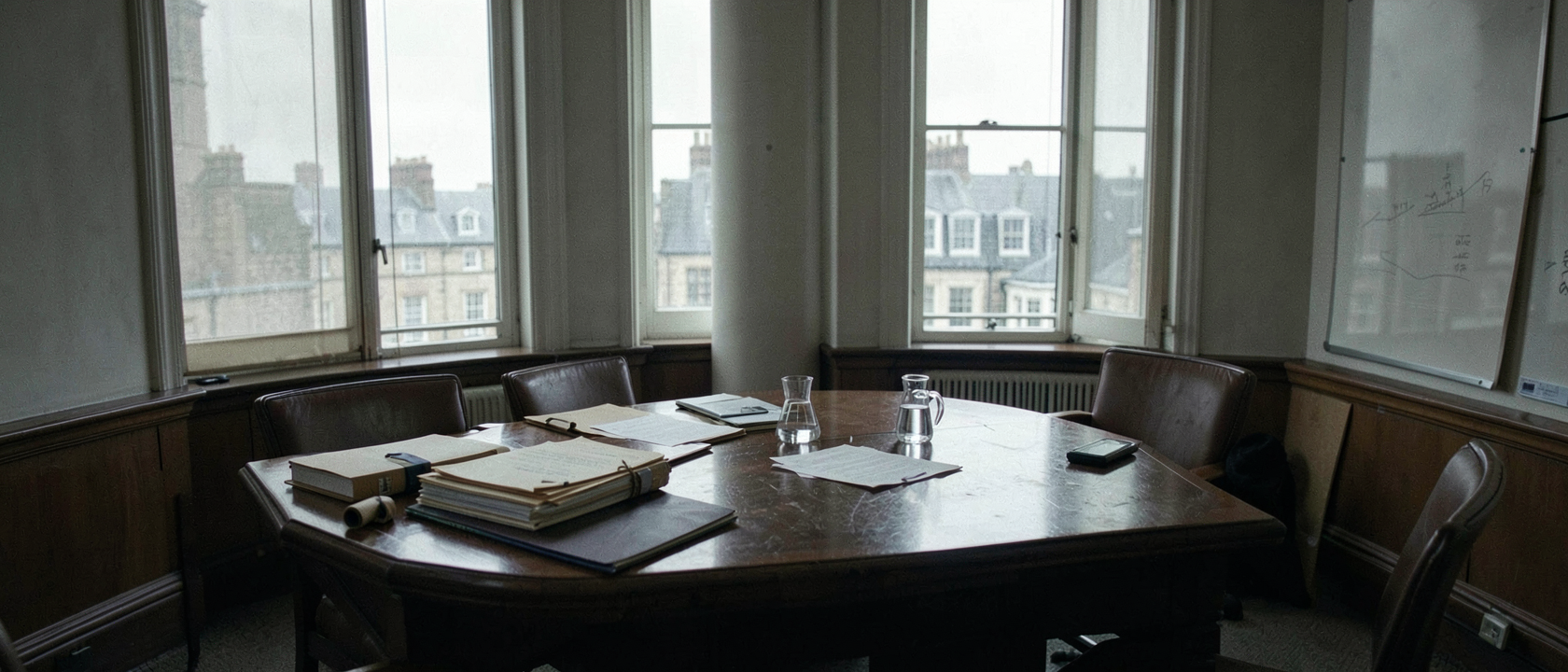
The paperwork survives in far greater detail than the story it tells. At The National Archives, the record of the inquiry into the death of Dr. David Kelly CMG runs to seven separate reference series, an annotated set of evidence kept by the judge who chaired it, and a saved copy of a government website frozen at the point the inquiry wound up. What the archive’s own guide to that material does not do, anywhere in its text, is explain what the inquiry concluded.
The shelf
The Hutton Inquiry Papers are cataloged at The National Archives in seven reference series, RJ 1 through RJ 7. RJ 1 holds the evidence the inquiry considered; RJ 2, its correspondence; RJ 3, press and media coverage; RJ 4, the Official Solicitor’s working papers; RJ 5, counsel’s working papers; RJ 6, Lord Hutton’s own annotated copies of the evidence; and RJ 7, a saved copy of the inquiry’s website as it stood while the inquiry was running. The terms of reference, the document setting out what the inquiry was and was not permitted to examine, were drawn up by the Lord Chancellor, Lord Falconer of Thoroton. What the guide describes is a filing structure: where material sits, not what it says.
What the inquiry was asked to examine
Lord Falconer opened the inquiry on August 1, 2003, into the circumstances surrounding Dr. Kelly’s death, his state of mind beforehand, and the conduct of any government official or other person in relation to him. The inquiry’s announcement itself is dated July 18, 2003. Lord Hutton, who had served as Lord Chief Justice of Northern Ireland from 1988 to 1997 and had sat as a Law Lord, the senior judicial title held by a Lord of Appeal in Ordinary, since 1997, was appointed to chair it. Beyond the fact that an inquiry was opened and what it was told to establish, the guide does not describe cause of death or any finding.
Hearings, in order
Oral evidence was taken in two stages. The first ran from August 11 to September 4, 2003, with witnesses called in chronological order. The second, which the National Archives dates to September 15 through September 25, 2003, recalled several of the same witnesses, among them the BBC reporter Andrew Gilligan, Defence Secretary Geoff Hoon, BBC chairman Gavyn Davies, and Alastair Campbell, for further questioning by counsel, alongside witnesses appearing for the first time. One witness who had been unwell during the second stage gave additional evidence separately on October 13, 2003. Every item of evidence submitted was disclosed to the inquiry’s core participants and given a unique reference number by contributor, bundle, and page, which is why the RJ series takes the shape it does. A separate account of the second stage gives its last day as September 24 rather than September 25; that one-day gap between sources is not resolved here.
Publication, and what the guide leaves out
The report was published on January 28, 2004, and runs to 337 pages; a bound edition issued separately by the Stationery Office is listed at 706 pages, a difference the archive does not address and that most likely reflects format rather than content. The government’s formal response followed on February 4, 2004, recorded in Hansard, the official transcript of Parliament. None of that is in question. What the National Archives’ guide to the collection does not do, at any point, is set out what Lord Hutton actually concluded about Dr. Kelly’s death. That conclusion exists, but in the report itself rather than in the archive’s description of it: Hutton found that Kelly took his own life, that no third party was involved, and that his death was hastened by a combination of drugs. He cleared the government of responsibility and criticized BBC management for allowing Gilligan to broadcast claims that Hutton judged unfounded and seriously damaging to the people they named. Gavyn Davies resigned as BBC chairman shortly after the report’s release. On January 29, 2004, several British newspapers called the findings a whitewash, a measure of press skepticism rather than a finding in the record itself.
A second inquiry that stayed open
Before the report’s official release, a British newspaper published what it said were extracts of Hutton’s conclusions. Lord Hutton investigated the leak himself and reported his findings to the Public Administration Select Committee on May 13, 2004. The guide records the outcome plainly: the source of the leaked extracts was never identified. That inquiry closed with that line, not with a name.
What’s still closed
Some material in the collection remains closed to public access or redacted under exemptions in the Freedom of Information Act 2000, the UK law governing public access to government records. The National Archives notes that closed information of this kind typically involves personal data about named individuals, or material whose release could affect someone’s physical or mental health or safety, and that such closures are time-limited and reassessed rather than permanent. The catalog does not say which exemption applies to which item, or why. A closed file is a fact about current access policy. It is not a description of what the file contains.
A date that disagrees with itself
The National Archives’ own text for the collection states that Dr. Kelly died “on 18 July 2004.” Elsewhere in the same guide, the inquiry into that death is described as having been announced on July 18, 2003, a full year earlier by the guide’s own numbering. Contemporary reporting from 2003, along with later reference sources, consistently places Kelly’s death on July 17, 2003, which suggests the “2004” in the archive’s text is a typographical slip rather than a second, unrecorded event. The guide does not flag the discrepancy or correct it. It sits there, one digit off, inside an otherwise precisely dated record.
One tape among the paper
Formats in the collection are almost entirely paper, apart from a small number of photographs and letters, and one audio recording. The catalog lists it alongside the written material without describing its length, its content, or why it is the single item that survived the inquiry in that form. The guide offers nothing further. The entry simply exists, one sound file inside a filing system built for paper, and the record stops there.