
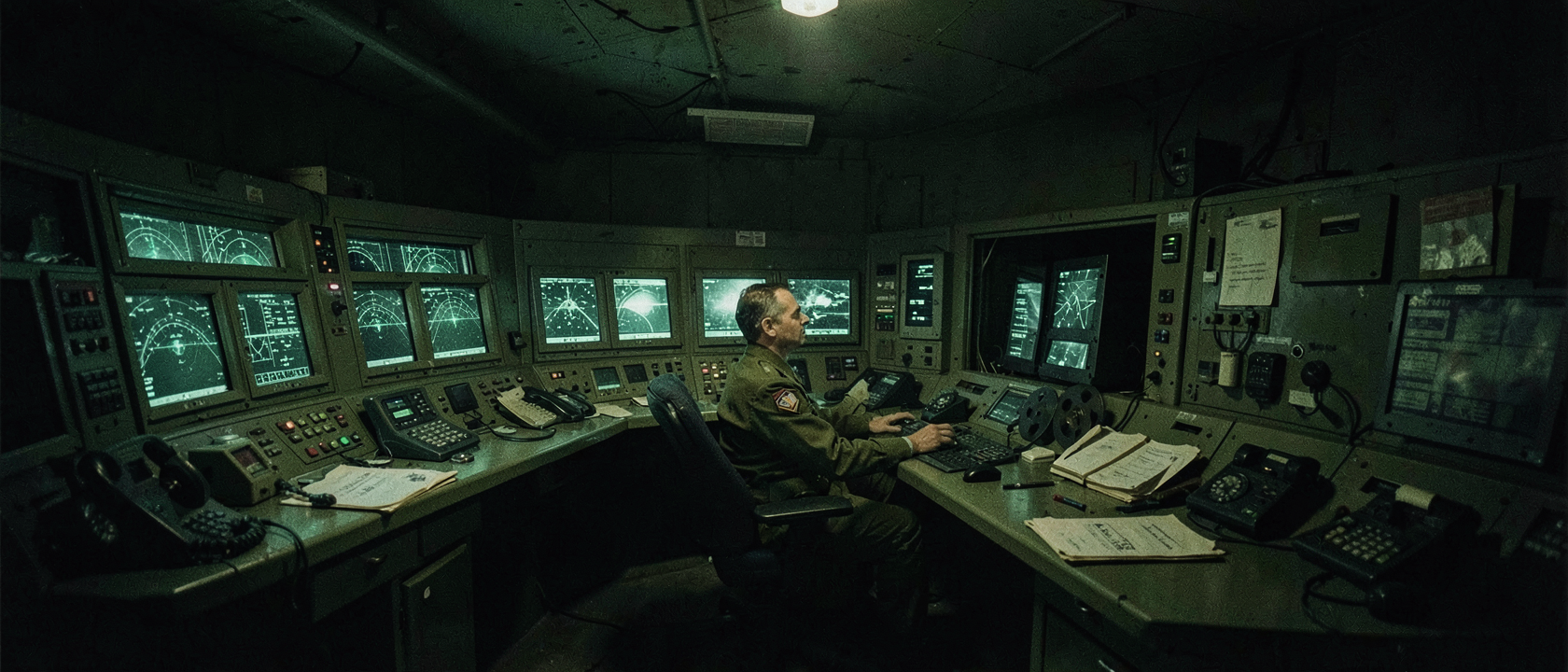
Most false alarms leave two kinds of paper behind: the message traffic that moved in real time, and the after-action account written once everyone had a chance to think it over. The National Security Archive’s posting on a 1979 false alarm at Mount Hebo, Oregon, is built mainly from the first kind, and it does not pretend otherwise.
What the Archive Released
On March 24, 2022, the National Security Archive published Briefing Book #789, “Colonel Odom’s ‘Chilling’ Four A.M. Phone Call,” edited by William Burr. The posting compiles declassified material on false missile warnings and on the Threat Assessment Conference, the procedure NORAD uses to judge whether a radar reading signals a genuine attack and to order preliminary steps to protect nuclear forces, covering 1977 to 1980. It also includes, for the first time in public, a 1976 U.S.-Soviet agreement governing NUCFLASH messages, the hotline channel the two countries had agreed to use for reporting ambiguous nuclear events. The posting states what the Archive assembled, and when; it does not by itself narrate a single incident, that comes from the documents inside it.
Mount Hebo, October 3, 1979
At four o’clock in the morning on October 3, 1979, Colonel William Odom, the Army officer serving as military assistant to national security adviser Zbigniew Brzezinski, took a call from the Pentagon’s National Military Command Center. A radar at Mount Hebo, in Tillamook County, Oregon, operated by Detachment 2 of the 14th Missile Warning Squadron, had registered an object as a submarine-launched ballistic missile headed for a point 150 nautical miles off the coast. The equipment was an AN/FSS-7, known inside the Air Force as “Fuzzy 7,” already scheduled for replacement by the newer PAVE PAWS phased-array system. Only one of three radars covering that stretch of coast picked up the return. NORAD nonetheless reported “high confidence” in the warning at first, according to Odom’s own account; it was the silence of the other two radars that led officials to decide against issuing a NUCFLASH message, the formal step that would have pushed the report up the chain as a probable attack.
The Conference, As Far As the Record Goes
The reading was serious enough to trigger a Threat Assessment Conference, a call convened four times in total across 1979 and 1980, according to a later Senate Armed Services Committee report. Odom wrote to Brzezinski about this one the same day, in a Top Secret memo titled “SIOP Changes and Tactical Warning,” SIOP being the Single Integrated Operational Plan, the U.S. nuclear war plan, with a map attached. He called the call “chilling,” said he had been “a little disturbed” by it, and admitted to wondering how he would use the remaining “four or five minutes” before the missile would hit and, as he put it, set off a “cataclysm.” He also noted that the conference system had worked efficiently enough that he could have brought Brzezinski, or the president, onto the line, but that the data was too “uncertain” for anyone to act on. The memo does not list other participants, include a transcript, or state a formal conclusion. The conference happened, and Odom reported it; what else it produced is not in the released material.
A Space Object, Twice Assessed
Two days later, on October 5, 1979, Odom wrote to Brzezinski again, in a memo titled “Causes of False Warning of SLBM Launch,” to say the cause still had not been explained. A space object, he wrote, could have been the basis for the sighting, but further investigation had made that look less probable. That was the assessment on file that week. A later accounting, published in 1980 by the Senate Committee on Armed Services under the title “Recent False Alerts from the Nation’s Missile Attack Warning System,” and corroborated by a General Accounting Office report, MASAD-81-30, reached a different point: the Mount Hebo radar had picked up a low-orbit rocket body close to decay, and that return had generated the false launch and impact report. Neither document names the object or cites a catalog entry, and neither explains why the theory Odom’s own office found “less probable” on October 5 is the one that stood a year later. The record contains both assessments; it does not reconcile them.
The Four A.M. Call
That Odom was the one answering the phone, rather than the one woken without explanation, is the clearest fact in the file. What happened on his end of the line afterward is less certain. Notes in his own papers leave open whether he called Brzezinski himself that night over the chance of an incoming Soviet attack; the Archive’s editors note that the only firm date tied to such a call is June 3, 1980, when Odom wrote to assure Brzezinski the White House had been kept “in the loop” during a period of false alarms, without naming which one. A memoir published later by Robert Gates describes Brzezinski being woken with a report of hundreds of incoming missiles, a second call reporting 2,200 missiles launched, and a third call a minute before he meant to phone the president, retracting the warning. The Archive flags this account as possibly describing a different night, since it more closely matches a separate false alarm on November 9, 1979, caused by a mistakenly loaded exercise tape and resolved within six minutes. Which night, if either, Gates was describing is not settled by the published material.
What the Period Covers
The Archive’s collection runs from 1977 to 1980, a span in which Mount Hebo produced at least one more false alarm, in the late winter of 1980, before the station was decommissioned and its mission shifted to PAVE PAWS at Beale Air Force Base, California. Four Threat Assessment Conferences were held across 1979 and 1980; no Missile Attack Conference, the most severe of NORAD’s three conference levels, has ever been convened. The posting does not say how many of the period’s false alarms involved Mount Hebo specifically, or how this one compared to others, including the November 9, 1979 exercise-tape error that reached Soviet leader Leonid Brezhnev’s attention after it leaked to the press. No later interview or tally in the released material fills that gap.
What the File Supports
What the record shows: a radar return at Mount Hebo on October 3, 1979, logged as a submarine-launched ballistic missile, a Threat Assessment Conference convened in response, and Colonel Odom’s own description of the call as “chilling.” What investigators concluded, a year on: a decaying rocket body in low orbit, named in two government reports but not otherwise identified. What remains open: the content of Odom’s side of the four a.m. call, whether it reached Brzezinski that night, and how the October 5 assessment gave way to the 1980 finding. What has been claimed afterward: Robert Gates’s account of a three-call exchange, which the Archive itself treats as possibly describing a different incident. The documents end there, with the conference logged, the object renamed but not identified, and the call that gives the file its title still only a title.