
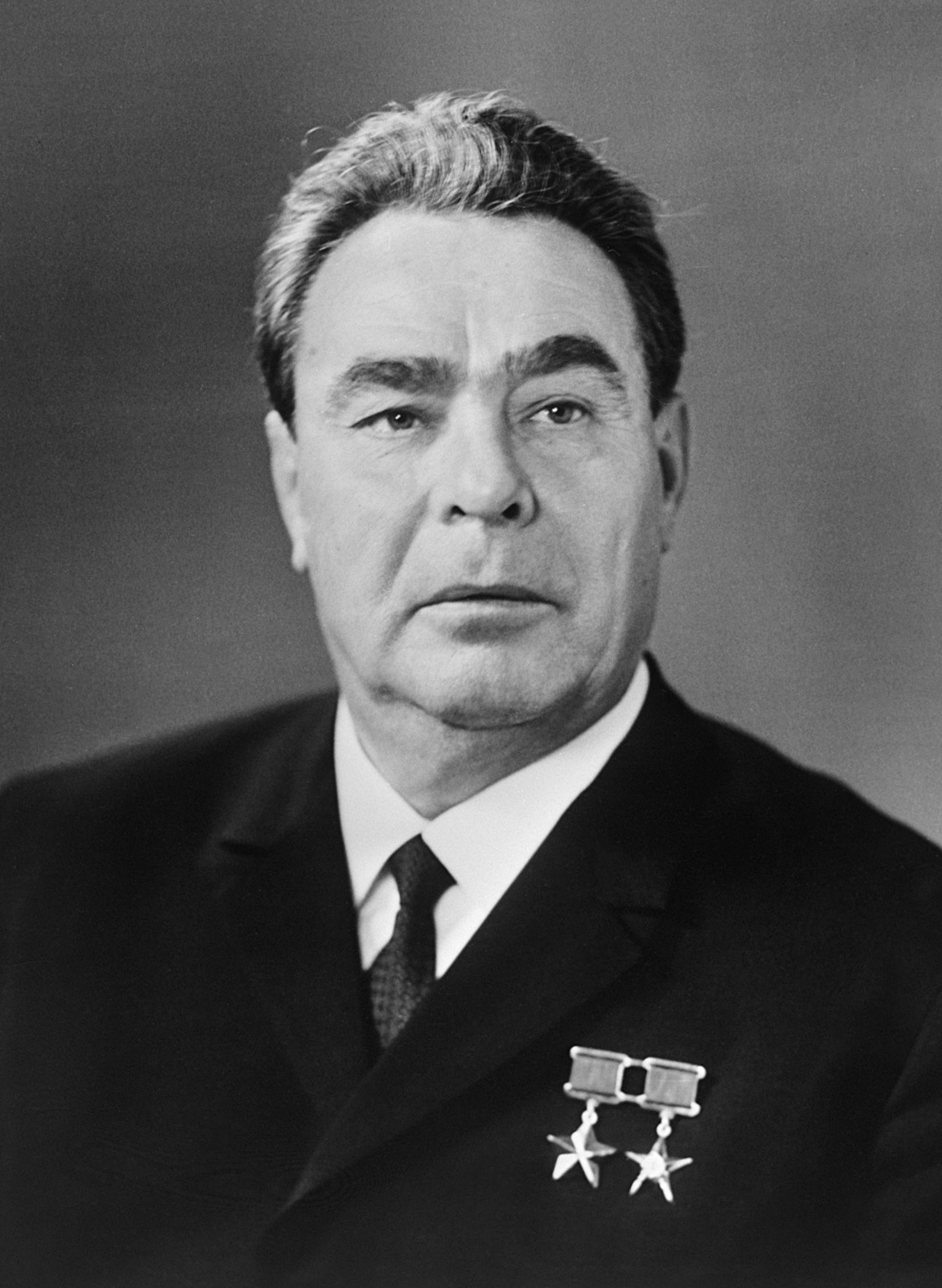
Leonid Ilyich Brezhnev led the Soviet Union as General Secretary of the Central Committee of the Communist Party from 14 October 1964 until his death on 10 November 1982, a tenure of 18 years that was second in length only to Stalin’s among Soviet leaders. Born on 6 December 1906 in Kamenskoye, a company town on the right bank of the Dnieper River in the Yekaterinoslav Governorate of the Russian Empire, he rose from a working-class steel-worker family to become the dominant figure in Soviet politics for nearly two decades. His rule produced both the high-water mark of Cold War arms control, sealed with two landmark treaties with the United States, and the catastrophic decision to send Soviet troops into Afghanistan. A 2013 Levada Center poll gave him 56 percent approval, placing him ahead of Vladimir Lenin as the most popular Russian leader of the 20th century in that survey.
Key facts
- Born: 6 December 1906
- Birthplace: Kamyanske
- Died: 10 November 1982
- Place of death: Zarechye
- Country: Soviet Union
- Occupation: politician; engineer; military personnel; surveyor
- Education: Dniprovsky State Technical University
- Awards: Order of Lenin; Medal “For the Victory over Germany in the Great Patriotic War 1941–1945”; Order of the Red Banner; Order of the Red Star
Early Life and Education
Brezhnev was born into a working-class family in Kamenskoye, a steel-industry company town in what was then the Yekaterinoslav Governorate of the Russian Empire. His father worked in the steel mills, and the industrial character of the town shaped his early outlook. He received his higher education at what is now Dniprovsky State Technical University, training as an engineer and, among other qualifications, as a surveyor.
Rise to Power
Brezhnev’s ascent to the top of the Soviet hierarchy came through patient coalition-building rather than dramatic confrontation. On 14 October 1964, he succeeded Nikita Khrushchev as First Secretary of the Soviet Communist Party, having been a central participant in the conservative coalition that organized Khrushchev’s removal. From that position he accumulated authority steadily, and his title eventually became General Secretary, a designation that carried the weight of supreme leadership.
Détente and Arms Control
The period known as détente reached its clearest expression in two arms-control agreements negotiated under Brezhnev. On 26 May 1972, he and U.S. President Richard Nixon signed the SALT I Treaty in Moscow. The treaty limited anti-ballistic missile systems and froze strategic ballistic missile launchers, representing a mutual acknowledgment that unconstrained nuclear competition carried unacceptable risks.
Seven years later, on 17 June 1979, Brezhnev and U.S. President Jimmy Carter signed the SALT II Treaty in Vienna. That agreement limited both nations’ nuclear delivery vehicles to 2,250 each and placed further restrictions on deployed strategic nuclear forces. The Vienna signing proved to be one of Brezhnev’s last major acts on the world stage in a period of relative diplomatic engagement.
Afghanistan and the Limits of the Brezhnev Era
On 12 December 1979, Brezhnev and a special Politburo commission authorized the introduction of Soviet troops into Afghanistan. Soviet forces began arriving on 25 December 1979. The decision committed the Soviet Union to a prolonged conflict that would outlast Brezhnev himself and place severe strain on an economy already showing signs of deep structural weakness.
Health and the Era of Stagnation
Soviet historian Roy Medvedev reported that Brezhnev suffered a near-fatal stroke in January 1976 that left him clinically dead before he was revived. According to Medvedev, Brezhnev’s speech and cognition remained impaired for the remainder of his rule. He governed in this diminished condition for another six years, a circumstance that shaped both policy-making and the culture of the leadership circle around him.
The economic record of his 18-year tenure became the defining feature of what Soviet and later Russian commentators called the Era of Stagnation. Annual Soviet GDP growth rates fell from an average of 5.2 percent in the 1960s to 2.5 percent in the 1970s, and corruption became deeply entrenched in the party and economy. Corruption reached Brezhnev’s own family: his son-in-law Yuri Churbanov, married to his daughter Galina, was implicated in a massive Uzbekistan cotton fraud while serving as the Soviet Union’s first deputy interior minister between 1980 and 1985.
Death and Legacy
Brezhnev died on 10 November 1982 at Zarechye. His rule had lasted 18 years, a span exceeded among Soviet leaders only by Stalin. Among the awards he received were the Order of Lenin, the Medal for the Victory over Germany in the Great Patriotic War 1941–1945, the Order of the Red Banner, and the Order of the Red Star.
Assessment of his legacy has been divided. In a Levada Center poll conducted in 2013, he received 56 percent approval, placing him first among 20th-century Russian leaders in that survey, ahead of Vladimir Lenin. The same era is also remembered for economic decline, institutional corruption, and the Afghanistan intervention, all of which shaped the crises his successors would inherit.
Did you know
- Brezhnev received his first job at the age of 15 at a butter-making factory in his home town of Kamenskoye, before he embarked on his professional and political career. (russiapedia.special-rt.com)
- Brezhnev was an avid collector of luxury automobiles. One Sputnik report noted that by 1980 his collection numbered 324 vehicles, including gifts from world leaders such as a Lincoln Continental from President Nixon and a Rolls-Royce Silver Shadow. (sputnikglobe.com)
- After Brezhnev’s death, Izvestia revealed that he had ordered 21 duplicate gold Hero of the Soviet Union medals and 13 duplicate Hammer and Sickle medals so he would not need to transfer them when changing suits. (washingtonpost.com)
Data sources
- Wikidata
- humansofhistory.com
- historylearning.com
- govbooktalk.gpo.gov
- history.state.gov
- globalsecurity.org
- deseret.com
- grokipedia.com
- factsanddetails.com
- themoscowtimes.com
Where it appears
Data updated: 2026-11-02