
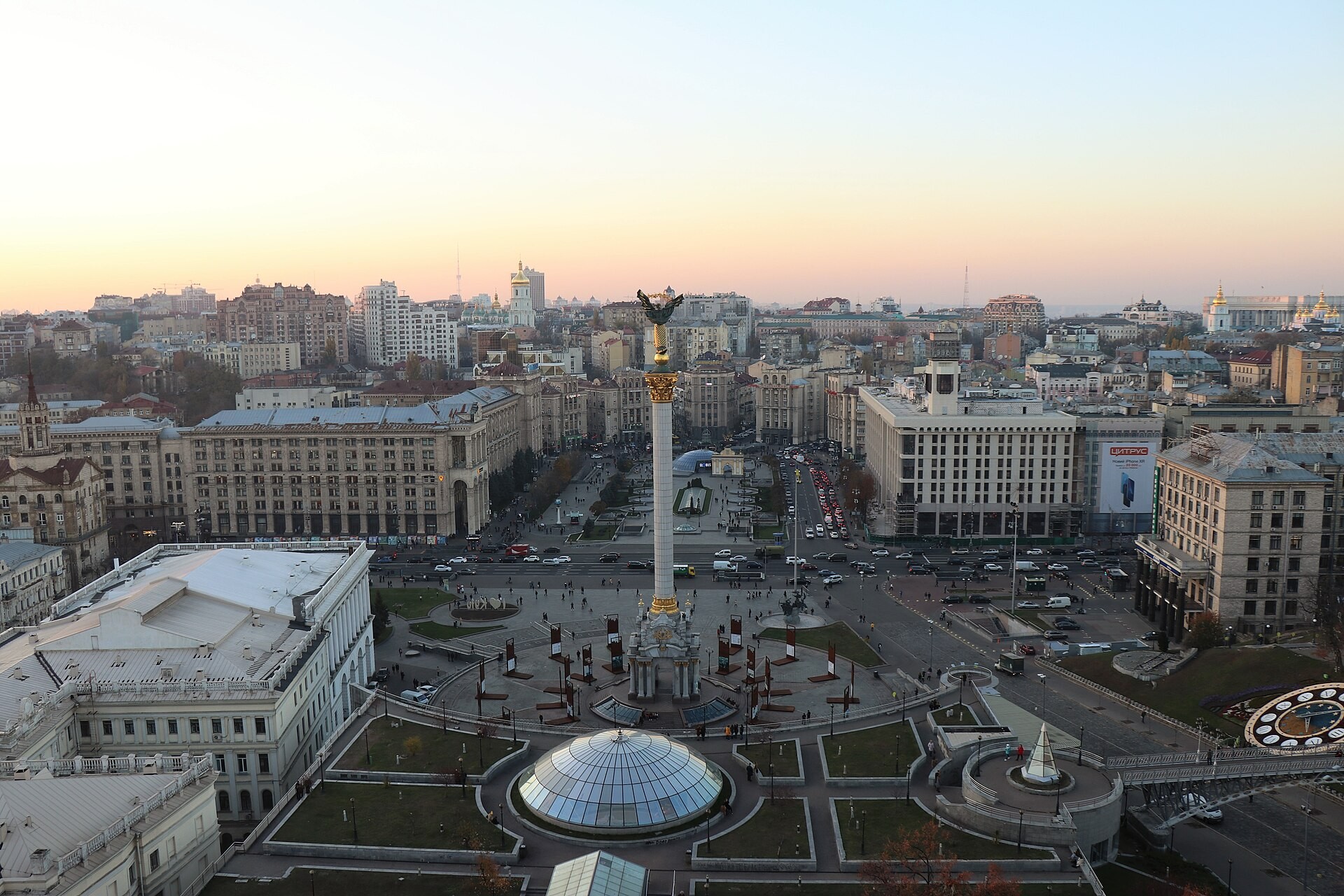
Ukraine is a country in Eastern Europe, bordering the Black Sea between Poland, Romania and Moldova to the west and Russia to the east. Its capital is Kyiv, and it covers 603,550 square kilometers, making it one of the larger states on the continent. Ukraine had a population of 41,167,335, with Ukrainian as the official language and the hryvnia as its currency. It became an independent state on 24 August 1991, and its head of state is Volodymyr Zelenskyy.
Key facts
- Capital: Kyiv
- Continent: Europe
- Population: 41,167,335
- Area: 603,550 km²
- Official language: Ukrainian
- Currency: hryvnia
- Head of state: Volodymyr Zelenskyy
- ISO code: UA
- Founded: 24 August 1991
Geography and climate
Ukraine has a coastline of 2,782 kilometers along the Black Sea and land boundaries totaling 5,581 kilometers, shared with Belarus, Hungary, Moldova, Poland, Romania, Russia and Slovakia. Its highest point is Hora Hoverla, at 2,061 meters, and its lowest point is the Black Sea itself, at 0 meters.
The country has a temperate continental climate overall. A Mediterranean climate occurs only along the southern coast of Crimea, distinct from the continental pattern found across the rest of the territory.
History
In 1648 the Cossack Hetmanate was established in central Ukraine under the leadership of Bohdan Khmelnytsky. In January 1654, Khmelnytsky signed the Pereiaslav Agreement with Tsar Alexei of Muscovy, placing the Hetmanate under the tsar’s protection. The agreement marked a turning point in the relationship between the Hetmanate and Muscovy that shaped Ukraine’s subsequent political history.
Between 1932 and 1933, the Holodomor, a man-made famine under Stalin’s regime, killed an estimated seven to ten million Ukrainians. On 14 May 2003, Ukraine’s Verkhovna Rada recognized the Holodomor as an act of genocide against the Ukrainian people, formally codifying a historical judgment on the famine decades after it occurred.
The Chernobyl nuclear power plant, site of a major accident, was finally shut down in 2000, fourteen years after the disaster. The long gap between the accident and the plant’s closure reflects the scale of the technical and safety work required before the site could be fully decommissioned.
Taras Shevchenko, who lived from 1814 to 1861, is considered the greatest Ukrainian poet and is credited with firmly establishing the modern literary Ukrainian language. His writing gave Ukrainian a literary standard that outlasted the political upheavals of the following century.
Economy and energy
Ukraine has depended on energy imports, particularly natural gas, to meet an estimated 85% of its annual energy requirements, according to an earlier CIA Factbook estimate. This reliance on imported gas has long shaped the country’s economic and strategic planning.
Since Russia’s full-scale invasion began in early 2022, Ukraine’s annual defense spending has risen to more than 30% of GDP according to some estimates, a level that marks a sharp shift in how the national budget is allocated compared with the pre-invasion period.
Cultural heritage
Ukraine is home to seven UNESCO World Heritage sites. As of 6 September 2023, UNESCO had verified war damage to 287 cultural sites across the country, including 120 religious sites, 27 museums, 107 buildings of historical or artistic interest, and 19 monuments. The tally covers damage recorded up to that date and spans both sacred and secular buildings.
In September 2023, UNESCO granted enhanced protection to 20 Ukrainian cultural heritage sites, including the Sofiivka landscape garden in Uman and Taras Shevchenko’s tomb in Kaniv. The designation extended a formal protective status to sites tied both to landscaped heritage and to the legacy of Ukraine’s national poet.
Did you know
- UNESCO celebrated Taras Shevchenko internationally twice, in 1961 and 1964. (shevchenko.ca)
Data sources
Where it appears
- Aspen Institute’s 2023 Ukraine cyber report ends mid-sentence November 19, 2026
- NSA Email to Nakasone Ordered Preservation for HPSCI Subpoena November 3, 2026
Data updated: 2026-11-16