
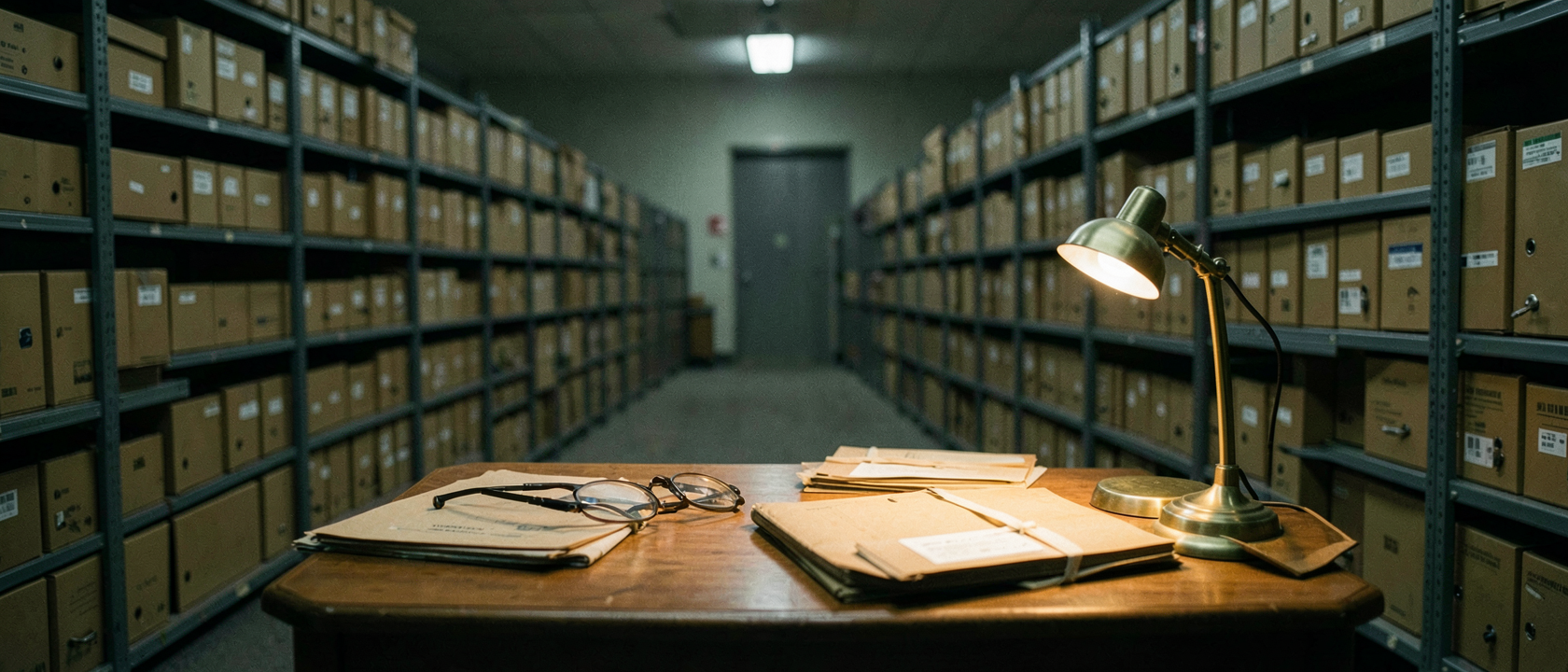
The Paperwork Behind Instrument 156
The file opens with a question about the building that holds the records, not about an incident in the field. On November 21, 2025, Richard Holt submitted a Freedom of Information request, the standard mechanism under UK law for compelling a public body to disclose what it holds, asking The National Archives at Kew why two internal administrative folders, cataloged as PRO 85/2662 and PRO 85/2663, had never been transferred to the open shelves for public inspection. Holt’s filing noted that the catalog described the PRO 85 series as domestic records of the Public Record Office, the institution’s own name before it merged into The National Archives in 2003. He also pointed to a catalog reference to a retention order he identified as Lord Chancellor’s Instrument LCI 156, signed on June 20, 2024, which he understood to withhold the files on security or other specified grounds. The Archives logged the case as CAS-299545 and closed it on December 3, 2025, recording the outcome simply as “some information provided.”
The Statutory Retainer
Behind LCI 156 sits a specific clause of law. Section 3(4) of the Public Records Act 1958 lets the Lord Chancellor, or since 2015 the Secretary of State for Culture, Media and Sport, after responsibility for the Archives moved to that department, keep a public record out of the normal transfer process, either for reasons of sensitivity or national security, or because a department still needs the file for day-to-day business. The Act originally fixed a fifty-year closure period before records had to open; a 1967 amendment cut that to thirty years, and the Constitutional Reform and Governance Act 2010 cut it again, to twenty years, phased in through 2022. PRO 85/2662 and PRO 85/2663 fall inside the Public Record Office’s own registered-files series on records management policy, essentially the institution’s paperwork about running itself. In its response, the Archives confirmed that both files remain in its own custody rather than on the public shelves, which settled Holt’s original question of who actually holds them.
Junior Staff and Section 40(2)
The Archives handled the request through its routine access channels rather than treating it as anything unusual. Its response applied Section 40(2) of the Freedom of Information Act 2000, the exemption covering personal data, to redact the names, signatures and contact details of junior staff appearing in the retention paperwork, stating that identifying them would be an unfair use of personal data under UK GDPR Article 5. The underlying documents, a record of the information held about the retention and a copy of the retention instrument itself, were not attached to the published case file; the Archives said both would be supplied as PDFs to anyone who emailed its records management disputes inbox. Read on its own terms, the response looks like ordinary compliance: the request was logged, the custody of the files was confirmed, and the redactions were tied to a named legal exemption rather than left unexplained.
The Missing Line in the Schedule
What the release does not do is say what PRO 85/2662 and PRO 85/2663 actually contain. The dossier confirms that the two files exist, that The National Archives holds them, and that an order dated June 20, 2024 authorized keeping them off the public shelves. It does not reproduce the schedule description that would normally tell a reader what kind of record is being withheld, and it does not include the internal submission that was put to the signing minister, or the specific security or operational grounds cited to justify it. Nor does the response confirm that “Lord Chancellor’s Instrument” is still the right name for that order, a title the department itself retired in 2015 in favor of “Retention Instrument” once sponsorship passed to the Department for Culture, Media and Sport; it simply does not address the label at all. The case closes with custody established, the legal authority named, and the subject of the two files left blank.