
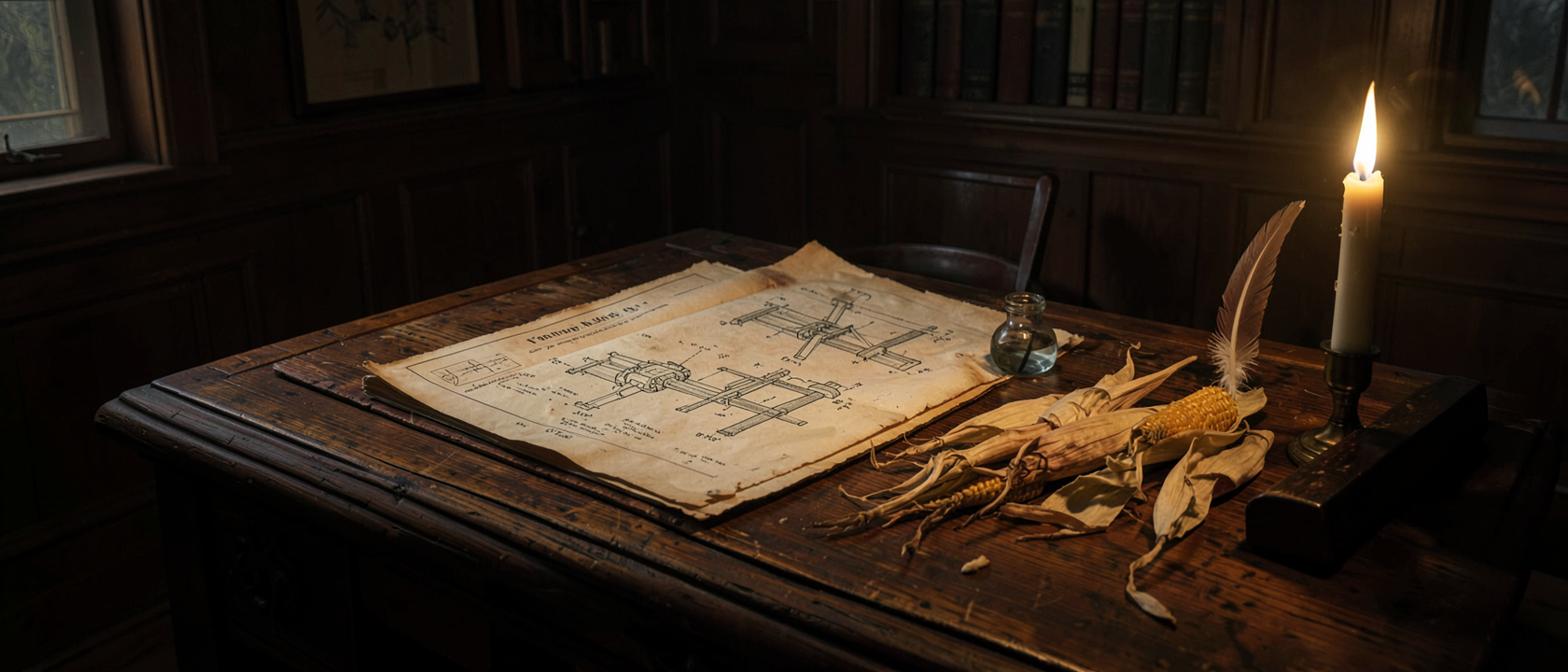
Sybilla Masters spent four years pursuing an English patent for an invention built in Philadelphia: a machine for shelling and grinding corn. She sailed for England in 1712 because Pennsylvania had no patent law of its own, and so no office in the colony could have granted her anything. What survives of that effort is held at the UK National Archives under the catalog reference SP 34/21/43, a file titled, in the Archives’ own cataloguing, “The first American invention to obtain an English patent.”
The record
The file holds drawings and testimony dated, in the document’s own words, “Philadelphia, the 2nd day of the 6th month called August 1716.” Masters signed it herself, as “Sibilla Masters,” a spelling that differs slightly from the “Sybilla” used elsewhere in the record. The same document carries a second, Latin-dated endorsement fixing November 3, 1716, in the third year of King George’s reign. A separate petition, written by Masters in her own words in 1713 and describing the effort behind the application, survives apart from this file; no catalog reference for it appears in the material reviewed here.
What the drawings describe
The drawings show a corn mill built around repeated impact. A series of hammers, fixed to an engine, strike the kernels over and over to shell and grind them. Two versions appear in the file: one with the hammers turned by an animal yoked to a wheel, the other driven by water. The testimony describes this as a new way of “cleaning and curing Indian corn.” Under English patent law of the period, the grant that followed gave its holder exclusive rights to make and profit from an invention for fourteen years.
The sentence inside the grant
Masters could not hold that grant herself. Coverture, the common-law doctrine that folded a married woman’s contracts into her husband’s, meant the patent had to be issued in the name of Thomas Masters, a Philadelphia merchant who served two terms as the city’s mayor. The grant names him as the holder. But its own text records the invention as having been “found out by Sybilla Masters his wife.” A separate historical patents database lists the same grant as the first issued to a resident of the American colonies, and the first on record credited to a woman inventor, even though the law required a man’s name on the document itself.
Thomas Masters’s name on the document reflects that coverture rule. The grant’s own wording still credits Sybilla as the one who “found out” the invention, written into the official instrument itself at the time it was issued. The restriction applied to any married woman in that position, whatever she had invented.
What the file doesn’t say
Four gaps remain, and they are worth keeping apart from one another. The record says nothing about Masters’s early life beyond her father’s work as a merchant and mariner; even her birth year is uncertain, with later sources placing it anywhere from the early to the mid-1670s. No document confirms or denies any real connection between Masters and the Tuscarora people, whose name she later gave her cornmeal product. Nothing in the file explains why that product failed in the English market, even after Thomas Masters bought a mill that is known to have operated. And no paperwork measures the cost she described in her 1713 petition, where she said she had been “at great trouble, expence, and have ventured my life across the seas” to secure the patent.
What was said about it afterward
Masters marketed her cornmeal as a health food, under the name “Tuscarora Rice,” claiming it could relieve tuberculosis. The National Archives treats this explicitly as her own marketing claim rather than a medical finding, and later medical opinion dismissed it outright; one characterization from 1891 called the remedy “nothing more than ground corn.” The “Tuscarora” name itself is treated by the Archives as a likely but unconfirmed reference to the Tuscarora people of North Carolina, since no source ties the product directly to them. Masters returned to Philadelphia in 1716 with her patent secured and died four years later, in 1720.