
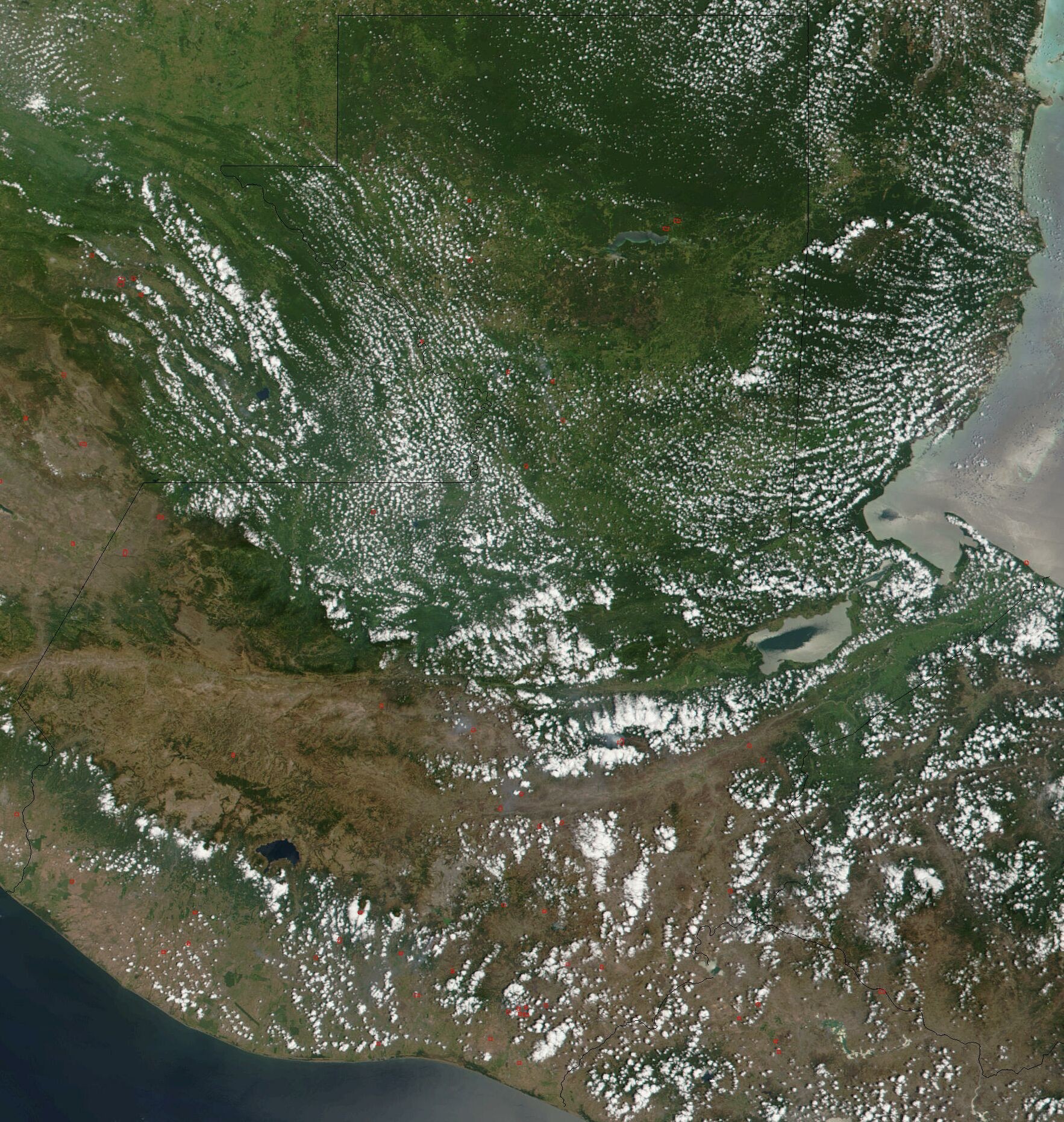
Guatemala is a sovereign state in Central America, with Guatemala City as its capital and Spanish as its official language. Wikidata records its population at 17,263,239, though the World Bank’s 2025 figure, updated October 8, 2026, puts it higher at 18,687,881. The country covers 108,889 square kilometers and borders the North Pacific Ocean, Mexico, Belize, Honduras, and El Salvador, with a further coastline touching the Gulf of Honduras in the Caribbean Sea. Bernardo Arévalo de León serves as head of state, and the country’s currency is the quetzal. Guatemala’s history spans a thirty six year civil war, a 1996 peace accord, and, more recently, a contested but ultimately successful democratic transition.
Key facts
- Capital: Guatemala City
- Continent: North America
- Population: 17,263,239
- Area: 108,889 km²
- Official language: Spanish
- Currency: quetzal
- Head of state: Bernardo Arévalo de León
- ISO code: GT
- Founded: 1821
Geography and divisions
Guatemala is divided into 22 departments, among them Petén, Quetzaltenango, Huehuetenango, and Guatemala. Its highest point is Volcán Tajumulco at 4,220 meters, also the highest point in Central America, while its lowest point is sea level at the Pacific Ocean. The climate is tropical, hot and humid in the lowlands, and cooler in the highlands.
Tikal National Park lies within the Maya Biosphere Reserve, described as the largest protected tropical forest north of the Amazon in Central America. The park holds jaguars, tapirs, and roughly 330 bird species, alongside the ancient temples that rise above the Petén rainforest canopy.
The civil war and its end
Guatemala’s civil war lasted thirty six years and ended with the Guatemalan Peace Accords, signed in 1996. A UN sponsored truth commission found that over 200,000 people were killed or disappeared, 83% of them indigenous Maya, with 93% of the atrocities committed by state forces. The civil war also displaced more than a million people.
The 1996 accord granted amnesty, which left the country in an ambiguous position regarding prosecutions for the killings and disappearances. The URNG’s General Secretary Rolando Morán and President Álvaro Arzú jointly received the UNESCO Peace Prize for ending the war.
Politics since 2023
Bernardo Arévalo, of the anti corruption Movimiento Semilla party, won the presidential runoff on August 20, 2023, with 61% of the vote. The United States and the European Union both imposed sanctions on Guatemalan officials accused of undermining that election. Arévalo’s inauguration in January 2024 followed months of legal attacks, including prosecutors opening sealed ballot boxes during the vote count dispute.
Guatemala’s next general election is scheduled for June 2027.
Economy
Guatemala’s economy grew 4.3 percent in 2025, a figure confirmed by IMF staff in June 2026, making it one of the stronger performing economies in Latin America that year. Family remittances, mostly from the United States, reached a record US$25.53 billion in 2025, equal to about 21 percent of GDP, and exceeded the country’s entire goods exports, making remittances the largest single source of dollars for the nation.
Total exports reached US$15.59 billion in 2025, while imports stood at US$34.61 billion. Central America took 38.4 percent of exports and the United States 30.4 percent. Coffee’s average export price rose 59% in 2025 to US$7.66 per kilogram; coffee, bananas, sugar, clothing, and edible oils ranked as the country’s top export goods. As of October 21, 2026, the central bank held reserves of US$32.97 billion, with a policy interest rate of 3.50%.
Culture and heritage
As of October 2026, the Academy of Maya Languages of Guatemala recognizes 22 official Maya languages. A government news agency report from October 10, 2026 stated that 34.77% of residents speak one of these languages. Over 6 million Maya people live in Guatemala, preserving traditions such as traditional textiles and festivals; one of the newer additions to UNESCO’s intangible cultural heritage lists is the tradition of giant kites, added in 2024.
Guatemala has four UNESCO World Heritage Sites: Antigua Guatemala, inscribed in 1979; Tikal National Park, also inscribed in 1979 as a mixed site; Quiriguá, inscribed in 1981; and Tak’alik Ab’aj, inscribed in 2023. Guatemala City, the capital, is home to nearly 3 million people according to a 2026 USDA report.
Did you know
- Over 6 million Maya people live in Guatemala today, preserving traditions such as traditional textiles and vibrant festivals. (blueparallel.com)
- One of Guatemala’s newest additions to UNESCO’s intangible cultural heritage lists is the tradition of giant kites, added in 2024. (riotimesonline.com)
- Tikal National Park shelters jaguars, tapirs, and roughly 330 bird species alongside its ancient temples rising above the Petén rainforest canopy. (cultural-hub.com)
- Guatemala recorded over 200,000 killed or disappeared during its civil war, yet the final 1996 peace accord granted amnesty, leaving the country in an ambiguous position regarding human rights prosecutions. (ebsco.com)
- The URNG’s General Secretary Rolando Morán and President Álvaro Arzú jointly received the UNESCO Peace Prize for ending Guatemala’s civil war. (courses.lumenlearning.com)
- Remittances to Guatemala in 2025 exceeded all of the country’s goods exports, making money sent home by workers abroad the largest single source of dollars for the nation. (riotimesonline.com)
- Bernardo Arévalo’s inauguration in January 2024 followed months of legal attacks, including prosecutors opening sealed ballot boxes during the vote-count dispute. (aljazeera.com)
Data sources
- Wikidata
- user.iiasa.ac.at
- relief.unboundmedicine.com
- ebsco.com
- humanconflicts.org
- americasquarterly.org
- aljazeera.com
- riotimesonline.com
- cultural-hub.com
- fas.usda.gov
Where it appears
- ‘Manual de Guerra Contrasubversiva’: a 1978 File With No Author Listed November 11, 2026
Data updated: 2026-11-06