
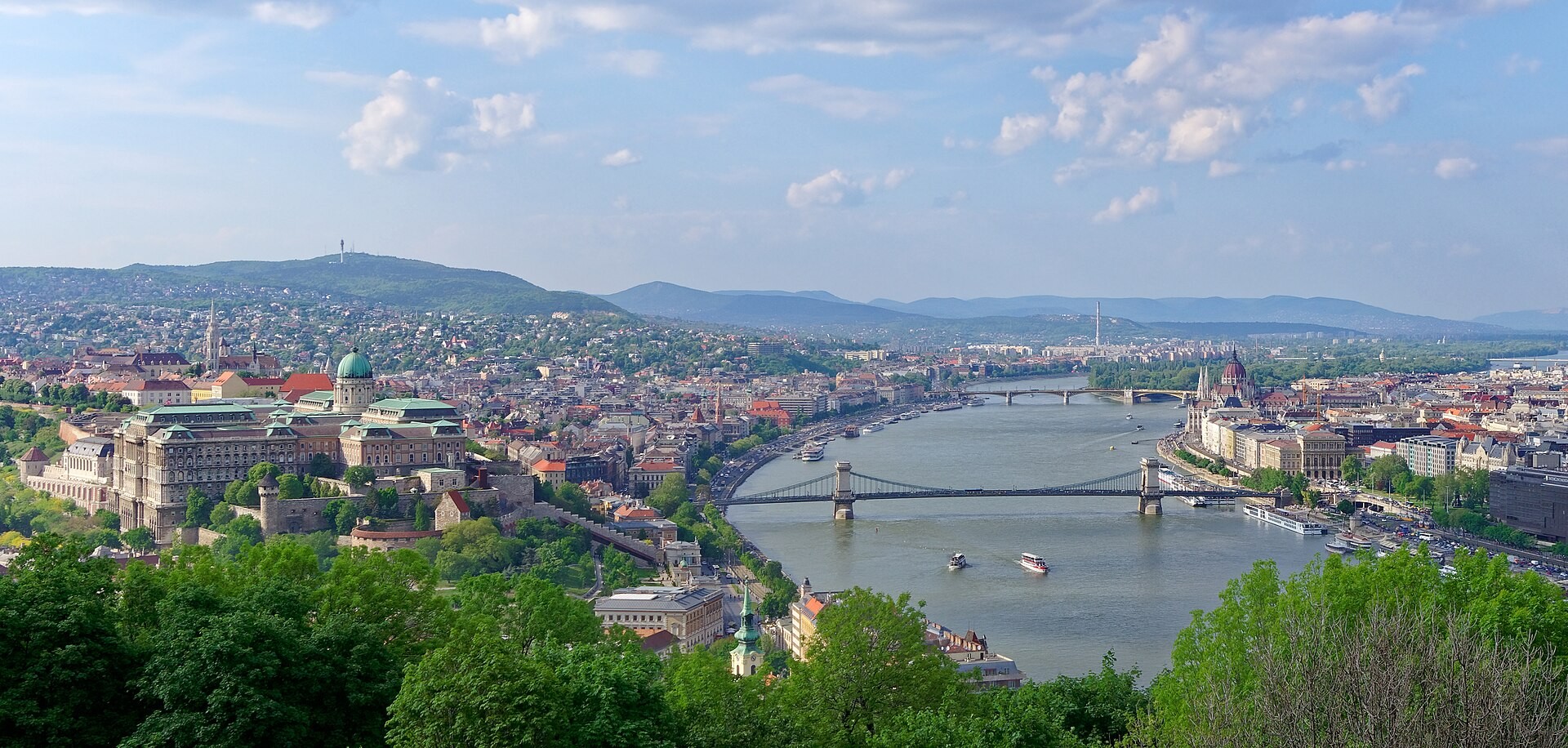
Hungary is a landlocked country in Central Europe, founded in the year 1000 and located northwest of Romania. Its capital is Budapest, and the country covers an area of 93,011 km² with a population of 9,603,634. Hungarian is the official language and the forint is the national currency. The Danube and Tisza rivers divide the country into three large regions, and András Baka serves as head of state. The country carries the ISO code HU.
Key facts
- Capital: Budapest
- Continent: Europe
- Population: 9,603,634
- Area: 93,011 km²
- Official language: Hungarian
- Currency: forint
- Head of state: András Baka
- ISO code: HU
- Founded: 1000
Geography and terrain
Hungary’s terrain is mostly flat to rolling plains, with hills and low mountains rising along the Slovakian border. The country’s lowest point lies along the Tisza River at 78 m, while its highest point, Kekes, reaches 1,014 m.
Natural resources include bauxite, coal, natural gas, fertile soils and arable land. These resources, together with the three regions formed by the Danube and Tisza rivers, have shaped where farming and industry developed across the country.
History
Imre Nagy, a reformist premier and leader of the 1956 revolution, was secretly tried and executed by the communist government. His ceremonial reburial in Budapest on June 16, 1989 drew hundreds of thousands of mourners. The event is recorded as a moment that symbolized the collapse of communism in Hungary.
The Roman city of Sopianae, now the southern Hungarian city of Pécs, contains a fourth-century Early Christian Necropolis. The site is listed by UNESCO and remains a popular destination for visitors, a physical link between Hungary’s Roman-era past and its present-day cities.
Economy and government
Hungary’s central government debt stood at 75.3% of GDP in 2022. The figure reflects the state of public finances recorded for that year.
The country is identified internationally by the ISO code HU. András Baka holds the position of head of state, and the forint remains the country’s official currency, used alongside Hungarian as the sole official language across a population of 9,603,634 people living within an area of 93,011 km².
Did you know
- The Roman city of Sopianae, now Pécs in southern Hungary, contains a fourth-century Early Christian Necropolis that is a popular UNESCO-listed site. (rollinginbudapest.com)
Data sources
Where it appears
- CIA File 00-B-93674 Keeps Two Pages on 7,400-MPH Saucers Classified November 23, 2026
Data updated: 2026-11-20