
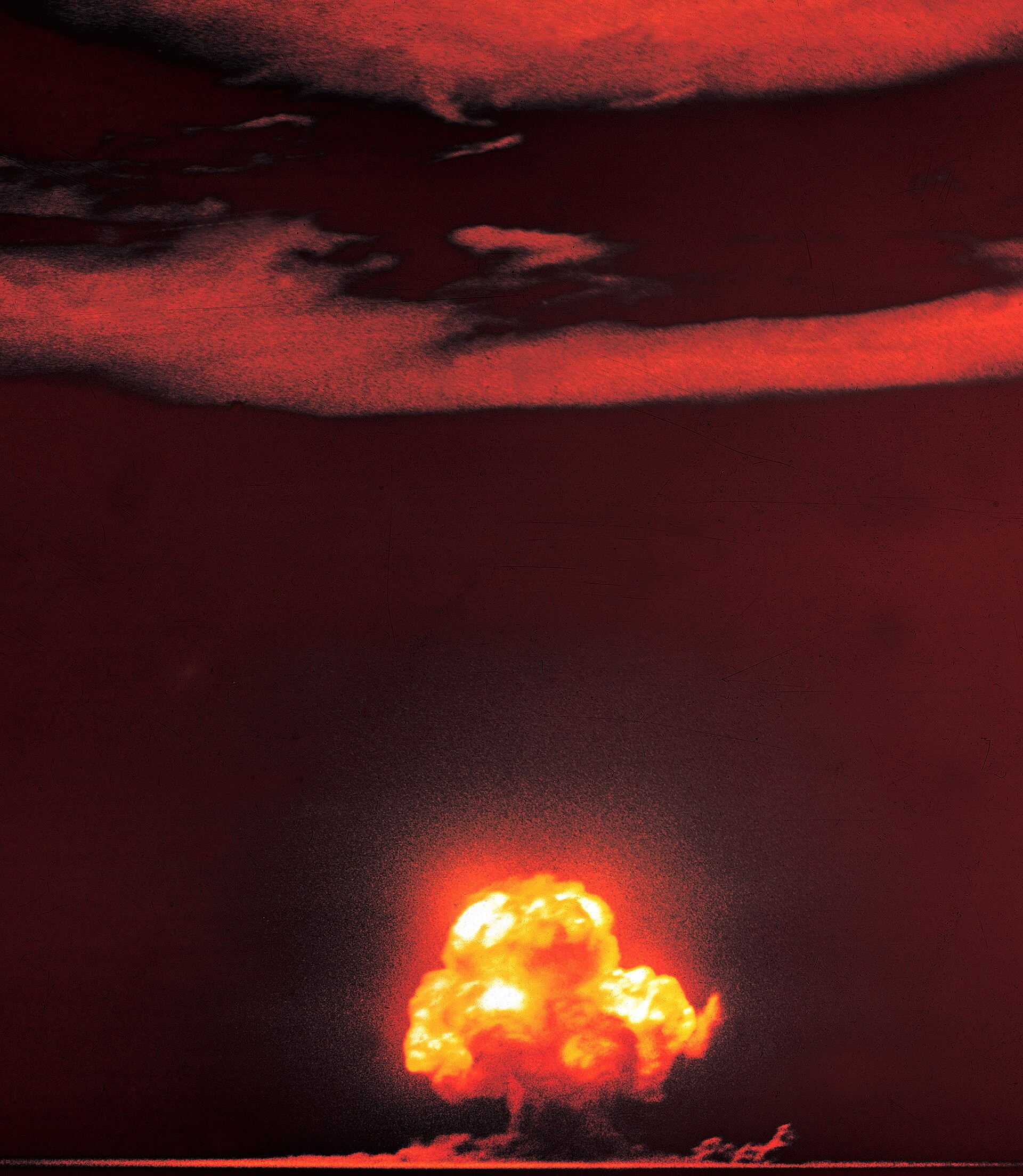
The Manhattan Project was a classified American research and development program, carried out jointly with the United Kingdom and Canada, that ran from 1939 to 1946 and produced the world’s first nuclear weapons. At its peak the project employed over 100,000 workers across more than 30 sites and cost approximately $2.2 billion. Directed by General Leslie Groves and with J. Robert Oppenheimer leading the scientific work at Los Alamos, the program transformed theoretical physics into an industrial enterprise on a scale that had never been attempted before. Its institutional legacy reached forward into the second half of the twentieth century, shaping both American science policy and the agency that became the U.S. Department of Energy.
Key facts
- Country: United States; United Kingdom; Canada
- Type: military project; task; group of humans; experiment
- Start: 1939
- End: 1946
- Location: Oak Ridge
- Participants: J. Robert Oppenheimer; Leslie Groves
Origins
The chain of events that produced the Manhattan Project began with a letter. On August 2, 1939, Albert Einstein signed a document co-written with physicist Leo Szilard, warning President Franklin D. Roosevelt that Nazi Germany might be developing nuclear weapons and urging the United States to begin its own atomic research. The outbreak of World War II on September 1 delayed delivery, and it was not until October 11, 1939, that economist Alexander Sachs personally placed the letter in Roosevelt’s hands.
The project’s formal code name derived from the Manhattan Engineer District, whose first headquarters were located in the borough of Manhattan in New York City. On August 13, 1942, after President Roosevelt formally authorized the effort, the Manhattan Project was officially created. The choice of name reflected bureaucratic geography more than scientific ambition, yet it became one of the most recognized project names in modern history.
Key milestones
The first controlled, self-sustaining nuclear chain reaction was achieved on December 2, 1942, by Enrico Fermi and his team. The reactor they used, Chicago Pile-1, was built in a squash court beneath the west stands of Stagg Field at the University of Chicago. That demonstration confirmed the physics underlying every subsequent step of the program.
Construction of the B Reactor at the Hanford Site in Washington state began in October 1943. The world’s first full-scale plutonium production reactor, it supplied the plutonium used in the Trinity test and in the Fat Man bomb later dropped on Nagasaki. To accommodate the Hanford Engineer Works, the Army Corps of Engineers commandeered roughly 600 square miles of land in Washington state, including the towns of Hanford, White Bluffs, and Richland.
Alongside the production work, the project ran Operation Alsos in three phases across Italy, France, and Germany. Manhattan Project personnel operated behind enemy lines to gather nuclear materials, capture key German scientists including Werner Heisenberg, and assess the state of the German atomic weapons program. By November 1944, Samuel Goudsmit, head of the Alsos Mission, had concluded that Germany had no atomic bomb and was not likely to have one in a reasonable time.
Scale and workforce
Operating across more than 30 project sites, the Manhattan Project drew workers from across the United States and its allied partners. Oak Ridge, Tennessee, was one of the largest installations; at the project’s height, its population reached 75,000, yet the city did not appear on any public maps.
Women formed a significant part of the workforce. At Los Alamos alone, more than 640 women were employed, representing 11 percent of the workforce there. They served as scientists, technicians, calutron operators, and in a range of other roles essential to the program’s operation.
Albert Einstein, whose 1939 letter helped set the project in motion, was denied a security clearance in 1940 because of his pacifist beliefs and never worked on the program. The man whose warning prompted the effort had no part in carrying it out.
Legacy
The U.S. Department of Energy traces its institutional origins directly to the Manhattan Project and the successor agencies that followed it. The project also became the organizational model behind the ‘big science’ approach to large-scale government-funded research, a pattern that shaped American science throughout the second half of the twentieth century.
The human cost of the program extended beyond its immediate participants. The Army Corps of Engineers displaced the populations of entire towns to build the Hanford facility, and the secrecy that governed Oak Ridge meant that tens of thousands of workers lived and worked in a city that officially did not exist.
Did you know
- Albert Einstein, whose 1939 letter helped launch the Manhattan Project, later expressed profound regret about his role. He said: “Had I known that the Germans would not succeed in developing an atomic bomb, I would have done nothing for the bomb.” (ahf.nuclearmuseum.org)
- Scientists watching the Trinity test in July 1945 ran a betting pool on the probable yield, with guesses ranging from zero to 45 kilotons. The actual yield of roughly 20 kilotons was 200 times greater than the 100-ton TNT reference explosion detonated in the preceding dress rehearsal. (thebulletin.org)
- The Trinity test fireball reached a temperature of 8,430 kelvin, or 14,710 degrees Fahrenheit — hotter than the surface of the sun. (nsarchive.gwu.edu)
- Following the Trinity test, officials publicly attributed the enormous explosion, felt across cities in New Mexico, to the accidental detonation of a bunker containing high explosives and pyrotechnics. The truth was not revealed until after the atomic bombings of Japan. (ahf.nuclearmuseum.org)
- At the height of the Manhattan Project, Oak Ridge, Tennessee’s population peaked at 75,000, yet the city appeared on no public maps. (everything-everywhere.com)
Data sources
- Wikidata
- worldhistory.org
- thebulletin.org
- docsteach.org
- nps.gov
- universite-paris-saclay.fr
- nationalww2museum.org
- hanford.gov
- ahf.nuclearmuseum.org
- energy.gov
- lostwomenofscience.org
Where it appears
- 355-Page FBI File on Physicist Robert Bacher Ends at Biography November 23, 2026
Data updated: 2026-11-02