
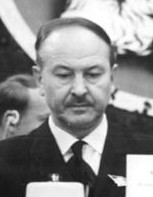
Boris Nikolaevich Ponomarev (4 January 1905 – 21 December 1995) was a Soviet historian, politician, and geopolitical analyst who spent more than six decades at the intersection of Communist Party ideology and international communist affairs. Born in Zaraysk in the Ryazan Governorate of the Russian Empire, he rose from provincial Komsomol work to the highest reaches of the Soviet apparatus, accumulating five Orders of Lenin along the way. His December 1962 speech at the All-Union Conference of Historians is recorded as a turning point in the development of Soviet historiography, and his rewritten party history that year displaced a text that had stood under Stalin’s name since 1938. Ponomarev died in Moscow on 21 December 1995.
Key facts
- Born: 4 January 1905
- Birthplace: Zaraysk
- Died: 21 December 1995
- Place of death: Moscow
- Country: Russian Empire; Russia
- Occupation: geopolitical analyst; politician; historian
- Field: politics; communism
- Employer: Lomonosov Moscow State University
- Education: MSU Faculty of Ethnology; Institute of Red Professors
- Awards: Order of Lenin; Hero of Socialist Labour; Order of the October Revolution; Order of the Red Banner of Labour
Early Life and Education
Ponomarev was born on 4 January 1905 in Zaraysk, the son of an office worker. From 1920 to 1923, still a teenager, he carried out Komsomol and party work in Zaraysk, serving as secretary of the district committee and as a member of the bureau of the Ryazan provincial committee of the Komsomol. That combination of local organisational work and ideological formation was typical of the path that Soviet cadres of his generation followed into full party careers.
He graduated from Moscow State University in 1926 and then spent two years, from 1926 to 1928, doing party work in the Donbas and Turkmenia. Returning to formal study, he completed the Institute of Red Professors in 1932 and received the rank of Professor that same year. His employer thereafter was Lomonosov Moscow State University, where his field centred on politics and communism.
Comintern and Wartime Roles
From 1937 to 1943, Ponomarev worked for the Executive Committee of the Comintern, the Soviet-dominated organisation that coordinated international communist parties. When the Comintern was dissolved, he moved into the Institute of Marx, Engels, and Lenin, serving as its deputy director in 1943–44. Both positions placed him close to the machinery through which Moscow shaped the ideological output of the global communist movement.
His patron in the ascent toward the Politburo was Mikhail Suslov, one of the last confirmed Stalinists to serve as a full Politburo member. Suslov remained active in that capacity until his death in 1982, and his backing shaped the arc of Ponomarev’s career through the same period.
Historian and Ideological Author
Ponomarev was the author and editor of numerous works on the history of the Communist Party of the Soviet Union, Soviet foreign policy, the international communist and workers’ movements, and the theory of scientific socialism. The most consequential of these was the updated state history of the CPSU that he wrote in 1962 to replace Stalin’s 1938 History of the Communist Party of the Soviet Union (Bolsheviks). The replacement was part of the Khrushchev Thaw.
His speech at the All-Union Conference of Historians in December 1962 was recorded at the time as a major turning point in the development of Soviet historiography. By issuing a revised official narrative and then publicly framing its significance for professional historians, Ponomarev helped set the boundaries within which Soviet historical scholarship was permitted to operate in the years that followed.
International Activity and the 1976 Britain Visit
Ponomarev represented Soviet foreign policy interests in several capacities beyond his party positions. During a 1976 visit to Britain as a guest of the Labour Party’s International Committee, he became the subject of demonstrations by Jewish and other minority groups. His presence also caused an internal Labour Party dispute. During that visit he told reporters that there was no Jewish problem in the Soviet Union, a statement that intensified the demonstrations already under way.
In January 1978, Ponomarev led a Supreme Soviet parliamentary delegation to the United States. On 25 January 1978 he met President Jimmy Carter at the White House for one hour, accompanied by Soviet Ambassador Anatoly Dobrynin. The meeting was one of the more direct instances of high-level Soviet legislative contact with a sitting American president during the late Cold War period.
The Afghanistan Commission
At the time of the 1979 Afghanistan crisis, Ponomarev was a member of the four-man body known as the Afghanistan Commission, alongside Andrei Gromyko, Yuri Andropov, and Dmitri Ustinov. The commission’s role was to advise the leadership on Soviet policy toward Afghanistan. Declassified records indicate that he was left out of key meetings held in December 1979, partly because his own policy experts had opposed the invasion. The records do not provide a fuller account of how that exclusion was decided or by whom.
The episode illustrates a recurring tension in Ponomarev’s position: he held formal standing at the top of the party hierarchy, yet the documented record shows that standing did not guarantee access when the most consequential decisions were being made.
Awards and Later Career
Ponomarev received five Orders of Lenin in total, along with the Order of the October Revolution, the Order of the Red Banner of Labour, and the Medal for the Defence of Moscow, among other awards. He was named Hero of Socialist Labour in 1975 and received the Lenin Prize in 1982. He also served as a deputy of the Supreme Soviet of the USSR across five consecutive convocations, from the fifth through the ninth.
He died in Moscow on 21 December 1995.
Did you know
- Ponomarev’s name is more accurately transliterated from Russian as “Ponomaryov,” though the form “Ponomarev” became more frequent in Western usage. (goodreads.com)
- During his 1976 visit to Britain, Ponomarev told reporters that “there is no Jewish problem in the Soviet Union.” The statement intensified demonstrations by Jewish groups that were already taking place against his presence in the country. (jta.org)
- Ponomarev served as a deputy of the Supreme Soviet of the USSR through five consecutive convocations, from the fifth through the ninth, a span that covered some of the most turbulent decades in Soviet history. (encyclopedia2.thefreedictionary.com)
- Declassified records from the 1979 Afghanistan crisis show that Ponomarev, though nominally a member of the four-man Afghanistan Commission alongside Gromyko, Andropov, and Ustinov, was left out of key December 1979 meetings. The records note that his own experts had opposed the invasion as a factor in his exclusion. (nsarchive.gwu.edu)
Data sources
- Wikidata
- encyclopedia2.thefreedictionary.com
- goodreads.com
- commons.wikimedia.org
- presidency.ucsb.edu
- jta.org
Where it appears
- Chernyaev’s 1982 Diary: Decay Recorded Live, Its Destination Unknown November 8, 2026
Data updated: 2026-11-02