
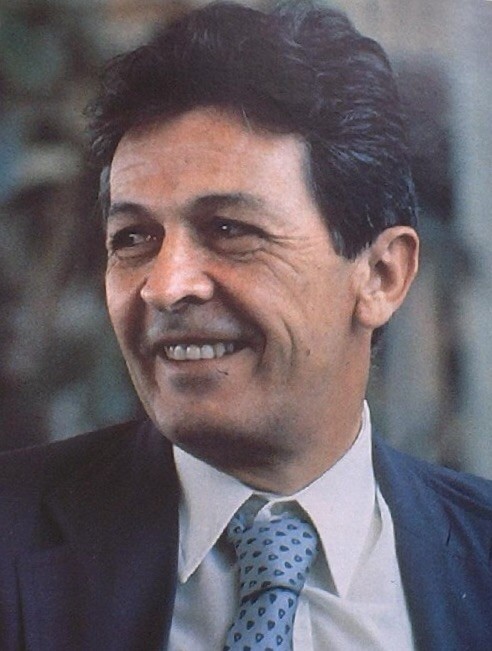
Enrico Berlinguer was an Italian politician born on 25 May 1922 in Sassari, Sardinia, who served as national secretary of the Italian Communist Party (PCI) from 1972 until his death on 11 June 1984 in Padua. Under his leadership the PCI reached 34.37% of the national vote in the June 1976 general election, the highest share the party ever achieved. His public challenge to political corruption and his pursuit of an independent path from Moscow fixed him as one of the most consequential Italian political figures of the twentieth century. More than one million people attended his funeral in Rome on 13 June 1984, making it the largest funeral in Italy’s republican history at that time.
Key facts
- Born: 25 May 1922
- Birthplace: Sassari
- Died: 11 June 1984
- Place of death: Padua
- Country: Italy; Kingdom of Italy
- Occupation: politician
- Field: politics
- Education: University of Sassari
Early life and entry into politics
Berlinguer was born on 25 May 1922 in Sassari, in the Kingdom of Italy, and later studied at the University of Sassari. In November 1943, he secretly joined the Italian Communist Party and organized the first party cell in Sassari, an act of considerable personal risk in a country then under German occupation and Fascist authority.
Rise to the party leadership
At the 13th Congress of the PCI in 1972, Berlinguer was elected national secretary of the party, succeeding Luigi Longo, who had suffered a stroke and resigned.
The PCI’s electoral peak came under his stewardship: in the June 1976 Italian general election the party won 34.37% of the vote, its highest-ever share of the national vote and its greatest number of parliamentary seats.
The moral question
On 28 July 1981, an interview with Berlinguer was published in La Repubblica in which he raised what he called the ‘questione morale’, or moral question. He accused the Italian political parties of systematic corruption and called for a renewal of public life. The interview became one of the most cited political statements of the Italian republic.
Legacy and cultural memory
Berlinguer died on 11 June 1984 in Padua. His funeral was held on 13 June 1984 in Piazza San Giovanni in Rome, drawing more than one million people, the largest such gathering in Italy’s republican history at that time.
Decades later, his life attracted renewed attention through film. The 2025 David di Donatello award for Best Actor was won by Elio Germano for his portrayal of Berlinguer in ‘The Great Ambition’, and the same film won the 2025 Nastro d’argento for Best Screenplay.
Did you know
- Although his wife Letizia Laurenti never joined the Communist Party, she reportedly referred to the PCI as “you communists” when speaking with her husband, keeping a notable personal distance from his political world throughout their 27-year marriage. (notizie.tiscali.it)
- On 3 October 1973, while heading to the airport in Sofia, Bulgaria, Berlinguer’s car was struck by a truck carrying stones. His interpreter was killed and two Bulgarian Communist officials were seriously injured; Berlinguer escaped with minor injuries. The incident became the subject of lasting controversy, with some sources claiming it was a KGB assassination attempt. A 2019 scholarly study published in the journal Ventunesimo Secolo concluded that the assassination conspiracy theory is groundless. (francoangeli.it)
Data sources
Where it appears
- Chernyaev’s 1982 Diary: Decay Recorded Live, Its Destination Unknown November 8, 2026
Data updated: 2026-11-02