
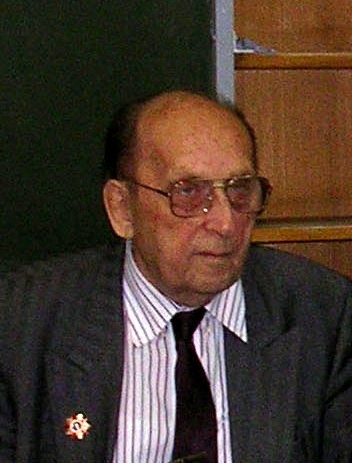
Georgy Arbatov (19 May 1923 – 1 October 2010) was a Soviet and Russian political scientist, geopolitical analyst, journalist, and historian whose career spanned the Cold War from its earliest years to its end. Born in Kherson, he founded the Institute for US and Canadian Studies in Moscow in 1967 and directed it for nearly three decades, building it into a leading Soviet institution for analysing American and Canadian policy. His 380-page memoir, The System: An Insider’s Life in Soviet Politics, published in English in 1992, remains one of the frankest accounts of how the Soviet foreign-policy apparatus worked from the inside. Named Academician of the Academy of Sciences of the USSR in 1974, he held simultaneously the titles of institute director and Senior Foreign Policy Advisor of the Foreign Department of the Central Committee of the CPSU, a dual standing formally recorded in US State Department historical documents.
Key facts
- Born: 19 May 1923
- Birthplace: Kherson
- Died: 1 October 2010
- Place of death: Moscow
- Country: Soviet Union; Russia
- Occupation: geopolitical analyst; politician; journalist; historian
- Field: political scientist
- Employer: Institute for US and Canadian Studies
- Education: Moscow State Institute of International Relations
- Awards: Order of Lenin; Order of the Red Star; Order of the October Revolution; Order of the Badge of Honour
Early life and education
Arbatov was born in Kherson on 19 May 1923. He served on the front lines during the Second World War, where he contracted tuberculosis. While recuperating in 1944, he read a newspaper report stating that a state institute of international relations was being created in Moscow and applied to attend. That notice set the course of his professional life. He went on to study at the Moscow State Institute of International Relations (MGIMO), where he prepared for a career that would bridge Soviet scholarship and Soviet statecraft.
His wartime experience was not confined to hospitals. Arbatov participated in the 7 November 1941 Red Square military parade, an event staged by Stalin to sustain morale during the German advance, and proceeded directly from that parade to the front.
The Institute for US and Canadian Studies
In 1967, Arbatov founded the Institute for US and Canadian Studies, known by its Russian acronym ISKRAN, and served as its director until 1995, when he was appointed director emeritus. Over nearly three decades the institute served as a Soviet and then Russian centre for studying American and Canadian politics, economics, and foreign policy.
Arbatov’s institutional standing extended well beyond ISKRAN. US State Department historical documents in the Foreign Relations of the United States series (FRUS 1969–76) list him simultaneously as ‘Director of the Institute of the United States of America’ and ‘Senior Foreign Policy Advisor of the Foreign Department of the Central Committee of the CPSU’. He became a deputy of the Supreme Soviet in 1973, and in 1981 he became a member of the Central Committee of the Communist Party, a rare combination of scholarly and party-political authority.
Scholarly recognition and published work
In 1974, Arbatov received the highest Soviet scientific distinction available to a researcher: he was named Academician of the Academy of Sciences of the USSR. He also received the Order of Lenin, the Order of the Red Star, the Order of the October Revolution, and the Order of the Badge of Honour.
His memoir The System: An Insider’s Life in Soviet Politics was published in English by Times Books in 1992. Running to 380 pages, it offered a first-hand account of Soviet foreign-policy decision-making from a participant who had worked at the intersection of scholarship and statecraft.
In 2023, on the centenary of Arbatov’s birth, the ISKRAN institute journal USA & Canada: Economics, Politics, Culture published a tribute article by Columbia University scholar Robert Legvold titled ‘Georgy Arbatov was a towering figure’.
Role as an interlocutor between East and West
Arbatov’s position made him one of the Soviet Union’s most visible contacts for Western officials and politicians. Over the course of his career he built working relationships with German Chancellor Willy Brandt, Swedish Prime Minister Olof Palme, Henry Kissinger, and George H.W. Bush, among others. His access on both sides of the Cold War divide was unusual for a Soviet academic.
Yevgeny Primakov, who served as prime minister of Russia under Boris Yeltsin, described Arbatov as belonging to ‘a group of reformers who believed that the Soviet system could be and had to be reformed.’
Death
Georgy Arbatov died on 1 October 2010 in Moscow at the age of 87. He had directed ISKRAN from its founding in 1967 before transitioning to the role of director emeritus in 1995, and he remained associated with the institute until his death.
Did you know
- Arbatov participated in the 7 November 1941 Red Square military parade, a wartime event staged by Stalin to boost morale, and marched directly from it to the front lines to fight the Nazi invaders. (rbth.com)
- Arbatov’s decision to pursue an academic career in international relations was triggered by a hospital stay: while recovering from tuberculosis contracted at the front in 1944, he read a newspaper notice about the newly founded MGIMO and applied on the spot. (rbth.com)
- Arbatov was a confidant, throughout his career, to a wide range of Western leaders, including German Chancellor Willy Brandt, Swedish Prime Minister Olof Palme, Henry Kissinger, and George H.W. Bush. (hnn.us)
- The US State Department’s own historical documents (FRUS 1969–76) list Arbatov as both ‘Director of the Institute of the United States of America’ and ‘Senior Foreign Policy Advisor of the Foreign Department of the Central Committee of the CPSU’ simultaneously. (history.state.gov)
- In 1973, Arbatov became a deputy of the Supreme Soviet, and in 1981 he became a member of the Central Committee of the Communist Party, a rare dual institutional standing for a scholar-diplomat. (hnn.us)
Data sources
Where it appears
- Chernyaev’s 1982 Diary: Decay Recorded Live, Its Destination Unknown November 8, 2026
Data updated: 2026-11-02