
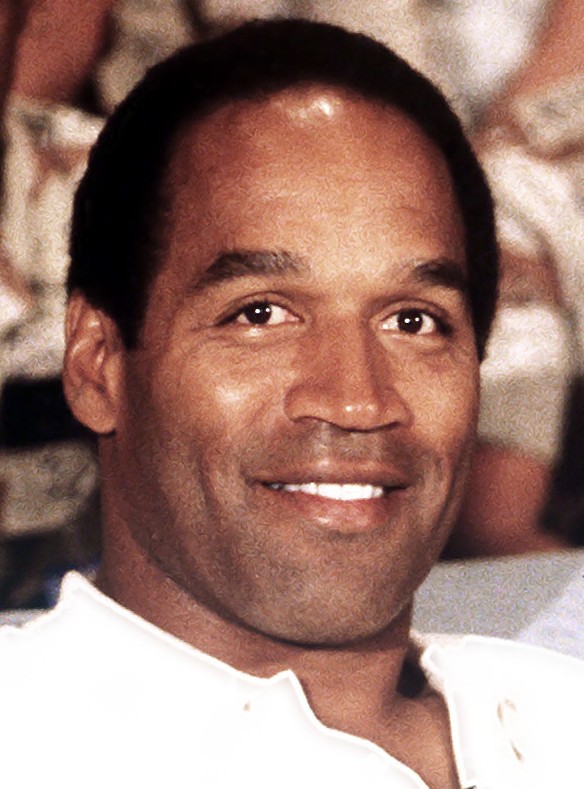
Orenthal James Simpson, born on July 9, 1947, in the Potrero Hill neighborhood of San Francisco, California, became one of the most celebrated and later most controversial figures in American public life. As a running back, he set records that defined an era: in the 1973 NFL season he became the first player in league history to rush for more than 2,000 yards in a single season, finishing with 2,003 yards across a 14-game schedule. His criminal murder trial in 1995, which ended in acquittal after the jury deliberated for less than four hours, drew an estimated 150 million American listeners and viewers and is widely recognized as a cultural turning point in national conversations about race, policing, celebrity, and the media’s role in the justice system. Simpson died of prostate cancer on April 10, 2024, in Las Vegas at the age of 76.
Key facts
- Born: 9 July 1947
- Birthplace: San Francisco
- Died: 10 April 2024
- Place of death: Las Vegas
- Country: United States
- Occupation: actor; athletics competitor; American football player; film actor
- Field: American football
- Education: Galileo Academy of Science and Technology; City College of San Francisco; University of Southern California
- Awards: Pro Football Hall of Fame; Associated Press Athlete of the Year
Early Life and Path to Football
Simpson was the third of four children born to Eunice (née Durden) and Jimmy Lee Simpson. He grew up in the Potrero Hill neighborhood of San Francisco, and his childhood was not without hardship: he suffered from rickets and wore leg braces fashioned by his mother until he was five years old. In 1960, at age thirteen, he joined the Persian Warriors, a San Francisco street gang, and in 1962 was briefly incarcerated at the San Francisco Youth Guidance Center.
A chance encounter with baseball legend Willie Mays changed his direction. Simpson later described the meeting in his autobiography as the moment that showed him a path out of poverty and gang life, and he redirected his energy toward athletics. After graduating from Galileo High School in San Francisco in 1965, he enrolled at City College of San Francisco, where he set national junior-college rushing records over two seasons.
College Career and the Heisman Trophy
Simpson transferred to the University of Southern California in 1967. Over his two seasons with the USC Trojans, he was twice named a unanimous All-American and led the nation in rushing yards both years. USC went 19-2-1 during his two seasons, and his performances were central to that stretch of success.
In 1968, Simpson won the Heisman Trophy by 1,750 points over runner-up Leroy Keyes of Purdue, the largest margin in Heisman Trophy history at that time. He was inducted into the College Football Hall of Fame in 1983.
NFL Career and Records
After his college years, Simpson entered the NFL and eventually produced a season that no player in a 14-game schedule has since equaled. In 1973, he rushed for 2,003 yards, breaking Jim Brown’s previous record of 1,863 yards set in 1963. His 143.1 rushing yards per game average during that season remains the highest single-season mark in NFL history.
The record-breaking final push came in the snow of Shea Stadium, where Simpson rushed for 200 yards in the season’s last game to push his total past 2,000. The Pro Football Hall of Fame inducted him in 1985, the first year he was eligible.
Broadcasting and Acting Career
After retiring from football, Simpson worked as a commentator for ABC’s Monday Night Football and NBC’s NFL Live pre-game show. He also built a parallel career in front of the camera. Beginning in 1975, he served as the television spokesman for Hertz car rentals for nearly 20 years, appearing in a series of commercials in which he ran through airports. Hertz terminated that relationship following his 1994 arrest.
On screen, Simpson played the recurring role of the accident-prone Detective Nordberg in all three films of The Naked Gun franchise: The Naked Gun: From the Files of Police Squad! (1988), The Naked Gun 2½: The Smell of Fear (1991), and Naked Gun 33⅓: The Final Insult (1994).
Marriage, Arrest, and the 1994 Murders
Simpson married Nicole Brown on February 2, 1985. On January 1, 1989, he was arrested for spousal battery after Nicole required hospital treatment. He subsequently pleaded no contest and received 120 hours of community service and two years of probation.
On June 12, 1994, Nicole Brown Simpson and her friend Ronald Goldman were stabbed to death outside her home in Los Angeles. Simpson became the primary suspect. On June 17, 1994, he led police on a widely televised slow-speed chase along the 405 freeway in a white Ford Bronco before surrendering.
The Criminal Trial
The criminal case, formally titled People of the State of California v. Orenthal James Simpson, ran from January 24, 1995, to October 3, 1995. After more than eight months of testimony, the jury deliberated for less than four hours before returning a not-guilty verdict on October 3, 1995.
An estimated 150 million Americans listened or watched on television as the verdict was delivered. The trial sharply divided American public opinion along racial lines and is widely recognized by scholars and journalists as a cultural turning point that brought issues of race, policing, celebrity, and media influence in the justice system into the national conversation.
Civil Liability and Aftermath
In a 1997 civil trial in Santa Monica, a jury found Simpson liable for the wrongful deaths of Nicole Brown Simpson and Ronald Goldman, ordering him to pay $33.5 million in damages to their families. Much of that judgment was never collected. According to attorneys, with accrued interest the judgment had grown to roughly $100 million by the time of his death in 2024, and much of it remained unpaid.
Death and Legacy in Media
Simpson died of prostate cancer on April 10, 2024, in Las Vegas. His family announced his death via a post on his verified X account. He was cremated in Las Vegas; his estate’s executor confirmed there were no plans to donate his brain for chronic traumatic encephalopathy (CTE) research.
The case and Simpson’s life have generated extensive documentary and dramatic treatment. ESPN’s five-part documentary O.J.: Made in America (2016), directed by Ezra Edelman, won the Academy Award for Best Documentary Feature in 2017 and is regarded as one of the most acclaimed sports documentaries ever produced. FX’s dramatized miniseries The People v. O.J. Simpson: American Crime Story (2016), produced by Ryan Murphy, starred Cuba Gooding Jr. as Simpson; Gooding earned an Emmy nomination for outstanding lead actor in a limited series for the role.
Did you know
- As a child, Simpson suffered from rickets and wore leg braces made by his own mother until he was five years old, yet went on to be regarded as one of the greatest running backs in NFL history. (etonline.com)
- The civil judgment of $33.5 million against Simpson in 1997 had, according to attorneys, grown to roughly $100 million with accrued interest by the time of his death in 2024, and much of it remained unpaid. (foxla.com)
- USC went 19-2-1 during Simpson’s two seasons (1967–68) with the Trojans, and his 64-yard touchdown run in the 1967 game against UCLA, from USC’s own 36-yard line, secured a 21-20 victory that clinched the national championship bid. (m.espn.com)
- During the 1973 season, Simpson rushed for 200 yards in the final game in the snow of Shea Stadium to surpass 2,000 yards for the season, finishing with 2,003 yards in only a 14-game schedule, a record that has never been matched in a 14-game season. (espn.com)
- As a teenager, Simpson had a brief encounter with San Francisco Giants centerfielder Willie Mays, which he later described in his autobiography as the defining moment that showed him a path out of poverty and gang life. (kbsagert.com)
Data sources
- Wikidata
- kbsagert.com
- aaregistry.org
- aetv.com
- ebsco.com
- m.espn.com
- profootballhof.com
- biography.com
- sfchronicle.com
- rottentomatoes.com
- today.com
- cbsnews.com
- foxla.com
- history.com
- espn.com
- foxnews.com
- bostonglobe.com
- spectrumnews1.com
Where it appears
- FBI’s 1994 Simpson File: Shoe Tracing, Toxicology, No Conclusion November 9, 2026
Data updated: 2026-11-03