
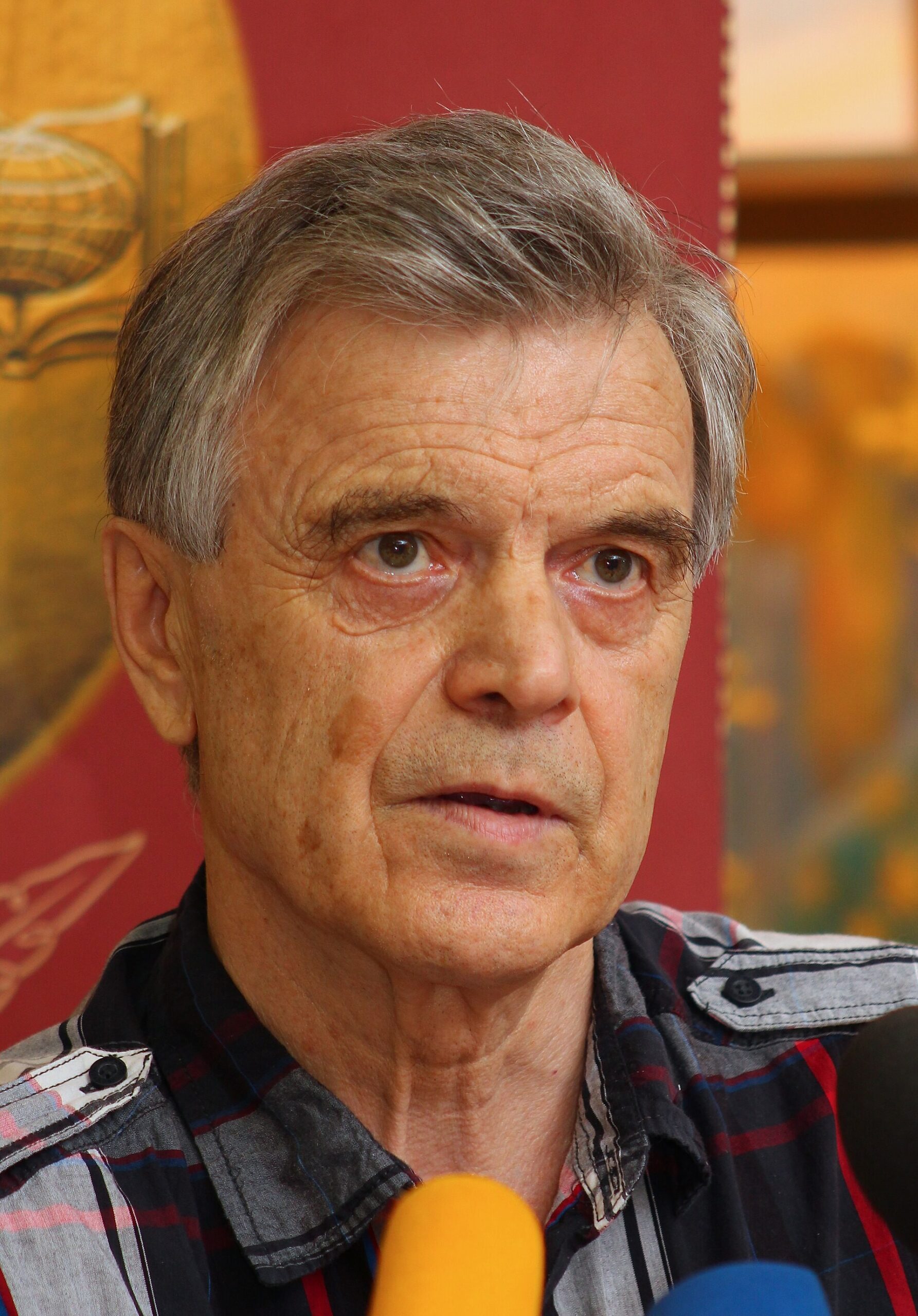
Ruslan Imranovich Khasbulatov was a Russian politician, economist, and jurist who served as chairman of the Supreme Soviet of the Russian Federation and became the most prominent institutional opponent of President Boris Yeltsin during the constitutional crisis of 1993. Born on 22 November 1942 in Tolstoy-Yurt, a village near Grozny in the Checheno-Ingush ASSR, he rose from an academic career at the Plekhanov Russian Economic University to the highest legislative office in post-Soviet Russia. His arrest following the October 1993 standoff at the White House, and his amnesty in February 1994, made him one of the most contested political figures of the Yeltsin era.
Key facts
- Born: 22 November 1942
- Birthplace: Grozny
- Died: 3 January 2023
- Place of death: Mozhaysk Municipal Okrug
- Country: Soviet Union; Russia
- Occupation: politician; university teacher; economist; jurist
- Field: politics; economics; law
- Employer: Plekhanov Russian Economic University
- Education: Moscow State University, Faculty of Law
- Awards: Honoured Science Worker of the Russian Federation; Medal “For Labour Valour”
Early life and education
Khasbulatov was born on 22 November 1942 in Tolstoy-Yurt, a village near Grozny; his registered birthplace is therefore technically the village rather than Grozny city itself. He grew up in the Checheno-Ingush ASSR, part of the Soviet Union, and pursued legal studies at Moscow State University, graduating from its Faculty of Law in 1965. He later earned a doctorate in economics in 1980, anchoring an academic identity that ran parallel to his political one throughout his career.
That dual grounding in law and economics shaped his work at the Plekhanov Russian Economic University, where he held a teaching post. He was also elected a corresponding member of the Russian Academy of Sciences, and the Russian Federation recognised his scholarly contributions with the title Honoured Science Worker and the Medal for Labour Valour.
Political ascent
In March 1990, Khasbulatov was elected a People’s Deputy of the Russian SFSR. When Boris Yeltsin was elected chairman of the Russian Supreme Soviet, Yeltsin chose Khasbulatov as his first deputy in May 1990. The two men worked in close alignment during the critical early months of Russia’s post-Soviet transition.
That alliance did not survive the consolidation of presidential power. By 1993 Khasbulatov, as Supreme Soviet chairman, was leading legislative resistance to Yeltsin’s decrees. The confrontation culminated in October 1993, when Yeltsin ordered tanks to fire on the White House building in Moscow. Khasbulatov was inside when the assault took place and was subsequently arrested.
The 1991 coup and its reversal
In August 1991, Khasbulatov stood alongside Yeltsin on a tank outside the White House to resist the attempted coup against Mikhail Gorbachev. At that point he was acting as Supreme Soviet chairman. Just over two years later, the same building became the site of an armed confrontation ordered by Yeltsin, with Khasbulatov on the opposite side of the barricade.
Arrest, amnesty, and return
After his arrest in October 1993, Khasbulatov was held until February 1994, when the newly elected State Duma passed a decree granting amnesty to those involved in the October 1993 crisis. The Kremlin objected, but the amnesty held and Khasbulatov was freed.
His release touched off a period of considerable public attention in Chechnya. According to journalist Mikhail Fishman, Khasbulatov traveled around Chechnya at the height of his post-prison popularity and drew between 200,000 and 300,000 people to rallies in his support. He considered running for President of the Chechen Republic in 2003 but ultimately did not enter the race; that election was won by Akhmat Kadyrov.
Later years and legacy
Khasbulatov remained in the same Moscow apartment from the early 1990s until his death, a span of roughly three decades. He returned to academic work at the Plekhanov Russian Economic University and continued to comment publicly on Russian politics and the situation in Chechnya.
He published a memoir on the First Chechen War under the title ‘Chechnia: mne ne dali ostanovit’ voinu’ (‘Chechnya: They Prevented Me From Stopping the War’), in which he described his peacekeeping efforts during that conflict. In a 2014 interview with the newspaper Argumenty i Fakty, he stated: ‘Yeltsin essentially ruined my life.’
In 2021, Khasbulatov endorsed incumbent Ramzan Kadyrov for re-election as head of Chechnya. After Khasbulatov’s death on 3 January 2023 in the Mozhaysk Municipal Okrug, Kadyrov called it ‘an irreparable loss’ for the Chechen people.
Did you know
- At the height of his popularity after his release from prison in 1994, Khasbulatov traveled around Chechnya and attracted between 200,000 and 300,000 people to rallies in his support, according to journalist Mikhail Fishman. (meduza.io)
- Khasbulatov considered running for President of the Chechen Republic in 2003 but ultimately chose not to; the election that year was won by Akhmat Kadyrov, whose son Ramzan Kadyrov Khasbulatov would go on to endorse for re-election in 2021. (meduza.io)
- Khasbulatov lived in the same Moscow apartment from the early 1990s continuously until his death on 3 January 2023, a period of roughly three decades. (meduza.io)
- When Khasbulatov joined Yeltsin on the tank outside the White House in August 1991 to resist the coup, he was acting as Supreme Soviet chairman; just over two years later, tanks were firing at that same White House building on Yeltsin’s orders, with Khasbulatov inside. (russianstudiesromania.eu)
Data sources
Where it appears
Data updated: 2026-11-01