
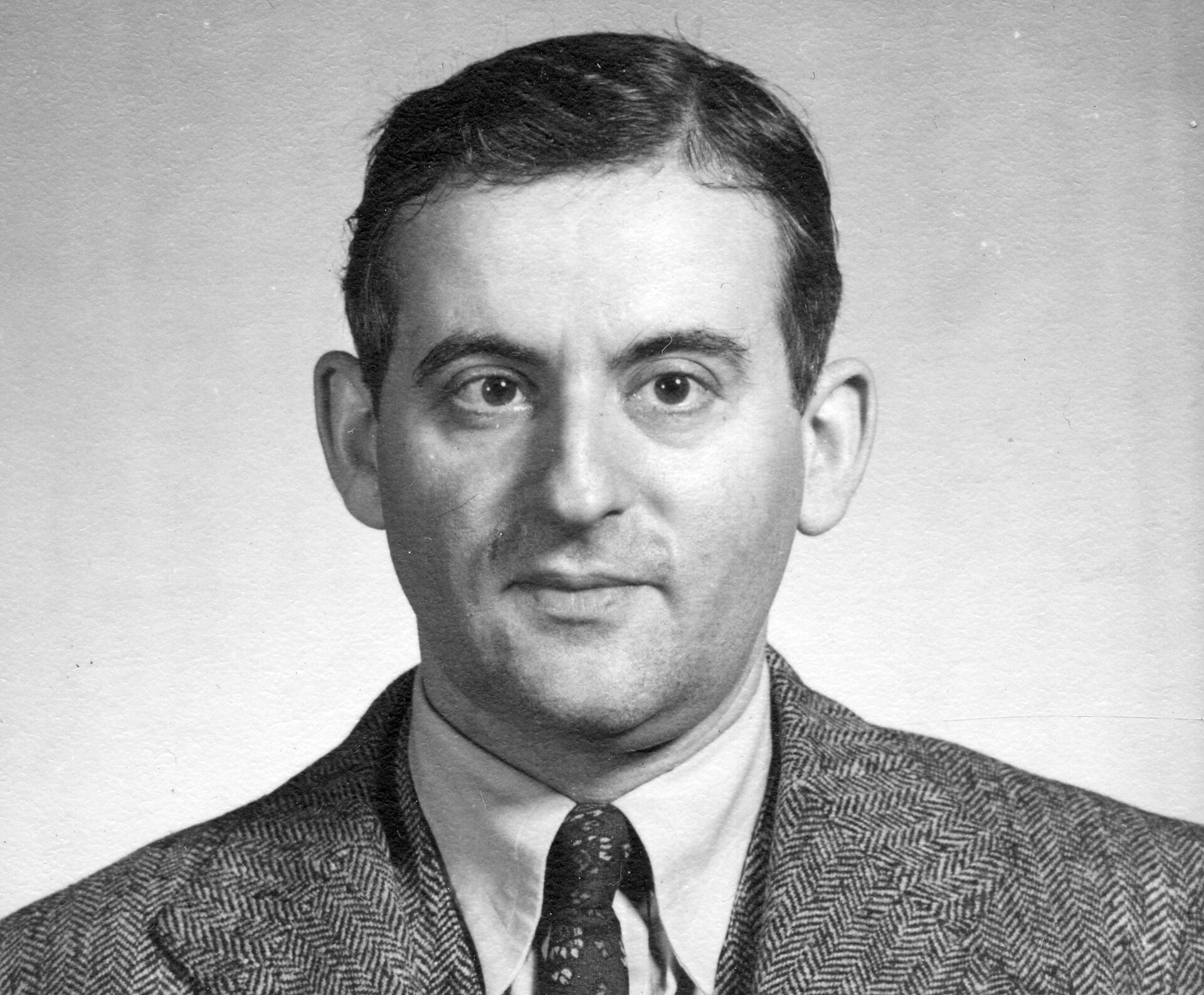
Samuel Goudsmit (11 July 1902 – 4 December 1978) was a Dutch-American theoretical physicist who, in mid-September 1925, proposed alongside George Uhlenbeck that the electron possesses intrinsic angular momentum — spin — with a value of one half Planck constant and a magnetic moment of one Bohr magneton. That single proposal reshaped quantum mechanics at its foundations. Beyond the laboratory, Goudsmit led wartime intelligence work, invented a precision instrument for measuring atomic mass, and edited scientific literature across four decades.
Key facts
- Born: 11 July 1902
- Birthplace: The Hague
- Died: 4 December 1978
- Place of death: Reno
- Country: Kingdom of the Netherlands; United States
- Occupation: physicist
- Field: theoretical physics
- Employer: University of Michigan; Leiden University; University of Nevada, Reno; Northwestern University
- Education: Leiden University
- Awards: Guggenheim Fellowship; Max Planck Medal; National Medal of Science; Fellow of the American Physical Society
Early life and education
Goudsmit was born in The Hague on 11 July 1902. He studied theoretical physics at the University of Leiden from 1919 to 1926, while also conducting experimental research at the University of Amsterdam from 1923 to 1926. He received his Ph.D. from Leiden in 1927. Both institutions shaped a career that moved steadily between theory and experiment throughout his life.
The discovery of electron spin
In mid-September 1925, Goudsmit and fellow Leiden graduate student George Uhlenbeck proposed that the electron carries intrinsic angular momentum, which they called spin, with a value of one half Planck constant and a magnetic moment of one Bohr magneton. The proposal gave a physical interpretation to a quantum number that had previously been treated as a formal bookkeeping device.
Their discovery note was published in Naturwissenschaften and is dated 17 October 1925. Their supervisor Paul Ehrenfest submitted it without waiting for their approval, having acted after Hendrik Lorentz raised objections about the idea’s compatibility with classical electrodynamics. The paper appeared despite those unresolved objections, and the concept of spin went on to become a cornerstone of quantum mechanics.
Wartime work: the Radiation Laboratory and the Alsos Mission
In 1941, Goudsmit joined the Radiation Laboratory at the Massachusetts Institute of Technology, where he conducted radar research and headed the laboratory’s document room. That room held information about German technical capacities, a responsibility that placed him at the edge of wartime intelligence work before he moved fully into it.
In May 1944, Goudsmit became scientific director of the Manhattan Project’s Alsos Mission, a top-secret operation tasked with gathering intelligence on Germany’s atomic program. He served in that role from 1944 to 1946. His fluency in Dutch, English, French, and German, combined with his personal acquaintance with virtually every major German physicist, were cited as the key reasons he was selected for the position.
The magnetic time-of-flight mass spectrometer
In 1948, Goudsmit invented the magnetic time-of-flight mass spectrometer, a device that determines atomic mass by measuring the flight time of ions over a known distance in a magnetic field. Its distinguishing feature was that it offered the same precision for all masses, addressing a limitation of earlier designs. The instrument extended his earlier experimental work and demonstrated that his contributions to physics were not confined to theoretical proposals.
Academic appointments and later career
Over the course of his career, Goudsmit held positions at the University of Michigan, Leiden University, Northwestern University, and the University of Nevada, Reno. He received several major honours: a Guggenheim Fellowship, the Max Planck Medal, the National Medal of Science, and election as a Fellow of the American Physical Society. In 1974, the American Institute of Physics awarded him the Karl T. Compton Medal, citing fifty years of creative leadership in physics as a researcher, teacher, author, and editor.
Goudsmit served as a member of the 1952 Scientific Advisory Panel on Unidentified Flying Objects, known as the Robertson Panel. The panel’s work fell well outside the orbit of quantum physics, making it one of the more unusual assignments of his career.
He died in Reno on 4 December 1978. After his death, his wife bequeathed the Samuel A. Goudsmit Collection of Egyptian Antiquities to the Kelsey Museum of Archaeology at the University of Michigan in Ann Arbor.
Did you know
- Goudsmit’s fluency in four languages — Dutch, English, French, and German — and his personal acquaintance with virtually every major German physicist were key reasons he was selected to lead the scientific intelligence work of the Alsos Mission. (caans-acaen.ca)
- When Ehrenfest submitted the electron spin paper to Naturwissenschaften in October 1925, Uhlenbeck asked him not to, fearing the idea was wrong. Ehrenfest reportedly replied: “You are both young enough to be able to afford a stupidity!” (lorentz.leidenuniv.nl)
- Goudsmit served as a member of the 1952 Scientific Advisory Panel on Unidentified Flying Objects (the Robertson Panel), one of the more unusual assignments in the career of a quantum physicist. (daviddarling.info)
- The American Institute of Physics awarded Goudsmit the 1974 Karl T. Compton Medal, citing “fifty years of creative leadership in physics as a researcher, teacher, author, and editor.” (aip.org)
Data sources
- Wikidata
- history.aip.org
- lorentz.leidenuniv.nl
- ahf.nuclearmuseum.org
- collections.ushmm.org
- handwiki.org
Where it appears
- 355-Page FBI File on Physicist Robert Bacher Ends at Biography November 23, 2026
Data updated: 2026-11-02