
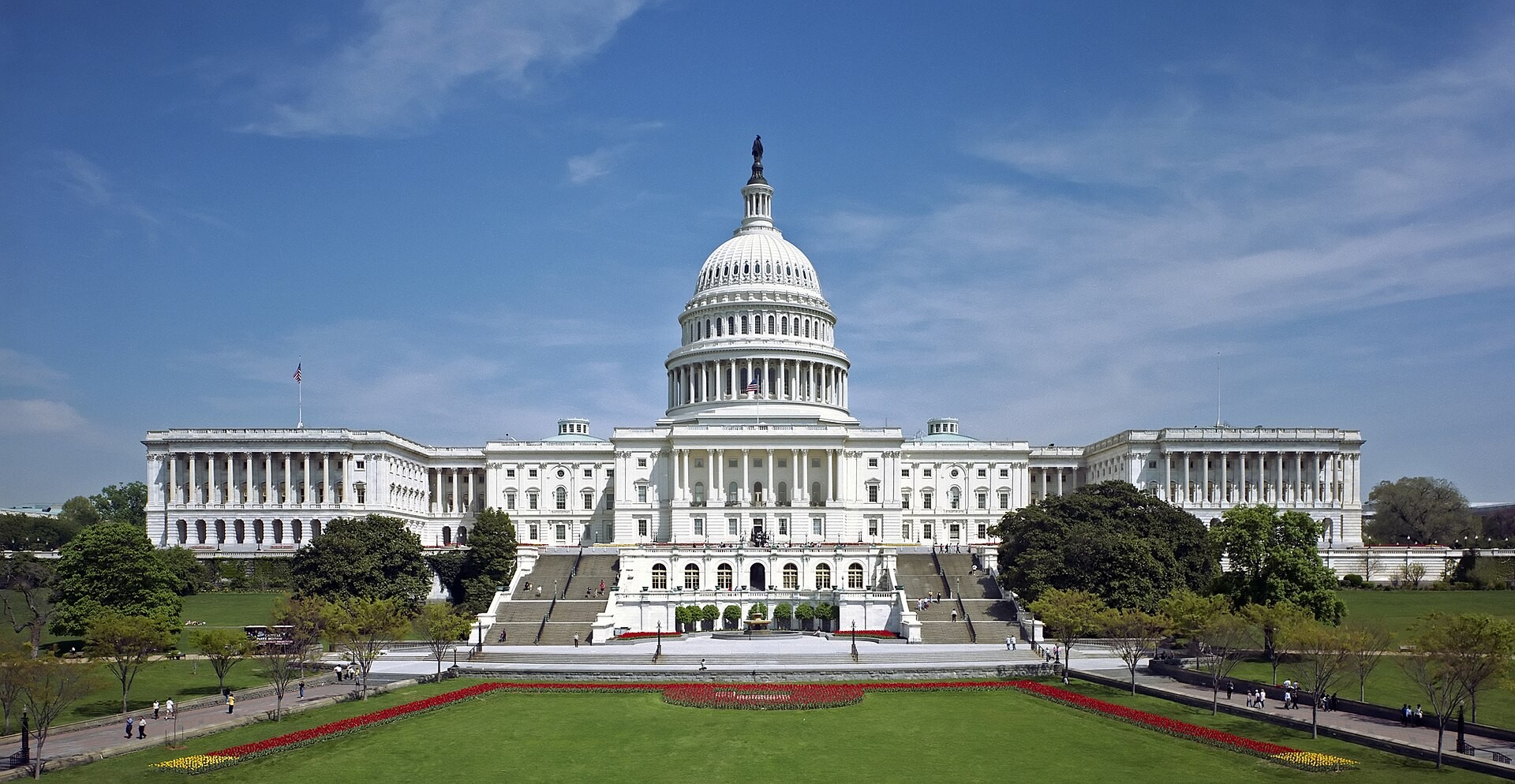
The United States Capitol is the building in Washington, D.C. where the U.S. Congress meets to conduct the legislative business of the federal government. Its cornerstone was laid on September 18, 1793, and after more than a century and a half of expansions, the complex reached its current size in 1960, covering 1.5 million square feet. The cast-iron dome that defines its silhouette weighs 8.9 million pounds and rises 288 feet, making it the tallest cast-iron dome in the world. What began as a proposal for a modest 15-room brick building grew into a structure containing roughly 540 rooms, 658 windows, and 850 doorways.
Key facts
- Country: United States
- Type: capitol building
- Located in: Washington, D.C.
- Coordinates: 38.8897, -77.0092
- Area: 1.5e+06 square foot
- Founded: 18 September 1793
Origins and early construction
The building’s origins trace to a competition held in the early republic. Amateur architect William Thornton first sketched his proposal on the Caribbean island of Tortola, and his design eventually won out. The cornerstone ceremony took place on September 18, 1793, launching a construction effort that would stretch across generations and involve repeated episodes of destruction and rebuilding.
What had been proposed as a compact 15-room structure evolved, through successive architects and congressional appropriations, into an ever-larger complex. Among the architects who shaped its early character was Benjamin Latrobe, who oversaw significant work on both the House and Senate wings in the early nineteenth century.
The burning of 1814 and its aftermath
On August 24, 1814, British troops set fire to the Capitol during their occupation of Washington. The blaze burned so intensely that the marble columns in the Senate chamber were reduced to limestone. Only a sudden rainstorm, by the accounts of those present, prevented the building’s complete destruction. Latrobe, surveying the wreckage afterward, described it as “a most magnificent ruin.”
With the Capitol gutted, Congress relocated temporarily to the Old Brick Capitol, which served as the seat of the U.S. government from 1815 to 1819 while repairs proceeded. Rebuilding took four years and required replacing or restoring virtually every interior element that the fire had destroyed. A separate fire in 1851 caused additional damage when it destroyed much of the Library of Congress, which was housed inside the Capitol at that time.
The dome: from wood and copper to cast iron
That combination made it a persistent fire hazard and demanded constant maintenance. Congress authorized a replacement after reviewing just a single drawing, an unusually swift decision for a project of such scale.
Work on the new dome began in 1856 when the Bulfinch structure was removed. The replacement consisted of an inner dome and an outer dome, both cast in iron, and the full project ran until 1866 at a total cost of $1,047,291. Construction did not pause during the Civil War. The work continued as a deliberate symbol of the Union’s resolve to endure, and laborers raised iron sections throughout the conflict.
The interior of the dome was completed in 1866 with the fresco known as the “Apotheosis of Washington,” which hangs 180 feet above the Rotunda floor. Crowning the outer dome is the bronze Statue of Freedom, which stands 19 feet 6 inches tall. In 2016, the Architect of the Capitol completed a multi-year restoration of the dome that repaired more than 1,000 cracks and structural deficiencies.
The chambers and the growing complex
The House of Representatives moved into its present chamber in 1857, and the Senate first occupied its present chamber in 1859. Both chambers were part of the wing extensions that expanded the building significantly during the mid-nineteenth century. The Capitol reached its current footprint in 1960, when the final expansion was completed and the building was designated a National Historic Landmark on December 19, 1960.
An extension of the east front began in 1958. The Capitol complex in its finished form contains roughly 540 rooms, 658 windows, and 850 doorways across 1.5 million square feet.
The grounds surrounding the building were redesigned by Frederick Law Olmsted, the leading American landscape architect of the nineteenth century, who reshaped the earlier wooded arrangement. Underground beneath the East Front Plaza, the Capitol Visitor Center opened in 2008 and receives millions of visitors each year.
National Statuary Hall
In 1864, Congress invited each state to contribute two statues of prominent citizens for permanent display inside the Capitol, establishing what became National Statuary Hall. As the number of statues grew and began to exceed what the Hall could hold, Congress authorized in 1933 the distribution of statues throughout the building, responding both to aesthetic concerns and to the structural load the Hall was bearing.
Security incidents
On July 24, 1998, gunman Russell Eugene Weston Jr. entered the Capitol and opened fire, killing U.S. Capitol Police Officer Jacob Chestnut and Detective John Gibson.
Following the January 6, 2021 riot at the Capitol, security measures were significantly expanded. As of January 6, 2025, 10-foot-high fencing was erected around the building for the certification of the 2024 presidential election, reflecting the lasting changes to the security posture that the 2021 event produced.
Did you know
- Philip Reid, a formerly enslaved man, helped cast and raise the Statue of Freedom onto the Capitol dome in 1863. (learningenglish.voanews.com)
- The Capitol dome, at 288 feet, is the tallest cast-iron dome in the world. (lostnewengland.com)
- Congress authorized replacing the original dome with the new cast-iron design after reviewing just a single drawing. (pbs.org)
- In 1851, a fire destroyed much of the Library of Congress, which was then housed inside the Capitol. (blogs.loc.gov)
- The idea for the Capitol building was first sketched on the Caribbean island of Tortola by amateur architect William Thornton. (blogs.loc.gov)
- Architect Benjamin Latrobe described the fire-ravaged Capitol as “a most magnificent ruin.” (dcist.com)
- In 2016, the Architect of the Capitol completed a multi-year restoration that repaired more than 1,000 cracks and deficiencies in the dome. (pbs.org)
Data sources
- Wikidata
- foxx.house.gov
- dcist.com
- pbs.org
- blogs.loc.gov
- aoc.gov
- kimshistorytravel.com
- nationalparkswitht.com
- cbinsights.com
- san.com
Where it appears
- 153 Pages on Jan. 6, the Findings Not Included November 25, 2026
- May 17, 2022 UAP Hearing: The Black Vault’s Unedited Record of Congress’s Return November 11, 2026
Data updated: 2026-11-04