
Reference C 81/456
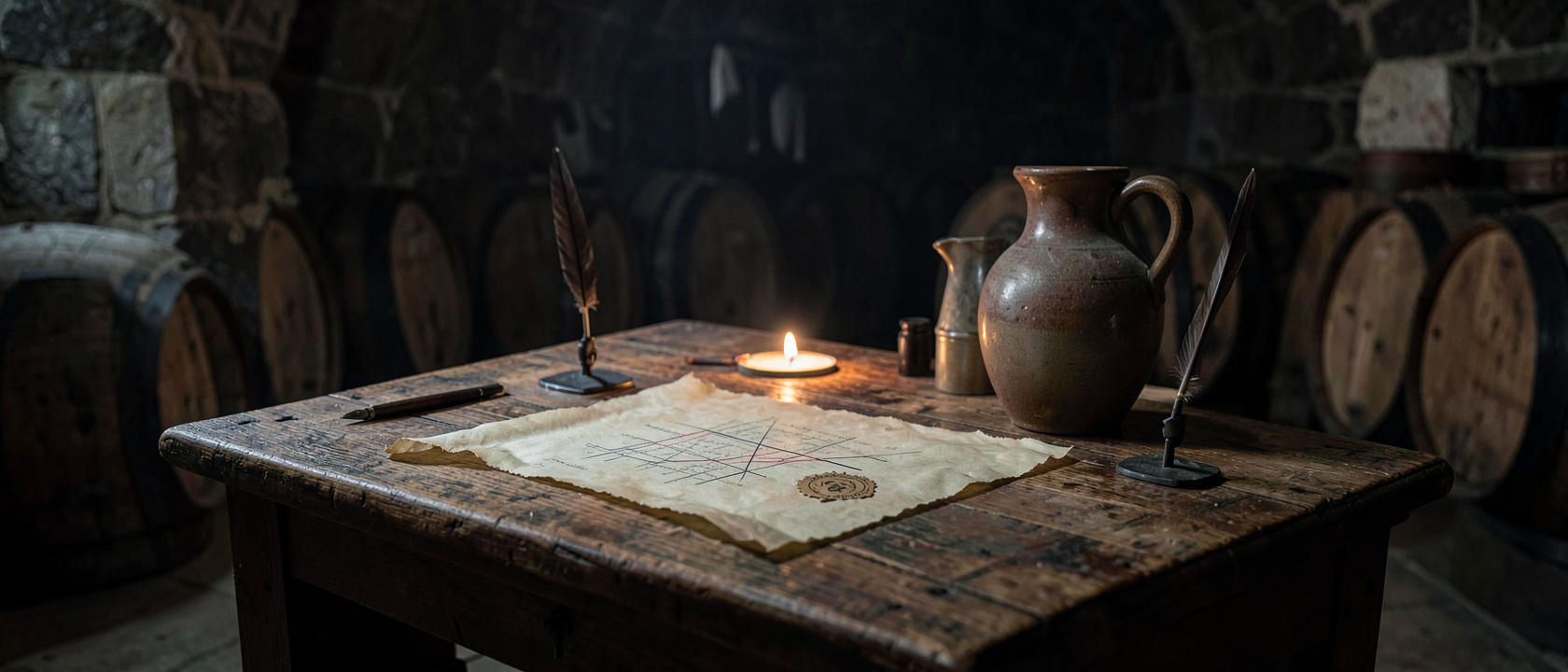
The National Archives at Kew holds a single slip of vellum in class C 81, piece 456. A report the Archives published on August 2, 2026, sets out its physical condition in detail. The parchment is Geoffrey Chaucer’s own retained copy of letters patent issued at Windsor on April 23, 1374, sealed under King Edward III’s privy seal and countersigned with the notation “Muskham.” The original Latin states that the king witnessed the grant himself at Windsor, in the forty-eighth year of his reign in England and the thirty-fifth in France. Across the face of the document run a series of drawn ink chevrons, a deliberate cancellation mark. The reverse carries a note recording that cancellation, and a slit lower on the sheet shows where the Great Seal was cut away to void the instrument.
One Pitcher Daily in the Port of London
The text of the grant records an annuity made directly to Chaucer, named in the document as “our beloved esquire.” It entitles him to one pitcher of the king’s wine every day for the whole of his life, probably equivalent to about one gallon (roughly 4.5 liters), collectable at the Port of London from the hands of the king’s butler or whoever stood in that office. The National Archives notes that wine grants from the crown were not unheard of, but they were usually paid as a barrel or barrels redeemed once a year. A daily pitcher, collected in person, was not the ordinary form. Four years later, Chaucer carried this same parchment back into Chancery, now under the reign of Richard II, and surrendered it so new letters patent could be drawn up converting the wine into a cash annuity of 20 marks a year, paid at the Exchequer.
The Logistics of a Surrendered Voucher
Archivists have pointed to an administrative detail that explains why this particular sheet survived at all. On June 8, 1374, six weeks after the grant, Chaucer was appointed to the customs post that other sources name as Controller of the Customs and Subsidy of Wools, Hides, and Wool-fells for the Port of London, putting him at the same quay where the butler’s stores were kept. The Archives describes the letters patent as a working voucher: the kind of document a recipient normally kept and produced to claim payment, rather than the official file copy the Chancery itself retained. Chaucer appears to have held and used this exact sheet until 1378, when he traded it in. At that point the Chancery canceled it, filed it alongside the warrant for his new cash grant, and it entered the public record rather than vanishing into a private estate, which the Archives notes makes it possibly the only document known to have passed through Chaucer’s own hands.
The Vintner’s Son and St. George’s Day
April 23 is the feast of St. George, also the patronal feast of the Order of the Garter observed at Windsor. The National Archives notes that this timing has led some to suggest the wine may have been a reward for a performance at that year’s St. George’s Day feast, an informal forerunner of a poet laureate’s role. A separate line of commentary points out that Chaucer’s father, John Chaucer, worked as a London wine merchant, and reads the 1378 exchange as a calculated move by someone who understood the wine trade, converting a perishable daily ration into fixed cash. Neither reading comes from the fourteenth-century paperwork itself. Both are later interpretations, and the Archives is explicit that the document does not state a reason for the gift.
“De Gracia Nostra Speciali”
What the parchment actually gives, in place of a reason, is a formula: the grant is made de gracia nostra speciali, by the king’s special grace. No poem is named. No diplomatic errand, no military service, no appearance at court is recorded as the cause. The clerks who drew up the letters were precise about where the wine would be collected, who would hand it over, and how long the arrangement would run. They were silent on why Edward III decided his esquire should have a gallon of wine a day for the rest of his life. Secondary accounts of Chaucer’s career also note that it is not known which, if any, of his writings might have prompted the reward. On that point the file, cancellation marks, missing seal, and all, simply stops.