
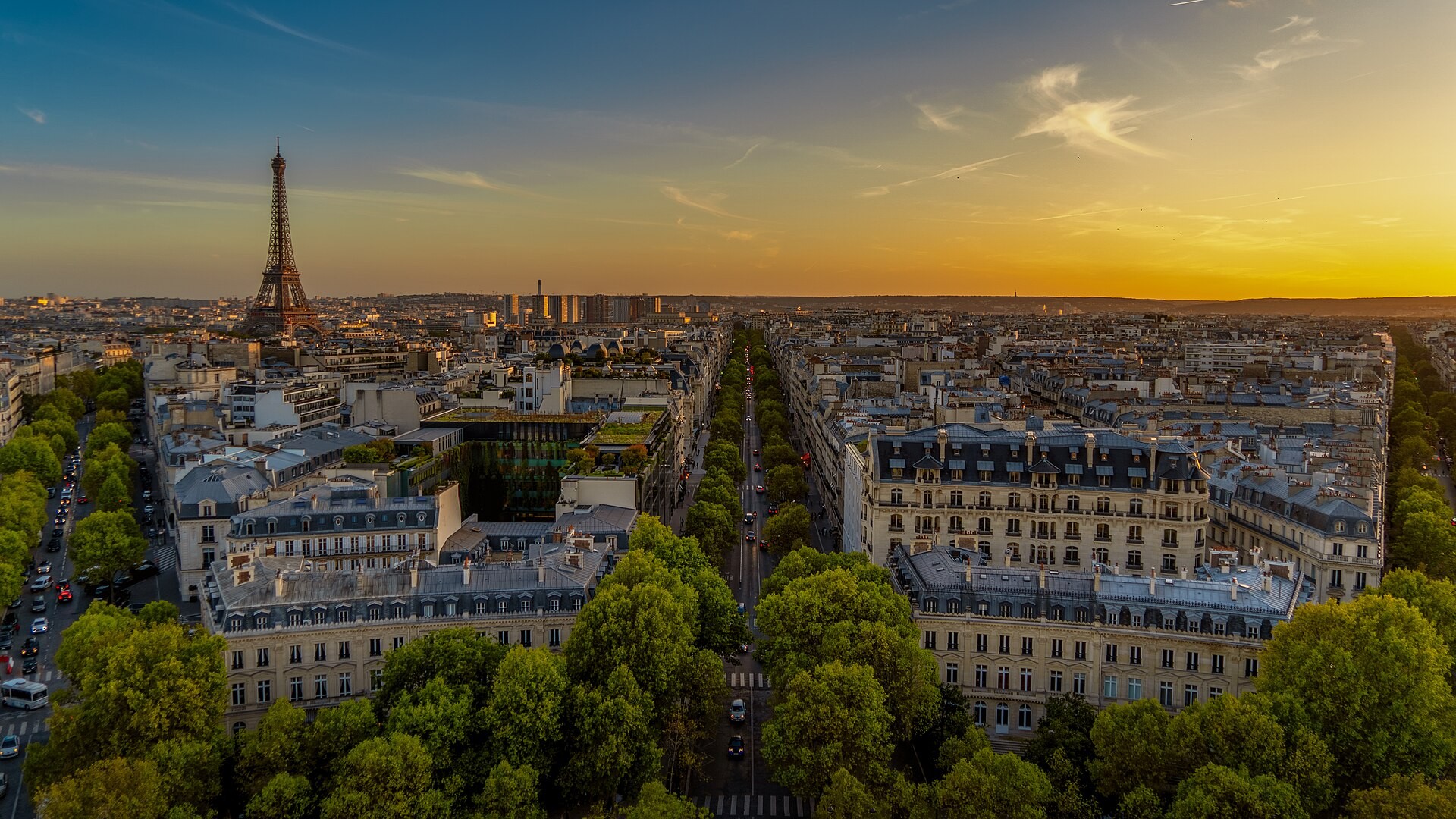
France is a country in Western Europe that also extends through its overseas territories into the Americas, Africa and Oceania. Its capital is Paris, and the country reports a population of 68,605,616 across an area of 643,801 square kilometers. France was founded as a state in 1792, and its current head of state is Emmanuel Macron, elected at age 39, the youngest French leader since Napoleon. With a nominal GDP of approximately $3.16 trillion in 2024, France is the world’s seventh-largest economy, and it holds one of the five permanent seats on the United Nations Security Council as a founding member of the organization.
Key facts
- Capital: Paris
- Continent: Europe
- Population: 68,605,616
- Area: 643,801 km²
- Official language: French
- Currency: euro; CFP Franc
- Head of state: Emmanuel Macron
- ISO code: FR
- Founded: 1792
Geography and language
Mont Blanc, located on the border of France and Italy in the French Alps, is the highest peak in Western Europe at 4,807 m (15,770 ft). France’s official language is French, spoken by 95.8% of the population according to European Commission Eurobarometer data from 2024; English is spoken by 24.6% and Spanish by 7.8%. The Ministry of Culture has recognized over 75 languages of France in total.
Administratively, France is divided into 18 regions, 13 in metropolitan France and 5 overseas, and 101 departments, 96 metropolitan and 5 overseas. The currency is the euro, with the CFP Franc used in certain overseas territories, and the country’s ISO code is FR.
Economy and energy
The service sector accounts for approximately 70.91% of France’s total GDP, while industry contributes around 17.21% and agriculture makes up about 1.30%. In 2024, nuclear energy generated 67.3% of France’s total electricity, making France the most nuclear-reliant country in the European Union and Europe’s largest electricity exporter that year. This strategy traces back to the 1974 Messmer Plan, a government decision made in direct response to the global oil crisis to rapidly expand nuclear capacity.
France’s ILO unemployment rate reached 8.3% in the second quarter of 2026, its highest level since the third quarter of 2020, with 2.7 million people unemployed, according to INSEE’s Labour Force Survey.
Government and politics
Emmanuel Macron has served as president since 2017. France’s current Prime Minister is Sébastien Lecornu, whose official residence is the Hôtel Matignon in Paris. Lecornu governs through a fragile ad-hoc coalition of centrist parties, reflecting political instability that has persisted since the 2024 snap election.
Lecornu’s minority government submitted a 2027 budget proposal to parliament for debate ahead of a planned vote. The draft budget proposes freezing public-sector wages and most pensions in an effort to curb the fiscal deficit.
Defense and international role
France spent $68 billion on defense in 2025, representing 2.0% of GDP, and maintains a nuclear arsenal of approximately 290 warheads as part of its strategic autonomy doctrine. As a permanent member of the UN Security Council, France holds veto power over Security Council resolutions.
History
The Hundred Years’ War, a series of conflicts between the kingdoms of France and England, lasted from 1337 to 1453, roughly 116 years, and ended with French victory at the Battle of Castillon in 1453.
The Palace of Versailles was built by Louis XIV starting in 1661 and served as the seat of French royal power from 1682 until the 1789 Revolution. It was inscribed as a UNESCO World Heritage Site in 1979 and received approximately 8.4 million visitors in 2024 to 2025, making it one of the world’s most visited monuments.
Culture
France has 78 Nobel Prize laureates as of 2025, ranking fourth in the world behind the United States, the United Kingdom and Germany. The Cannes Film Festival, held annually on the French Riviera, awarded its first Palme d’Or in 1955 to Delbert Mann for his film Marty; the prize was reintroduced permanently in 1975 after a temporary suspension from 1964 to 1974.
The Tour de France, first held on 1 July 1903 over six stages covering 2,428 kilometers, was created by journalist Géo Lefèvre to boost newspaper sales for the French sports daily L’Auto. It has grown into the world’s largest annual multi-day cycling event.
Did you know
- France has more time zones than any other country in the world, 13 in total, due to overseas territories spanning from the Caribbean to the Pacific, surpassing the United States and Russia, which each have 11. (rusticpathways.com)
- The Eiffel Tower was designed by Gustave Eiffel for the 1889 World’s Fair and was originally given only a 20-year permit; it survived demolition because it proved invaluable as a radio transmission antenna. (rusticpathways.com)
- King François I purchased the Mona Lisa from Leonardo da Vinci in 1518, making it French royal property long before it became the centerpiece of the Louvre; the painting was stolen from the Louvre in 1911 and recovered two years later. (earthsattractions.com)
- The Louvre in Paris began as a medieval fortress in the late 12th century, later served as a royal palace, and opened as a public museum in 1793; it received over 8 million visits in 2023, making it the world’s most visited art museum. (france-hotel-guide.com)
- France’s first public film screening took place on 28 December 1895, when the Lumière brothers held the world’s first paid movie screening at the Salon Indien in Paris, an event now considered the birth of modern cinema. (jetpacglobal.com)
- France held the top spot as the world’s most visited country for more than 30 years and in 2024 became the first nation ever to record 102 million international tourist arrivals in a single year, according to UN Tourism. (roadgenius.com)
- In 2024, France’s CO2-free electricity generation, nuclear plus renewables, reached 95% of the total power mix, resulting in a record low carbon intensity of 21.3 gCO2e/kWh for the French electricity grid. (enerdata.net)
- France contains a commune with the single-letter name Y, one of the shortest place names in the world, located in the Somme department of northern France. (jetpacglobal.com)
- The Schengen Agreement of 1985 was signed aboard a riverboat, the MS Princesse Marie-Astrid, on the Moselle River near the village of Schengen, Luxembourg, chosen because that precise spot sits at the tripoint where Luxembourg, France and Germany meet. (schengenprotect.com)
Data sources
Where it appears
- Chaucer’s Wine Grant (C 81/456): Edward III’s Reason Left Unrecorded November 20, 2026
Data updated: 2026-11-17