
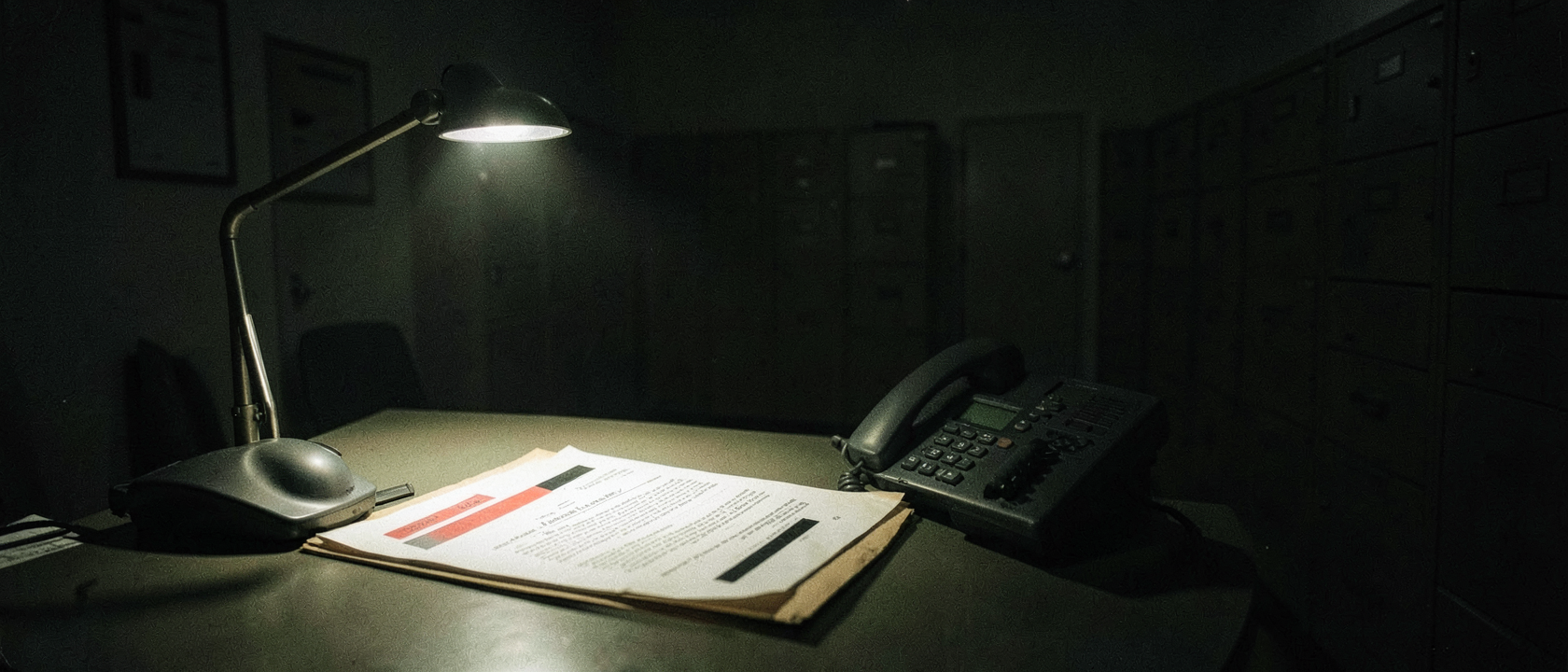
A federal office with explicit legal authority to receive anything he had, classified or not, nondisclosure agreement or none, spent seven months trying to get David Grusch into a room. He had already told Congress that the government held retrieved craft and “non-human” biological material. He would not tell the office built to investigate that claim. That paperwork, released under FOIA in April 2024, tells a narrow, well-dated story: not about what Grusch claims, but about what happened when an agency asked him to back it up.
What Greenewald Asked For, and What Came Back
John Greenewald of The Black Vault filed FOIA case 24-F-0266 with the Department of Defense on November 2, 2023, through the Office of the Under Secretary of Defense for Intelligence and Security. The release came back in April 2024: 28 pages, roughly 4MB, processed under one case number but holding three distinct kinds of document, a memorandum for record dated January 8, 2024, summarizing AARO‘s contact history with Grusch; email correspondence between AARO and Grusch or people speaking for him; and a transcript of Signal text messages between Christopher Mellon, a former deputy assistant secretary of defense for intelligence, and Dr. Sean Kirkpatrick, then AARO’s director, dated June 11 to June 13, 2023.
Nine Attempts, One Appointment
The memorandum’s timeline reads like a log. AARO made contact or attempted contact with Grusch or his associates at least nine times between June 8, 2023, and January 8, 2024, starting with outreach to people close to him and moving, by late June, to a direct request for his contact information and a formal interview invitation, which he declined. More attempts followed in late June, July, and October. On November 10, 2023, after congressional staff pressed him to cooperate, Grusch agreed to an interview set for November 14. He did not appear. According to the correspondence, when AARO reached him afterward, he said he was not convinced AARO was legally authorized to receive the levels of classified and sensitive information his claims involved.
The Memo That Answered the Objection
That objection had an answer already on file. Months before the missed interview, Major General David Abba, director of the Pentagon’s Special Access Program Central Office, had signed a memorandum stating that AARO was authorized to receive classified and compartmented UAP-related information from any individual, nondisclosure agreement or not, an authority grounded in Section 1673 of the fiscal year 2023 National Defense Authorization Act. The correspondence shows AARO citing that authority to Grusch directly and repeatedly, including a November 19, 2023, email that invoked the statute by name, and again in January 2024, when it sent further documentation meant to address his concerns. What the record does not show is Grusch responding to that authority on its merits.
AARO’s Conclusion, and Its Limits
By January 8, 2024, AARO closed the file on its own terms. The memorandum states that “during interactions between AARO and Mr. Grusch from November 2023 to January 2024, it became evident that Mr. Grusch had no intention of providing AARO with information regarding his claims.” That is a finding about conduct, not content. AARO reached no conclusion about whether the claims Grusch had made to Congress and in interviews were accurate, because it never had the material to try. The finding closes the question of cooperation. It leaves the question of substance exactly where it started.
Two Men, One Unfinished Sentence
The Signal transcript, running June 11 to 13, 2023, shows the dispute was not only between AARO and Grusch. It also ran between Kirkpatrick and Mellon, the intermediary who had encouraged Grusch’s cooperation with Congress. Kirkpatrick told Mellon that Grusch’s stated reason for withholding information, that the Inspector General’s office needed to release material first, was inaccurate, and he called claims relayed through Mellon “absurd and false,” adding that Mellon was undermining the very organization he had helped establish. Mellon answered that he had never vouched for the accuracy of Grusch’s claims, only for Grusch himself, whom he called “sincere and credible.” The released screenshot cuts off before Mellon’s message is finished. The Black Vault has an appeal on file for the remainder.
What the Cut-Off Leaves Open
The truncated message is a fact about the release, not a clue to what it says. No complete version of it has been made public, and the appeal’s outcome is not recorded in this file. A second gap sits beside it: AARO cited its legal authority to Grusch more than once, by statute and by Abba’s memorandum, yet the file never shows him addressing that authority directly, only restating that he remained unconvinced. A third gap is the largest one. No notes, documents, or named corroborating witnesses from Grusch appear anywhere in these 28 pages, because, by AARO’s own account, he never gave the office any.
The Briefing Nobody Can Read
Outside the FOIA package entirely, the record confirms one more event. On April 17, 2024, Abba and Tim Phillips, by then AARO’s acting director, gave a classified briefing to members of Congress. That it happened, and who gave it, is documented. What was said, who attended, and what came of it are not part of this release and are not described anywhere in it. The Black Vault has reported making repeated past attempts to reach Grusch for comment, all unanswered, and did not attempt a new one for this release, having exhausted the methods available to it.