
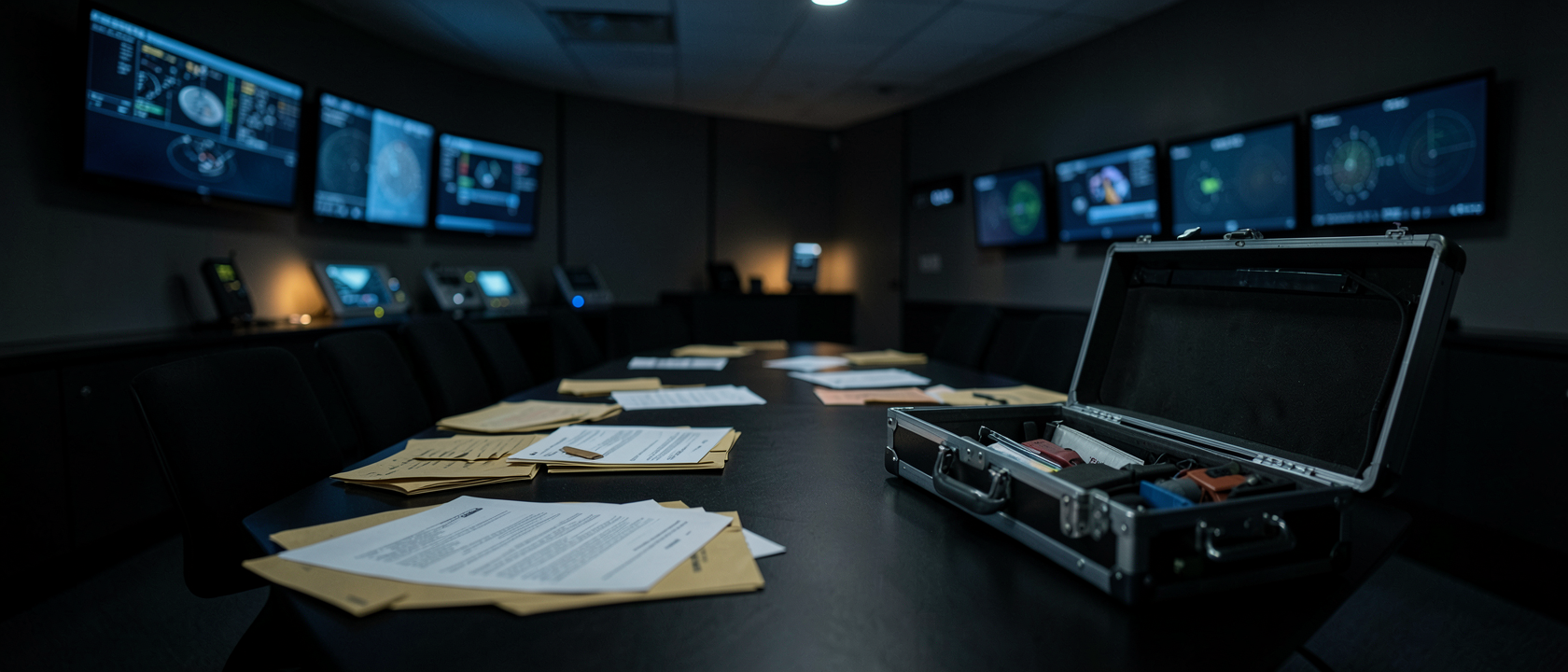
Military bureaucracies rarely explain their priorities in a press release. They appear instead in distribution lists, timestamps, and the rules governing who must act on an incoming transmission. A document released under the Freedom of Information Act in March 2024 offers an example: operational directives setting standard administrative procedures for service personnel who encounter, target, or recover an unidentified object.
The Origin of File 23-F-1429
On May 19, 2023, the Joint Staff J3, the operations directorate of the U.S. Joint Chiefs of Staff, transmitted a message logged with the date-time group 19 1452Z MAY 23. The transmission was a GENADMIN, a general administrative message used to broadcast standing instructions across commands. Its title: “Unidentified Anomalous Phenomena Reporting and Material Disposition.” It went out over Department of Defense communications lines to unified combatant commands, service branches, and defense agencies worldwide, including NORAD and U.S. Cyber Command. It was marked Controlled Unclassified Information, the handling designation for material restricted from public release but below the threshold of formal classification.
Word of the message first appeared in an August 30, 2023 DefenseScoop article by journalist Brandi Vincent. The next day, researcher Douglas Dean Johnson asked Pentagon spokesperson Susan Gough for a copy. Gough stated she could not provide one because the document contained information that was not publicly releasable. Johnson submitted Freedom of Information Act request 23-F-1429 on August 31, 2023. The Department of Defense issued a release letter dated March 15, 2024; Johnson received the file on March 18 and published it online the following day. The FOIA letter describes a nine-page responsive record, though the posted archive file runs to 13 pages, a discrepancy that remains unexplained in the paperwork. Johnson noted that redactions were minimal, though the released copy does not detail the withheld text or the specific statutory exemptions used.
Twelve Hours for an Engagement
The directive establishes binding deadlines. Routine reports of unidentified anomalous phenomena, the Pentagon’s current term for UFOs, must move up operational channels within 96 hours. When an encounter meets the definition of an engagement, that reporting window narrows to 12 hours. The text defines an engagement as a kinetic or non-kinetic response intended to deny, disrupt, or destroy an object, encompassing weapons fire, electronic countermeasures, or active defensive maneuvering.
The instructions also dictate how physical material must be handled. Units recovering debris, components, or craft are directed to bypass routine field handling channels and transfer custody to the All-domain Anomaly Resolution Office, the agency tasked with tracking and analyzing anomalous events. Each transfer requires signed chain-of-custody paperwork. A separate Navy-wide implementing message, cataloged in the Navy FOIA reading room under case number 2024-000568, references the Joint Staff message directly, showing that the reporting timeline was incorporated into subordinate service commands.
The Eleven Categories of the J3 Matrix
The system was not designed for standard unauthorized flights. Routine airspace incursions remain under existing intelligence channels, while the J3 directive focuses on cases meeting specific technical filters. The reporting matrix requires units to log observations across 11 distinct categories. These include flight characteristics beyond known performance parameters, such as extreme acceleration, instantaneous changes in direction, or travel across air, water, and space without an observable transition, and equipment interference affecting mechanical, electrical, or weapons systems.
Most military sensor hits resolve into conventional objects. The protocol routes routine observations elsewhere, preserving the expedited pathway for contacts that match the criteria in the matrix. The matrix functions solely as an intake standard; it does not record how any individual report was ultimately explained.
One Hundred Inquiries a Month
On March 6, 2024, AARO’s acting director, Tim Phillips, provided the first public estimates of the traffic moving through these intake lines. Phillips, serving at AARO on assignment from the Office of the Director of National Intelligence, reported that the office receives between 90 and 110 reports each month from military personnel through the pathways formalized in the May 2023 directive. Phillips stated that AARO was developing reporting mechanisms for other federal bodies, including the Department of Homeland Security, and already logs civilian pilot reports forwarded by the Federal Aviation Administration. During the same briefing, Phillips noted that AARO had closed roughly 122 cases during the preceding month, concluding that 68 percent represented airborne trash and balloons picked up by high-sensitivity sensors.
Unpublished Engagement Records and Custody Transfers
The release contains procedural instructions rather than operational logs. The nine pages establish reporting deadlines, specify the routing of files, and designate the office responsible for physical custody. They contain no after-action reports, no unit records of weapons discharges, and no ledger of material transferred to AARO. While the directive creates a mandatory 12-hour reporting deadline for engagements, the Department of Defense has not associated the release of file 23-F-1429 with any specific operational incident.