
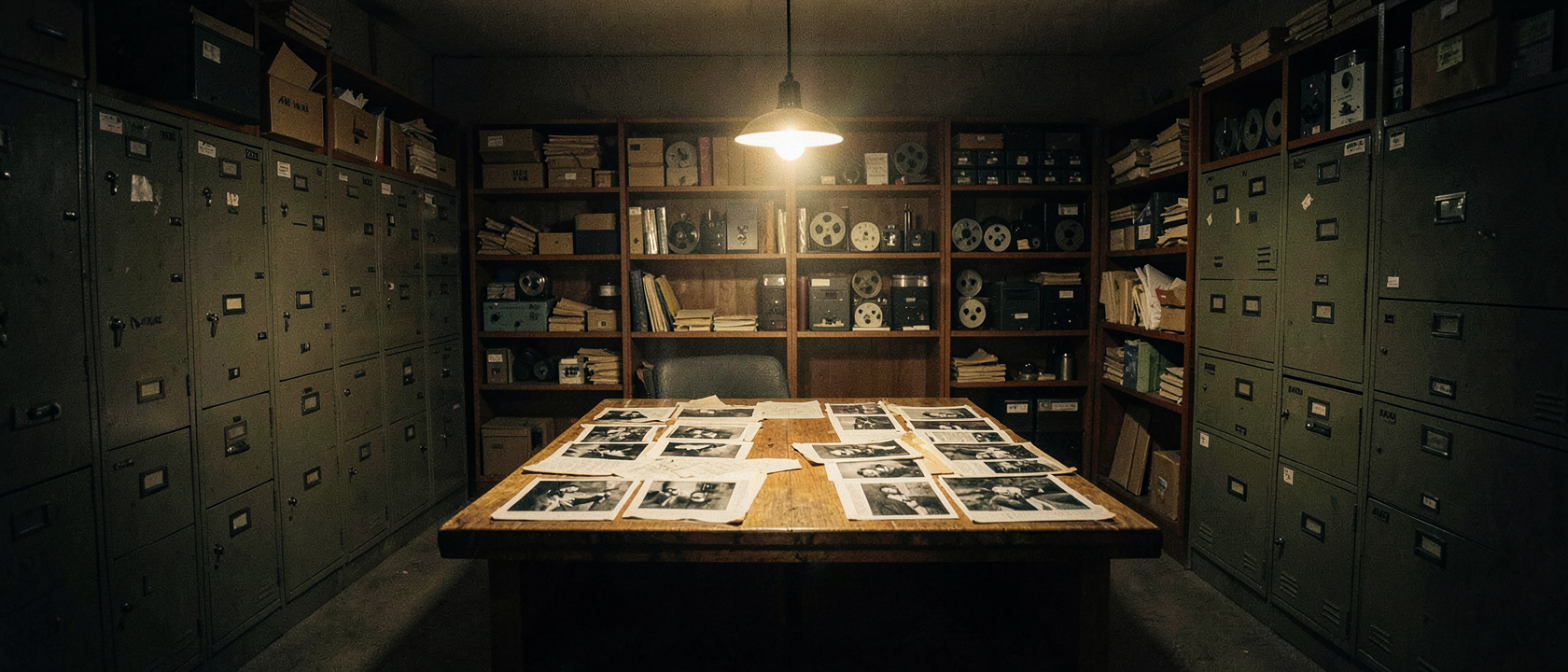
Inside NASA’s own photographic archive at the National Archives sits a set of images captioned “Flying Saucer, June 4, 1964.” The paperwork does not say who filed them, why, or whether anyone at the agency ever looked at them again.
Record Group 255, Goddard Space Flight Center
The photographs are held in Record Group 255, the National Archives and Records Administration‘s designation for records of the National Aeronautics and Space Administration, inside the Goddard Space Flight Center’s Graphic and Publication Services Branch Collection. One image carries the file name 255-GS-65-108.jpg. Every frame bears the same typed caption: “Flying Saucer, June 4, 1964.”
On February 15, 2024, the research site The Black Vault retrieved the images from the Archives, scanned them at high resolution, and released them as a set of .tif files, about 165 megabytes in total. The caption draws attention because of where it sits: Record Group 255 is NASA’s own photographic record, and researchers who have gone through the group report no other NASA-generated photograph filed under this heading. Villa’s pictures are the whole of it.
A mechanic named Paul Villa
The images are attributed to Paul (Apolinar) A. Villa, Jr., an Albuquerque mechanic born September 24, 1916, who died in 1981. No NASA document names him; the attribution rests on matching the Goddard prints against Villa’s already-known body of photographs, not on any agency paperwork identifying a source.
By the time the Goddard caption surfaced, Villa had already told his own story in print. He said that on June 16, 1963, his contacts directed him to a site near Peralta, New Mexico, about 15 miles (24 kilometers) south of Albuquerque, where he photographed a landed craft and nine humanoid occupants using a Rokuoh-Sha camera loaded with 120 Kodak film. He described a second encounter on April 18, 1965, Easter Sunday, near Bernalillo, with a larger craft and three crew members. Journalist Gabriel Green published the account in the October 1965 issue of UFO International.
Those photographs had already been examined, by the Air Force rather than NASA. Project Blue Book, which investigated UFO reports for the military from 1952 to 1969, concluded they were staged; its photo analyst noted that every frame showed the object against clear, unobstructed sky, which he judged unlikely for a genuine set of multiple-angle shots. Civilian analyst William Spaulding, of Ground Saucer Watch, later reported finding strings suspending the object from tree branches in enhanced scans, putting its real size at a little over 3 feet (1 meter) across, not the 70 feet (21 meters) and 300 feet (91 meters) Villa had described. Other researchers reported the same anomalies independently, and the hoax finding has stood since, though the same images still circulate elsewhere as genuine.
No transfer record, no NASA review
None of this explains how the photographs moved from a private citizen’s camera into a federal agency’s files. No acquisition record, transfer memo, donation form, or correspondence is cited anywhere showing how Villa’s prints entered Goddard’s collection, who delivered them, or under what authority.
Nor does any NASA or National Archives document record an examination of the Goddard set’s origin or authenticity. The Black Vault has said it conducted no investigation of its own and takes no position on whether the images are genuine, presenting them only as what it found already cataloged. The Archives’ own caption offers nothing beyond a date and two words. A record of NASA studying the photographs and reaching no conclusion would still leave something behind, a memo, a report, a note marked inconclusive. Nothing like that is cited anywhere. The Air Force’s fraud finding belongs to a separate investigation, run by a different agency, apparently before these prints entered NASA’s files; whether anyone connected the two is not recorded.
Three dates that do not agree
The caption reads June 4, 1964. Villa’s own account gives two other dates: June 16, 1963, for the Peralta encounter, and April 18, 1965, for Bernalillo. None of the three match, and Villa’s account does not mention a 1964 date at all. The Black Vault’s release does not explain the discrepancy, and no NASA paperwork reconciles it.
Taken together, the record leaves three things open: no chain of custody from Villa’s camera to Goddard’s files, no NASA or NARA analysis of the images anywhere in the public record, and a caption date matching none of Villa’s own accounts. Proof of how the photographs reached Goddard would not explain the date, and an explanation for the date would not produce the missing transfer form.
Villa’s wider claims, told by Gabriel Green
Green’s 1965 article carries far more than two dates and two sets of photographs. Villa said he had communicated telepathically with extraterrestrial beings since age five, and that direct contact began in 1953 on a beach in Long Beach, California. He described a “mothership” controlling nine smaller discs, said a craft’s effects had started a brush fire near his truck, and said the beings told him the Gemini 4 astronauts, Edward White and James McDivitt, had sighted a spacecraft in orbit. He said the beings told him the government was withholding Mariner 4 images of artificial “pumping stations” on Mars, that Phobos was hollow and built rather than natural, and that extraterrestrials kept bases on the Moon.
None of this is corroborated anywhere in the record, by NASA, by the Archives, or by any independent source. It appears here because it belongs to the historical figure the Goddard caption is attributed to, not because it bears on whether those photographs belong in a federal archive. Villa made the claims; Green put them into print. Nothing beyond that publication is on file.