
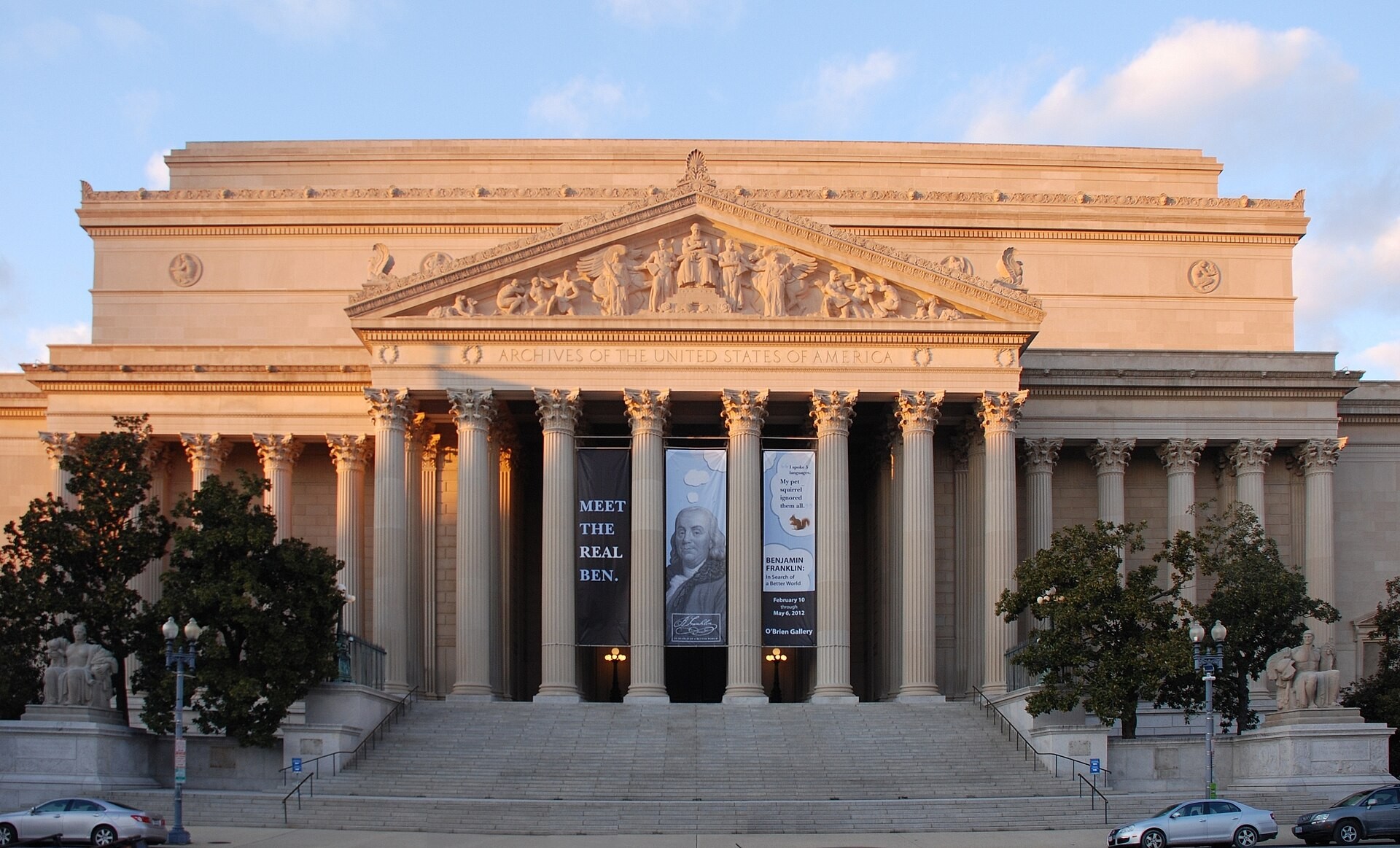
The National Archives and Records Administration (NARA) is the independent federal agency responsible for preserving and providing access to the historical records of the United States government. Founded on 19 June 1934 by an act under President Franklin Delano Roosevelt, it is headquartered in Washington, D.C. Across its facilities, NARA holds billions of documents, maps, photographs, public records and other items covering American history since 1775. It operates 22 regional records facilities in 17 states and maintains 16 Presidential libraries, making it the central repository of the federal government’s permanent records.
Key facts
- Country: United States
- Founded: 19 June 1934
- Headquarters: Washington, D.C.
- Founder: Franklin Delano Roosevelt
- Type: independent agency of the United States government; national archives
- Parent organisation: Federal Government of the United States
- Website: https://www.archives.gov/
Facilities and holdings
The original National Archives Building, informally called Archives I, opened as the agency’s headquarters in 1935 on Constitution Avenue in Washington, D.C. Space constraints later led NARA to open a second facility, Archives II, in 1994 at College Park, Maryland, which now serves as its base of operations. Beyond these two main sites, NARA runs 22 regional records facilities spread across the country, from Atlanta to Seattle, covering 17 states, and it operates and maintains 16 Presidential libraries.
The agency’s grant-making arm, the National Historical Publications and Records Commission (NHPRC), funds historical documentation and archival projects. Together, NARA’s holdings amount to billions of documents, maps, photographs and public records spanning American history back to 1775.
History and independence
NARA regained its status as an independent agency through an act of October 19, 1984, which took effect on April 1, 1985, formally establishing it as the National Archives and Records Administration under the federal government. Supporters of this independence during the 1984 campaign included the American Historical Association, the National Association of Government Archives and Records Administrators, and the Society of American Archivists. National Archives staff marked the change with a ceremony in the Rotunda on November 8, 1984, for the passage of the NARA Independence Act.
Leadership disputes since 2025
On February 7, 2025, President Donald Trump dismissed Archivist Colleen Shogan, who had served only 632 days in the role. Reports linked the dismissal to NARA’s part in the Justice Department’s Mar-a-Lago classified documents investigation. Under statute, Deputy Archivist William “Jay” Bosanko automatically became acting archivist following Shogan’s removal.
In October 2024, reports alleged that Shogan and her advisers had censored museum displays, removing images including those of Martin Luther King Jr. Dolores Huerta, and Minnie Spotted-Wolf, in order to de-emphasize negative episodes in U.S. history. In December 2024, a coalition of historians and journalists sued NARA, demanding faster declassification of Cold War era foreign policy and intelligence records.
Secretary of State Marco Rubio later served as acting Archivist before stepping down; NARA then said he had tapped political appointee James Byron to perform the duties of archivist. The United States Senate confirmed Bradford P. Wilson as the 12th Archivist of the United States on August 7, 2026, and he assumed office on August 21, 2026. Wilson had been nominated by President Trump on March 2, 2026, and had previously served as a Distinguished Visiting Scholar in Civic Thought at Utah Valley University. From 1984 to 1987, he served as Research Associate to Chief Justices Warren E. Burger and William H. Rehnquist.
Did you know
- On July 12, 1973, a fire at the National Personnel Records Center in St. Louis destroyed approximately 16 to 18 million Official Military Personnel Files. (archives.gov)
- The 1973 fire burned uncontrollably for almost 24 hours before firefighters extinguished it. (dvidshub.net)
- NARA still spends the equivalent of more than 40 full-time staff each year responding to requests tied to records lost in the 1973 fire. (archives.gov)
Data sources
- Wikidata
- ebsco.com
- federalregister.gov
- prologue.blogs.archives.gov
- en.wikibooks.org
- archives.gov
- thebulwark.com
- liblime.com
- federalnewsnetwork.com
Where it appears
- Photographs Labeled “Flying Saucer, June 4, 1964” Sit in NASA’s Archive November 14, 2026
Data updated: 2026-11-10