
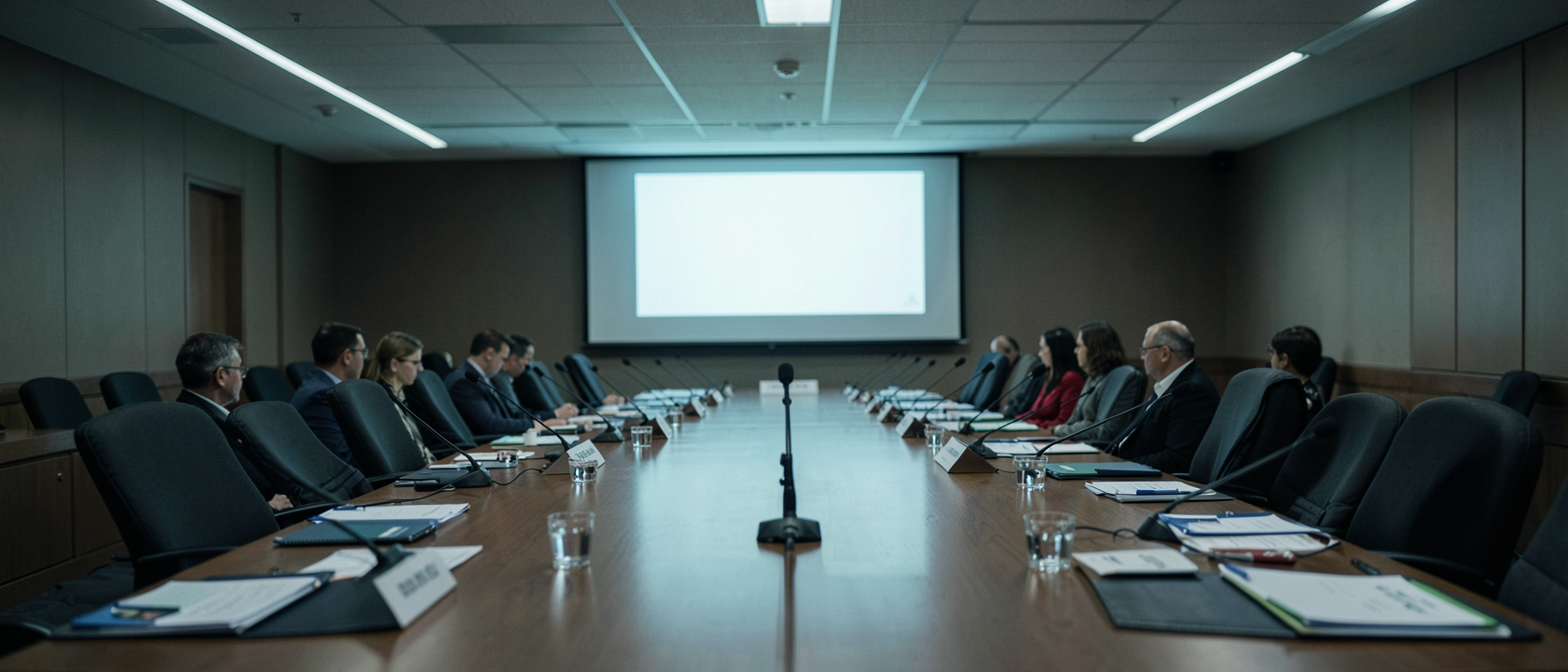
NASA’s first public session on unidentified anomalous phenomena, or UAP, was built to produce a plan, not a verdict. The transcript of the May 31, 2023 meeting says so more than once, in the officials’ own words, and it stops recording before the panel reaches the part of the day where something closer to a verdict might have started to take shape.
The posting
The Black Vault, a site that collects declassified and FOIA-released government material, published an archived broadcast and a working transcript of the meeting the day after it took place. A publisher’s note attached to the transcript states it was produced with AI assistance and then manually corrected for speaker attribution, with the caveat that the result is “far from perfect.” NASA also held a separate media teleconference once the meeting ended; a transcript of that session is referenced in the same posting but is not reproduced there in full. What exists, in other words, is an archived audio-and-video record of the meeting paired with a text transcript built from it, plus a pointer to a second, related document that lies outside what was retrieved here.
Who was in the room
David Spergel, president of the Simons Foundation, chaired the session. Dan Evans, NASA’s assistant deputy associate administrator for research and the meeting’s designated federal official, the staff member responsible for keeping an advisory panel’s public meeting within the rules set by the Federal Advisory Committee Act, gave opening remarks. Sean Kirkpatrick, director of the Defense Department’s All-domain Anomaly Resolution Office, had also been invited to open the meeting, and his remarks preceded the rest of the program alongside Evans’s. Nikki Fox, NASA’s associate administrator for the Science Mission Directorate, followed with a presentation on the state of UAP data, after which Spergel led a question-and-answer session with her.
Evans paid tribute to Sam Satow, a retired US Air Force master sergeant who had worked as an intelligence collection manager on aviation UAP analysis and who was laid to rest at Arlington National Cemetery that same day. Evans also told the room that several panel members had faced online harassment for taking part in the study and that NASA’s security staff was responding. The transcript records that the subject was raised. It does not record who was responsible or what the response involved.
What Fox said about the data
Fox’s description of the existing evidence was plain, and not especially encouraging. Most UAP data, she told the panel, consists of eyewitness reports of limited quality, frequently confused by ordinary explanations: commercial and military aircraft, weather, and auroras, the atmospheric light displays that can resemble something stranger than they are. She drew a distinction that runs through the rest of the meeting: UAP sightings themselves are generally not classified, she said, but the sensor platforms that sometimes capture them can be, which is why some underlying material cannot be shared. The study itself, she said, relies on unclassified data drawn from civilian, government, and commercial sources, and she pointed attendees toward NASA’s Open Data portal as one place the public can look. When Spergel asked how that data is calibrated, Fox answered that NASA’s standard datasets go through a rigorous calibration process, and that anything released as preliminary “quick look” data is labeled as such.
This is Fox’s own characterization of the data, offered at the meeting and recorded in the transcript. It is not an independent assessment of any particular sighting, and the transcript does not show the panel testing that characterization against a specific case.
A roadmap, not a finding
NASA officials returned to the same framing repeatedly. The purpose of the meeting, as Evans and Fox both described it, was to help build a roadmap for how the agency might study UAP scientifically going forward, not to analyze a piece of footage or determine the cause of a specific report. The team operates under the Federal Advisory Committee Act, and its recommendations pass through NASA’s Earth Science Advisory Committee rather than directly to the agency’s leadership or to Congress. No conclusions were reached at the May 31 meeting. That is not an inference drawn from what is missing from the transcript; it is what the officials said about their own session while it was happening.
Where the transcript stops
The material archived by The Black Vault covers the opening remarks, Fox’s presentation, and the question-and-answer session that follows with Spergel. It ends there. Whatever the panel discussed once its working deliberations began is not part of the retrieved transcript, and no specific sighting, case file, or dataset is named or described in the pages available. That is a fact about this document: the posting captures the meeting up to a particular point in the day and no further. It is not evidence, one way or the other, about what was said after the point where this recording stops.
What the record doesn’t say
Three things are absent from this transcript, and each is absent for a different reason. The final report’s actual contents, and its exact release date beyond officials’ statement at the meeting that it was expected by the end of July, are missing because the report did not yet exist. Who harassed the panelists, and what NASA’s security team did about it, is missing because the transcript shows the subject raised without elaboration. And what the panel discussed once deliberation began is missing because the available transcript stops before that point. None of the three implies an answer. Each is simply a place where this particular document does not go further.
The study team’s final report did eventually appear, on September 14, 2023, on NASA’s website, later than the summer estimate given at the May meeting. At the briefing that day, Administrator Bill Nelson said the team had found no evidence that UAP have an extraterrestrial origin, while adding that the phenomena themselves remained unexplained. That finding belongs to a separate document, issued more than three months after the meeting examined here. It closes one of the three gaps listed above. It does not change what the May 31 transcript does, and does not, contain.