
Some files are interesting for what they contain. This one is interesting for what the Pentagon admits exists and then refuses to show. The Department of Defense released six minutes of infrared video of something it says it cannot identify. A requester asked how that footage was reviewed and cleared. The department confirmed the paperwork exists, and withheld every page of it.
The Request and the Answer
In May 2025, the All-domain Anomaly Resolution Office (AARO), the Pentagon office set up in 2022 to investigate unidentified anomalous phenomena, posted an infrared video titled “Unresolved UAP Report: Middle East 2024” to the Defense Department’s public hosting service. On May 19, 2025, researcher John Greenewald Jr., who runs the FOIA archive The Black Vault, filed a request for the internal communications, review logs, classification guidance, legal opinions, and technical documentation connected to that release.
The Defense Department’s final response came on September 19, 2025. It confirmed that records responsive to the request exist. It then denied the request in full, citing Exemption (b)(5), which protects deliberative material, internal agency discussion that precedes a final decision, and a set of exemptions under (b)(7), which cover information compiled for law enforcement purposes.
What the Video Shows
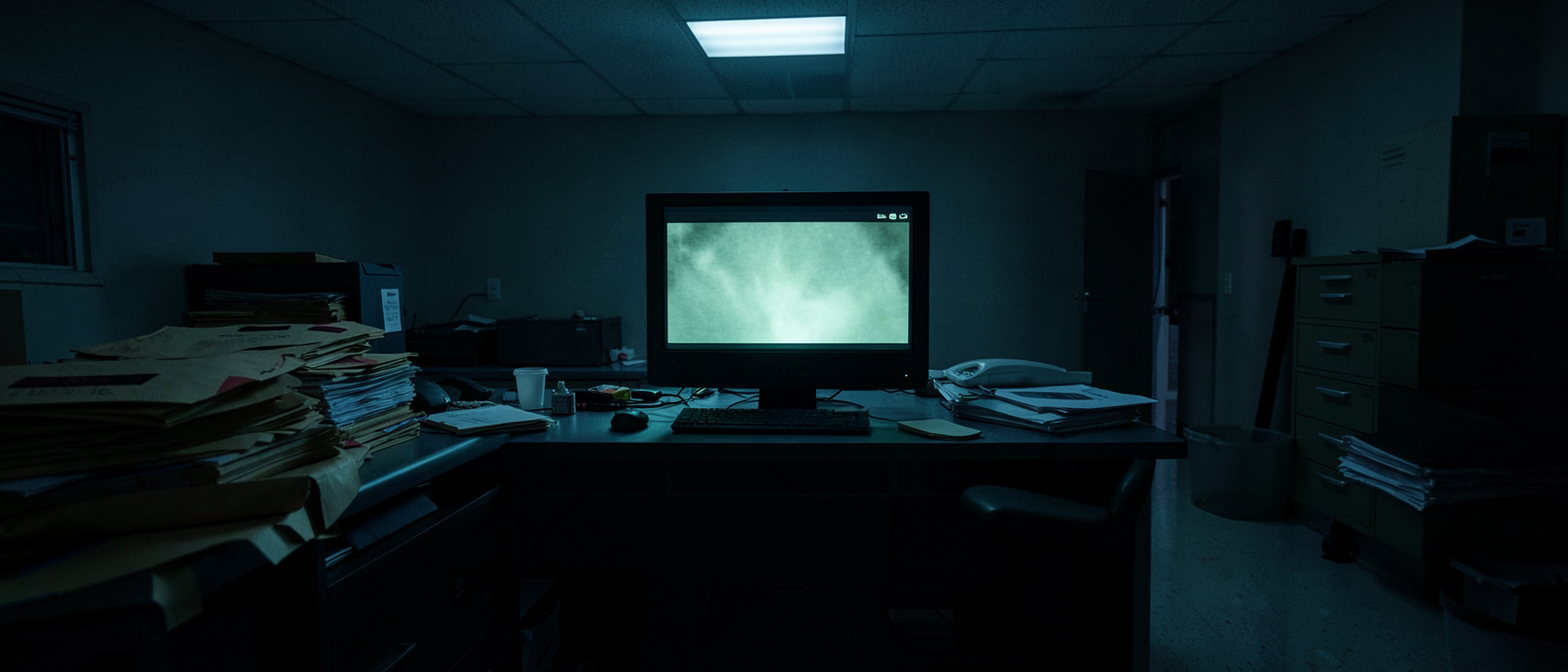
The footage runs roughly six minutes and forty-two seconds, recorded in 2024 by an infrared sensor aboard a U.S. military platform in the Middle East theater. It shows a patch of thermal contrast against the surrounding frame. There is no accompanying flight path, altitude, or speed data in the public release. What’s public is the video itself, dated and filed on the Pentagon’s own hosting service, and nothing else. Everything describing how it got there sits behind the September 19 denial.
The Official Conclusion
AARO’s own written description, posted alongside the video, states that the area of contrast “may be consistent with the presence of a physical object,” but that without corroborating telemetry or data from a second sensor, the office cannot determine whether the signature is a sensor artifact, a reflection, or a thermal emission from something real. It calls the available data insufficient for a conclusive analytic evaluation.
That is not a finding that something unidentified was flying. It is a finding that the office tasked with resolving the case could not resolve it. No mundane explanation, balloon, drone, aircraft, atmospheric effect, appears anywhere in AARO’s released material. One forum analyst, writing under the name Mendel on the technical discussion site Metabunk in May 2025, suggested the dark circular feature could be a lens artifact known as the Narcissus effect rather than an object at all. That is a technical opinion from an outside enthusiast, not an AARO determination, and the two should not be confused.
The Exemptions, Examined
Exemption (b)(5) is the ordinary one. Agencies use it constantly to keep draft memos and internal back-and-forth out of public view before, and sometimes after, a decision is made. Nobody needs a special theory for that.
The (b)(7) exemptions are a different animal. They exist to protect law enforcement matters: interference with an active proceeding, (b)(7)(A); a person’s right to a fair trial, (b)(7)(B); unwarranted invasion of personal privacy, (b)(7)(C); and investigative techniques that would lose their value if disclosed, (b)(7)(E). Each of those rests on the same premise, that a law enforcement matter exists: a suspect, a case file, a proceeding somewhere in motion. Nothing in AARO’s public description of the “Middle East 2024” video, and nothing in the Defense Department’s own characterization of the request, describes this review as a law enforcement matter.
The Silence
The request asked how the footage was reviewed, redacted, and approved for release. The answer was that such records exist and will not be shown, not in part, not in redacted form, not with an index describing what was withheld and why. There is no visible bridge between what AARO said in May and why the Defense Department invoked those particular exemptions in September. The public record holds the video and the denial. It does not hold the reasoning connecting them.
What Isn’t Known
Four things remain open, and they are not the same thing. What the object in the footage actually is remains undetermined, by AARO’s own account, not because the file was hidden but because the agency says its sensor data can’t settle it. How the review and release decision was actually made internally is undocumented in anything public. Why law enforcement exemptions attach to a case that nothing on the record describes as a law enforcement matter is unexplained. And the outcome of Greenewald’s appeal, filed after the September 19 denial, has not been reported anywhere, including by Greenewald himself as of this writing.
The Pattern Claim
The Black Vault has argued, in material published September 29, 2025, that this case fits a broader habit at the Pentagon: releasing UAP footage to the public while withholding the analytical and deliberative paperwork behind it, and reaching increasingly for law enforcement exemptions in cases that are not, on their face, criminal matters. That is a claim made by a requester with a long filing history, not a finding drawn from this single denial. The Black Vault’s archive has been cited by outlets including The Washington Post and USA Today, which matters for how much weight the claim carries, but it doesn’t make the claim and the file the same kind of thing. One is an argument about a pattern. The other is a denial letter, dated, exempted, and sitting in a drawer somewhere with an appeal attached to it.